
Fireplace Wall Ideas With TV UK: Layouts, Sizes & Design Guide 2026
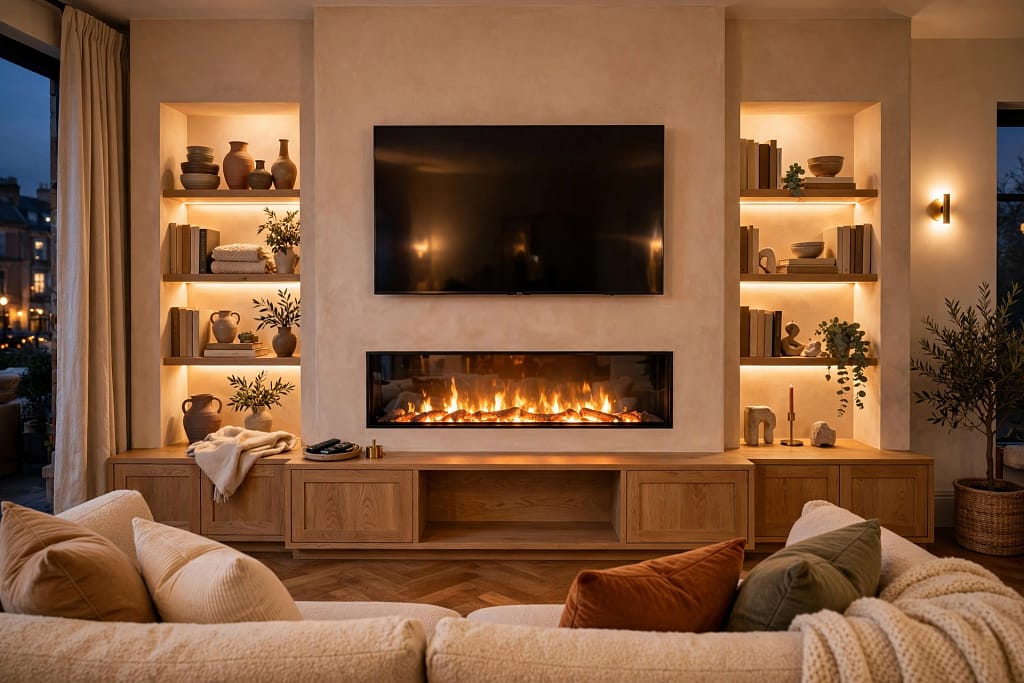
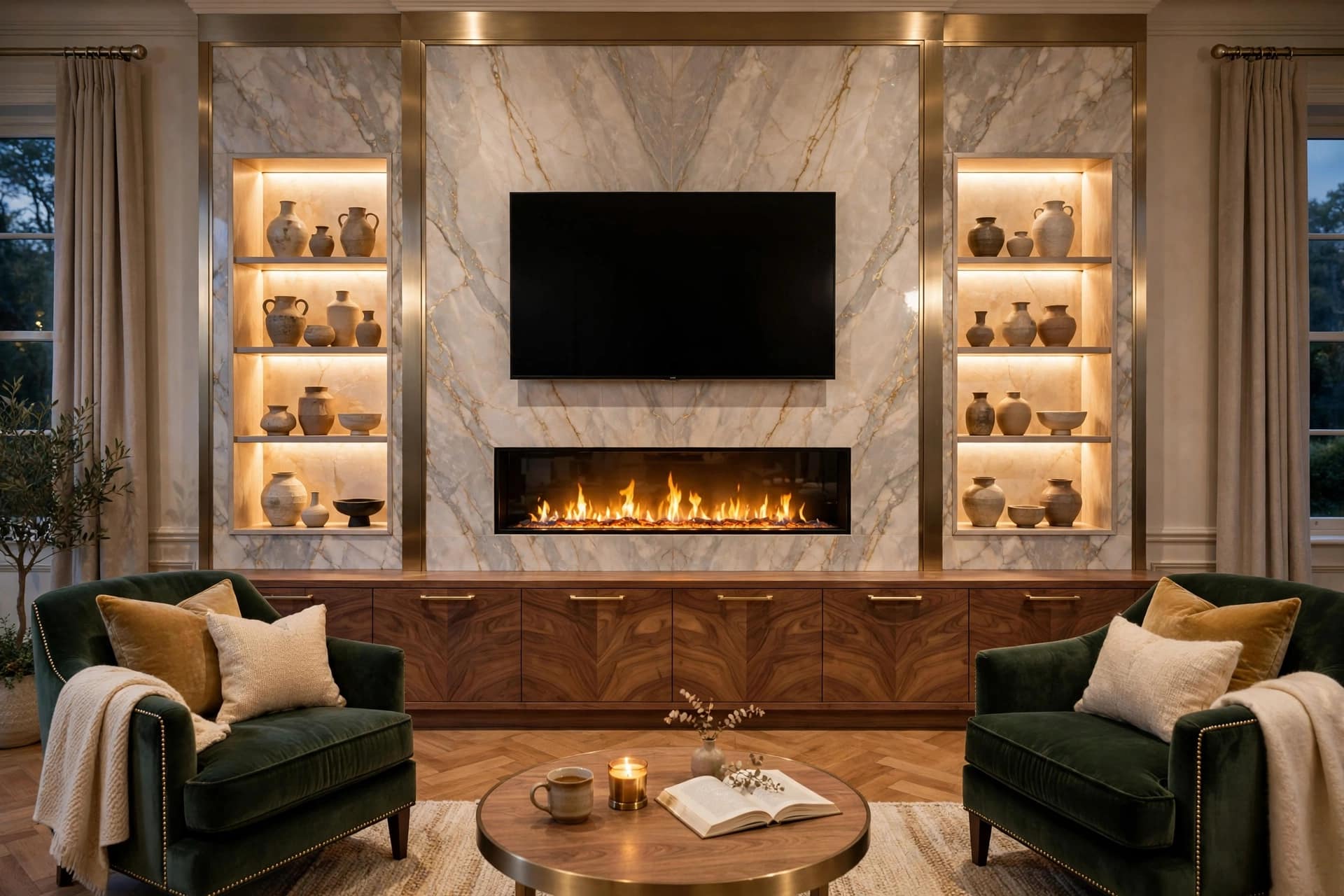
A fireplace wall with a TV can turn an ordinary living room into a strong focal point, bringing the television, electric fire, storage and decorative finishes together in one carefully planned feature.
The challenge is getting the proportions right.
A television that is too large for the fireplace can make the wall feel top-heavy, while a fireplace that is too large for the room can dominate the entire space. The position of the TV, the height of the fire, the width of the wall and even the location of the sofa all affect how the finished design looks and feels.
For UK homes, there is also another consideration: many living rooms have awkward chimney breasts, alcoves, narrow walls or limited floor space. A good fireplace wall therefore needs to look attractive while working with the architecture of the room.
For broader inspiration, start with our Media Wall Ideas UK guide.
Quick Answer: What Is the Best Fireplace Wall Layout With a TV?
The most common fireplace wall layout is a TV mounted above an electric fire, with both centred on the same vertical axis.
For a balanced appearance, the fireplace is often designed to be approximately the same width as the TV or slightly wider. A wider fireplace can visually anchor the television and create a more substantial feature-wall appearance.
However, there is no single correct layout for every room.
The best arrangement depends on:
- TV size
- Fireplace width
- Fireplace depth
- Wall width
- Ceiling height
- Sofa position
- Viewing distance
- Soundbar position
- Storage requirements
- Available floor space
- Overall interior style
What Is a Fireplace Wall With a TV?
A fireplace wall with a TV is a built-in feature that combines a fireplace and television into one designed wall.
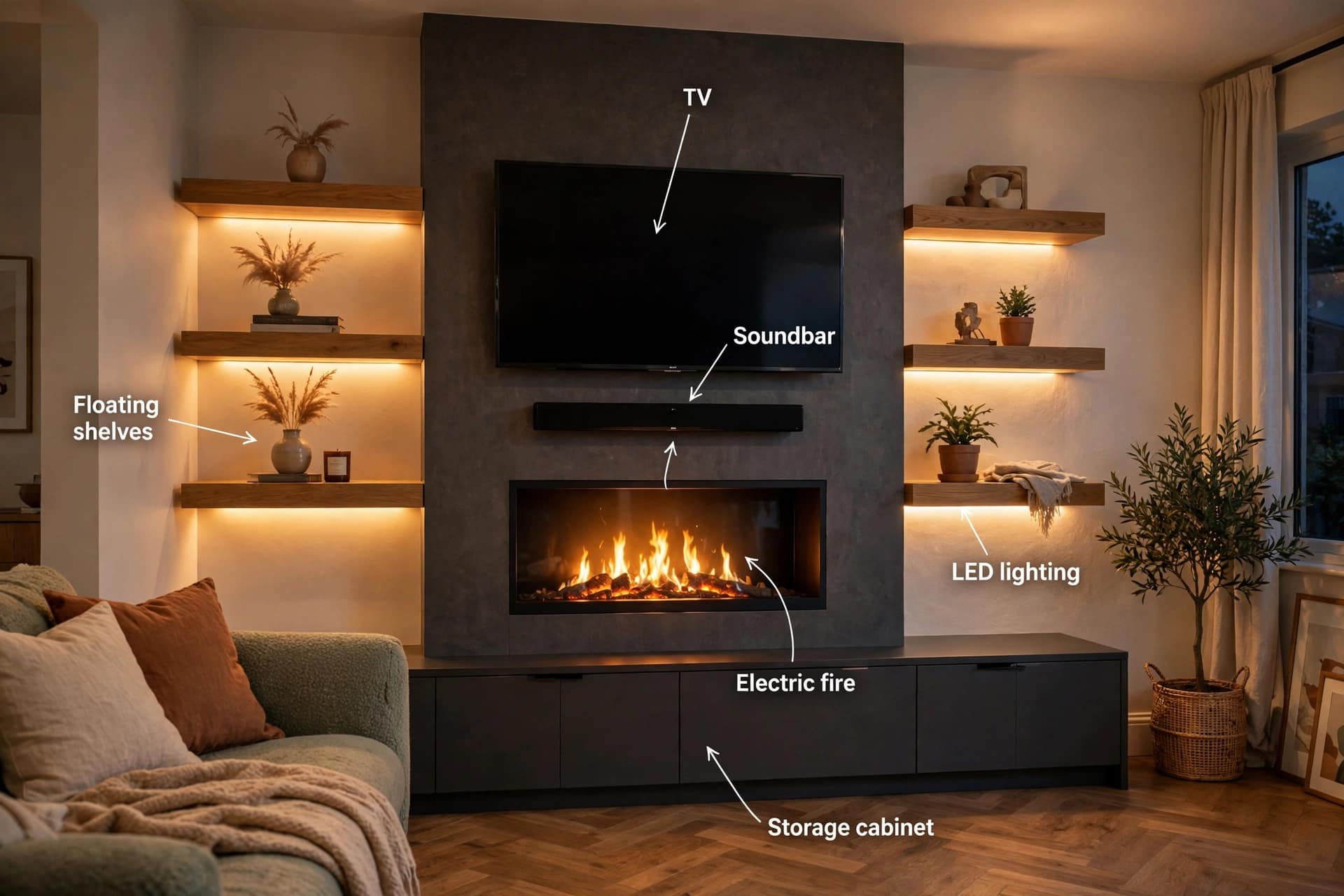
Instead of treating the fireplace and TV as separate pieces of furniture, the wall creates a unified composition.
A typical design may include:
- Wall-mounted TV
- Built-in electric fire
- Storage cabinets
- Open shelving
- Soundbar
- LED lighting
- Decorative wall panels
- Cable management
- Display niches
- Painted or textured finishes
If you are also considering the wider fireplace concept, see our media wall with fireplace ideas for additional layouts and design inspiration.
1. TV Above Fireplace: The Classic Layout
The TV-above-fireplace arrangement remains one of the most popular fireplace wall designs.
The basic composition is:
TV
Gap / Soundbar
Electric Fire
This creates a strong vertical focal point and works particularly well on a symmetrical feature wall.
The fireplace provides visual weight at the bottom, while the television naturally becomes the main viewing point.
This layout can suit:
- Modern living rooms
- New-build homes
- Victorian terraces
- Open-plan spaces
- Renovated chimney-breast walls
- Minimalist interiors
The important point is to avoid placing the TV and fire too close together or creating an excessively tall stack.
2. Wide Fireplace With a Slightly Smaller TV (2)
One of the most effective ways to create a premium-looking fireplace wall is to use a fireplace that is slightly wider than the TV.
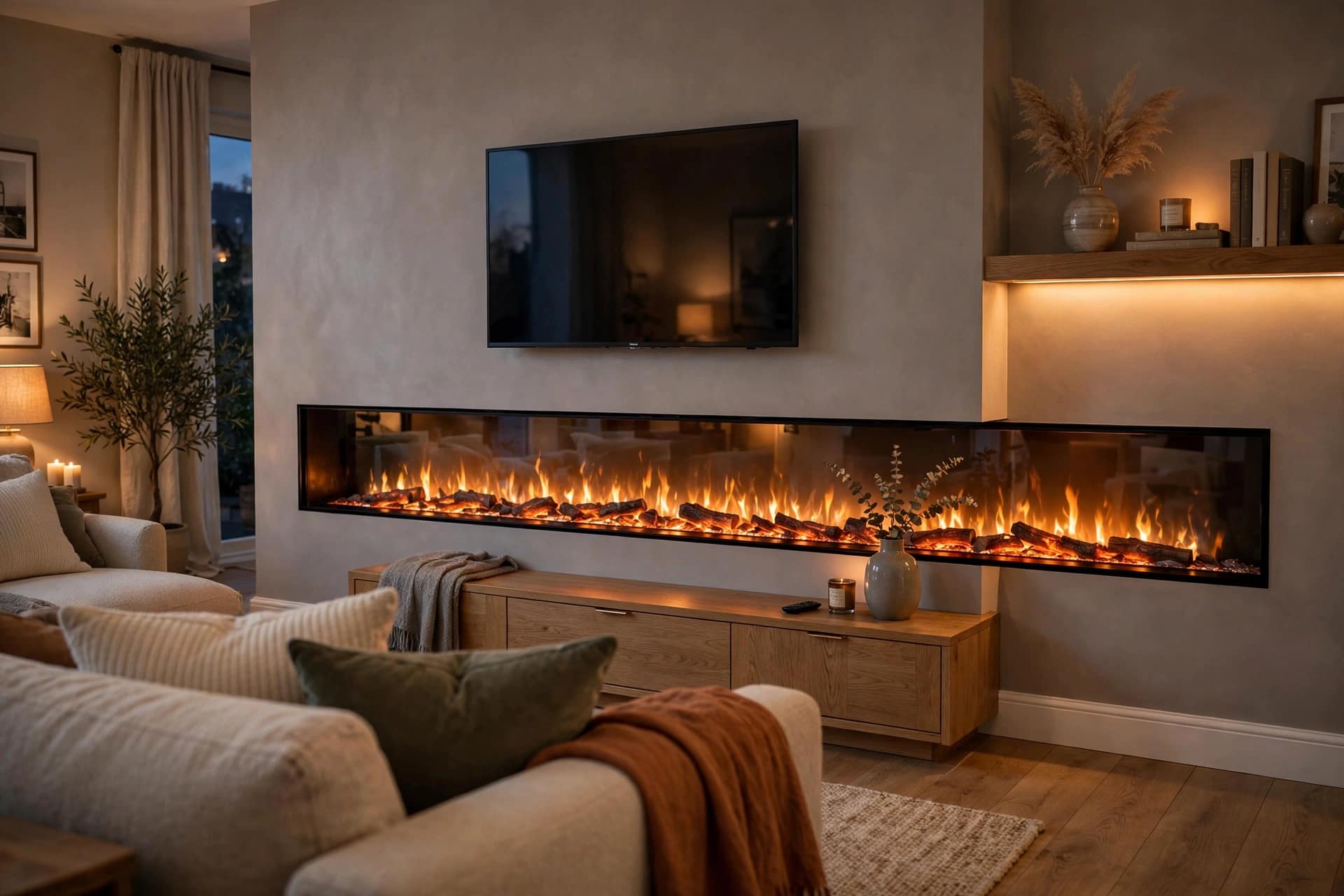
For example:
- 55-inch TV with approximately 1,300–1,500mm fireplace
- 65-inch TV with approximately 1,500–1,800mm fireplace
- 75-inch TV with approximately 1,800–2,000mm fireplace
These are planning ranges rather than universal rules. The actual television width and fireplace manufacturer’s dimensions should always be checked before construction.
A wider fireplace can give the wall a more grounded appearance and create additional visual space around the TV.
3. Fireplace Wall With a Large TV
Large televisions can work extremely well in fireplace walls, but the proportions need to be considered carefully.
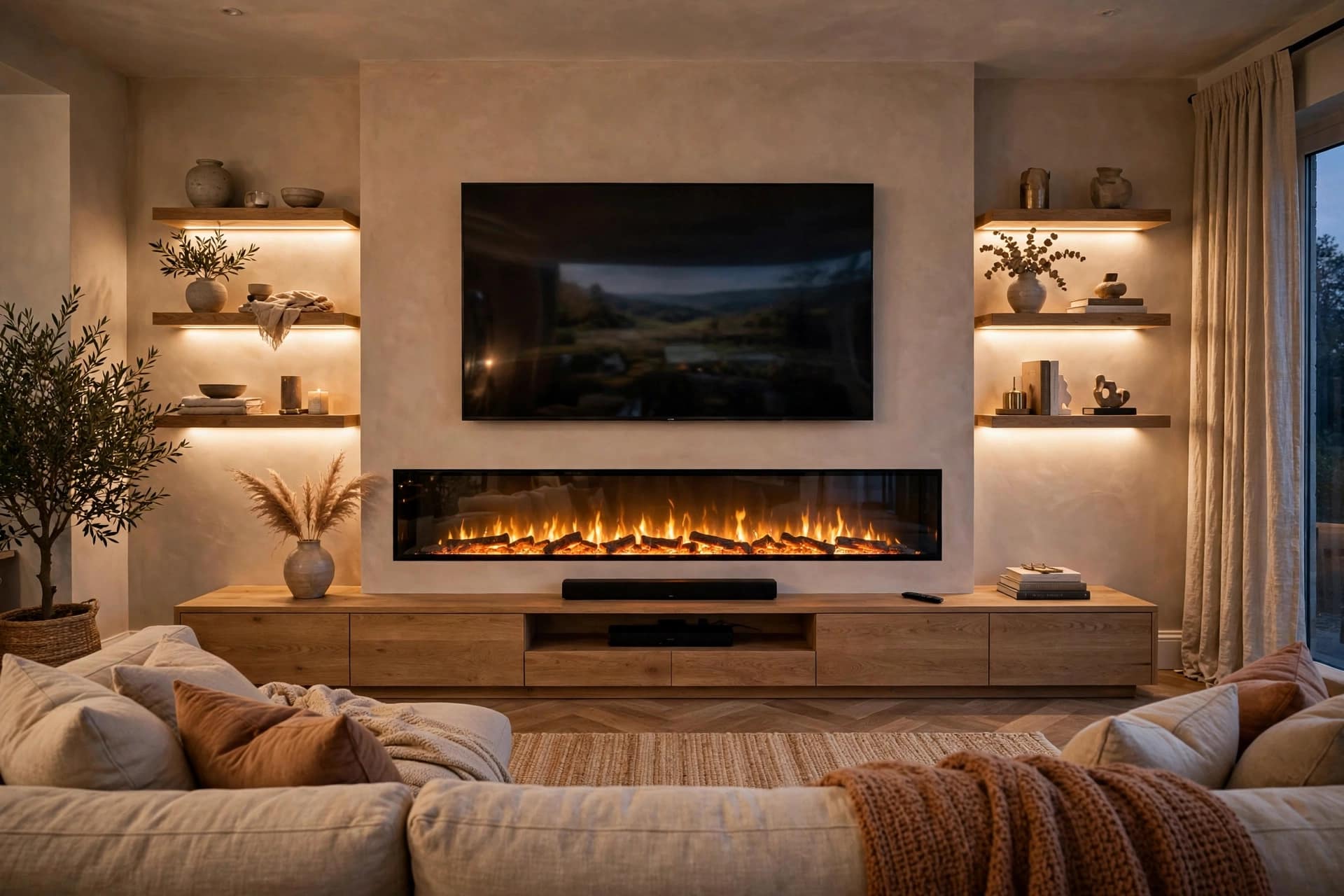
An 85-inch television, for example, requires considerably more wall width than a 55-inch screen.
Before choosing a large TV, measure:
- Actual TV width
- Actual TV height
- Wall width
- Wall height
- Viewing distance
- Fireplace width
- Soundbar width
- Cabinet width
Do not select a TV based only on the diagonal screen size.
A 65-inch TV may sound compact when described by screen size, but its actual width is roughly 1.44 metres. The fireplace and surrounding wall therefore need to be designed around the physical dimensions rather than the advertised screen size.
4. Fireplace Wall With a Soundbar
A soundbar is often forgotten during the initial design stage.
If the TV is positioned above the fireplace, the soundbar may need to sit between them.
This creates three important measurements:
- Top of fireplace
- Soundbar position
- Bottom of television
If these are not planned together, the finished arrangement can look cramped.
The soundbar should also remain acoustically useful rather than being hidden behind decorative features.
For detailed planning, see our Soundbar Placement for Media Walls guide.
5. Full-Width Fireplace Wall
A full-width fireplace wall can create a dramatic architectural feature.
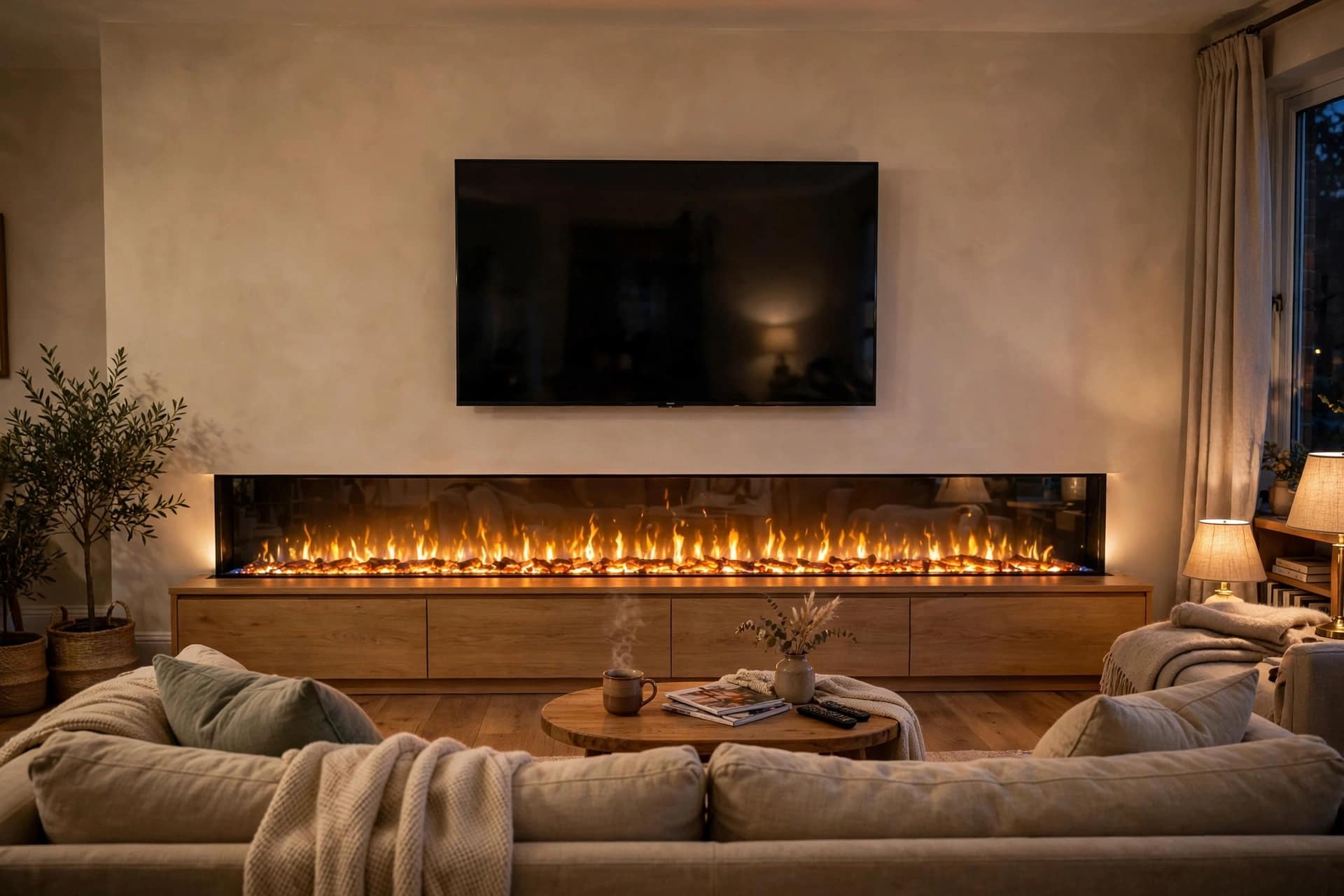
Instead of building only a narrow TV section, the media wall can extend across most or all of the available wall.
This approach allows space for:
- TV
- Fireplace
- Storage
- Open shelving
- Decorative niches
- Lighting
- Display areas
It works particularly well in larger living rooms where a smaller media wall could appear lost against a broad wall.
However, full-width does not mean the wall should automatically be as deep as possible.
The projection into the room should still be considered carefully.
6. Fireplace Wall With Built-In Storage
Storage can be integrated below or beside the fireplace.
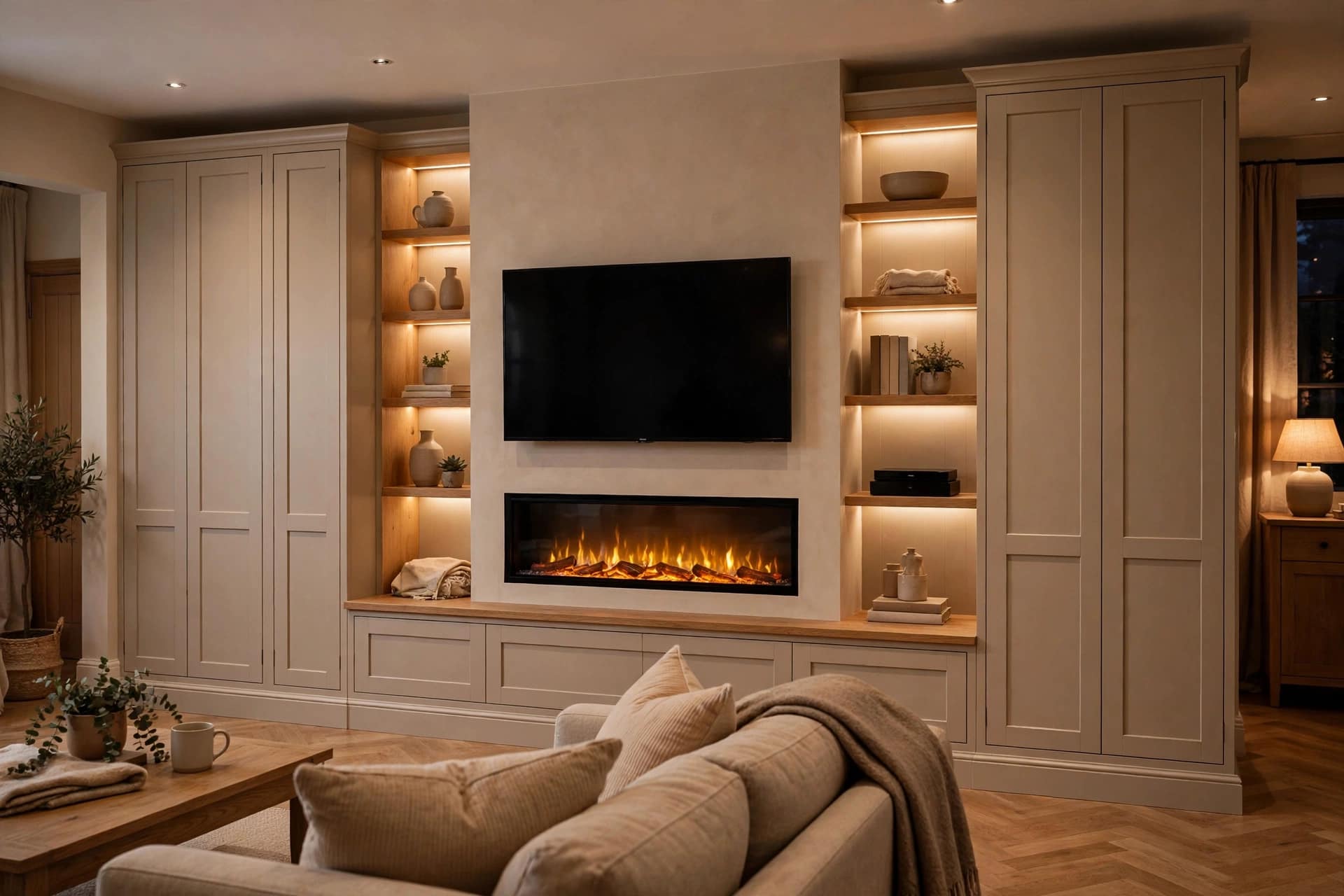
Popular options include:
Closed Storage
Ideal for hiding:
- Games consoles
- Remote controls
- Cables
- Media equipment
- Children’s toys
- Everyday clutter
Open Shelving
Open shelves can display:
- Books
- Artwork
- Plants
- Decorative objects
- Photographs
Combination Storage
A combination of closed cabinets and open shelving provides both practical storage and display space.
This is particularly useful where the fireplace wall is replacing an existing TV cabinet.
7. Fireplace Wall With Side Shelving
Side shelving can make the fireplace wall feel wider without requiring the fireplace itself to occupy the entire wall.
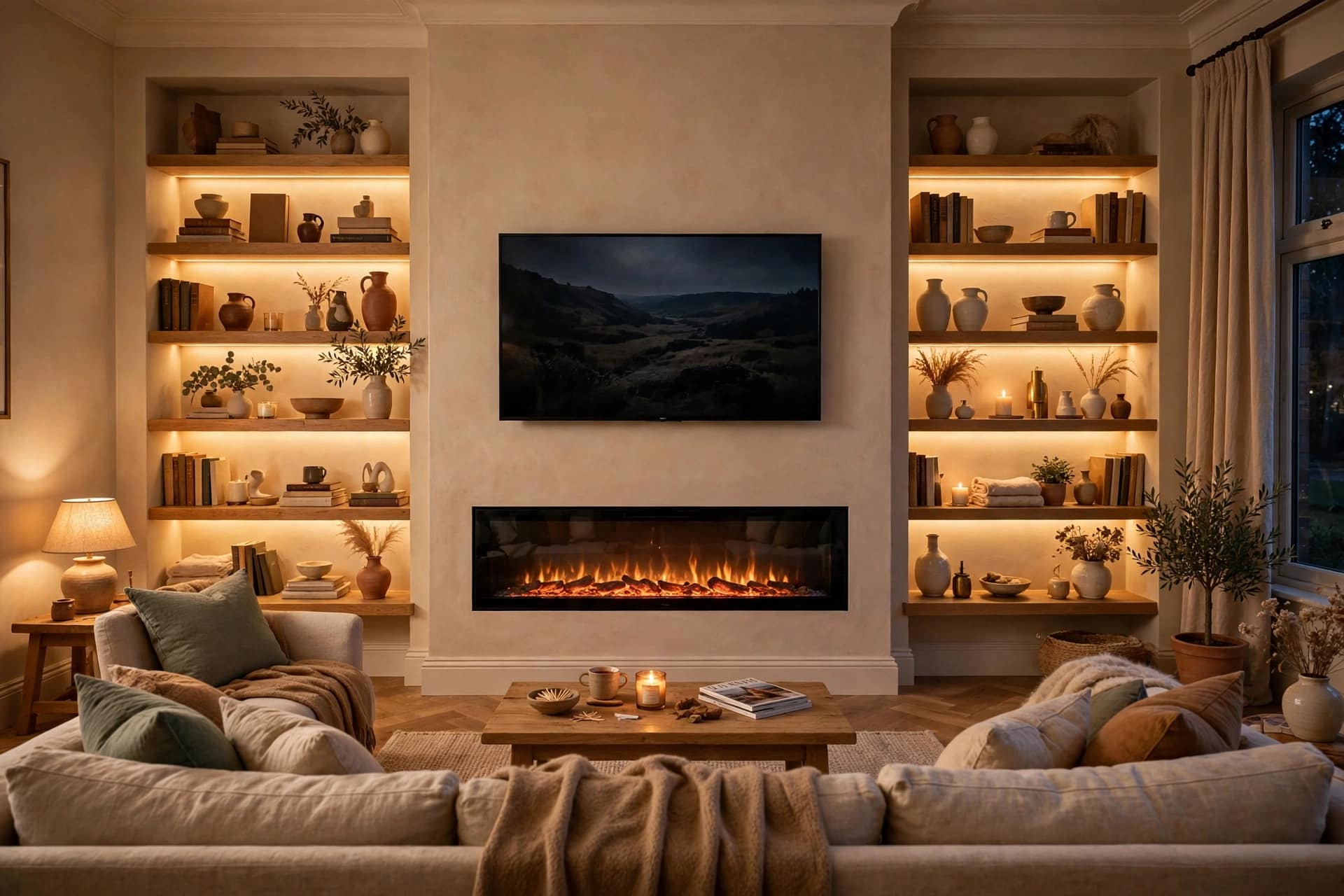
A typical arrangement might be:
Shelving | TV | Shelving
with the fireplace centred beneath the TV.
This creates symmetry and provides additional opportunities for lighting and decoration.
For a more minimalist appearance, keep the shelves relatively uncluttered.
8. Fireplace Wall With Asymmetrical Shelving
Not every fireplace wall needs to be symmetrical.
An asymmetrical layout might have:
Shelving | TV + Fireplace
or
TV + Fireplace | Tall Storage
This can work particularly well in rooms where doors, windows or alcoves prevent a perfectly symmetrical design.
The key is to create visual balance even when the physical arrangement is not symmetrical.
9. Fireplace Wall With Open Shelving
Open shelving can make a fireplace wall feel lighter than a completely enclosed design.
LED lighting can be added inside the shelves to create subtle evening illumination.
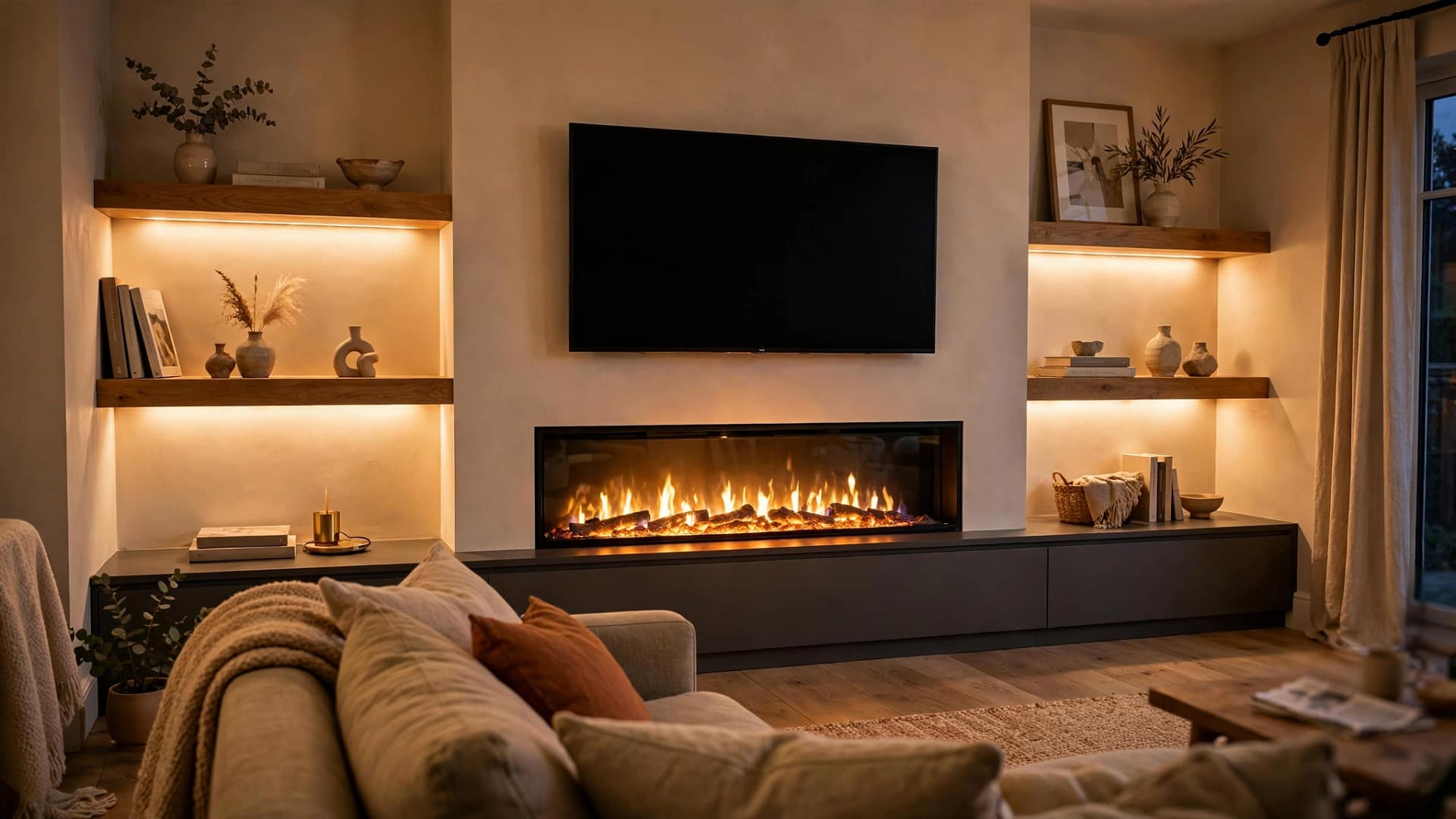
However, avoid filling every shelf with accessories.
A premium-looking media wall generally benefits from negative space.
A few carefully selected objects often look more intentional than dozens of decorative items.
10. Fireplace Wall With Closed Cabinets
Closed cabinets provide a cleaner appearance.
They are particularly useful if the living room contains a lot of technology.
Games consoles, routers, controllers and other equipment can be hidden while the TV and fireplace remain the visual focus.
Cabinet doors can be finished in the same colour as the wall for a seamless built-in effect.
11. Modern Minimalist Fireplace Wall
A minimalist fireplace wall usually relies on:
- Simple geometry
- Neutral colours
- Minimal decoration
- Flush cabinetry
- Clean TV mounting
- Integrated lighting
- Limited visible cables
White, warm grey, beige, taupe, charcoal and natural wood tones can all work well depending on the wider interior.
For more inspiration, explore our Luxury & Minimalist Media Wall ideas.
The aim is to make the fireplace wall feel like part of the architecture rather than a collection of separate products.
12. Fluted Panel Fireplace Wall
Fluted panels can add vertical texture around the TV and fireplace.
The vertical lines can also make a wall appear taller, which can be useful in rooms with relatively low ceilings.
Fluted finishes can be used:
- Across the entire feature wall
- Behind the TV
- Behind the fireplace
- On one side of the TV
- Inside shelving areas
For more design ideas, see our Fluted Panel Media Wall UK guide.
13. Wood-Effect Fireplace Wall
Wood finishes can make an electric-fire media wall feel warmer and less stark.
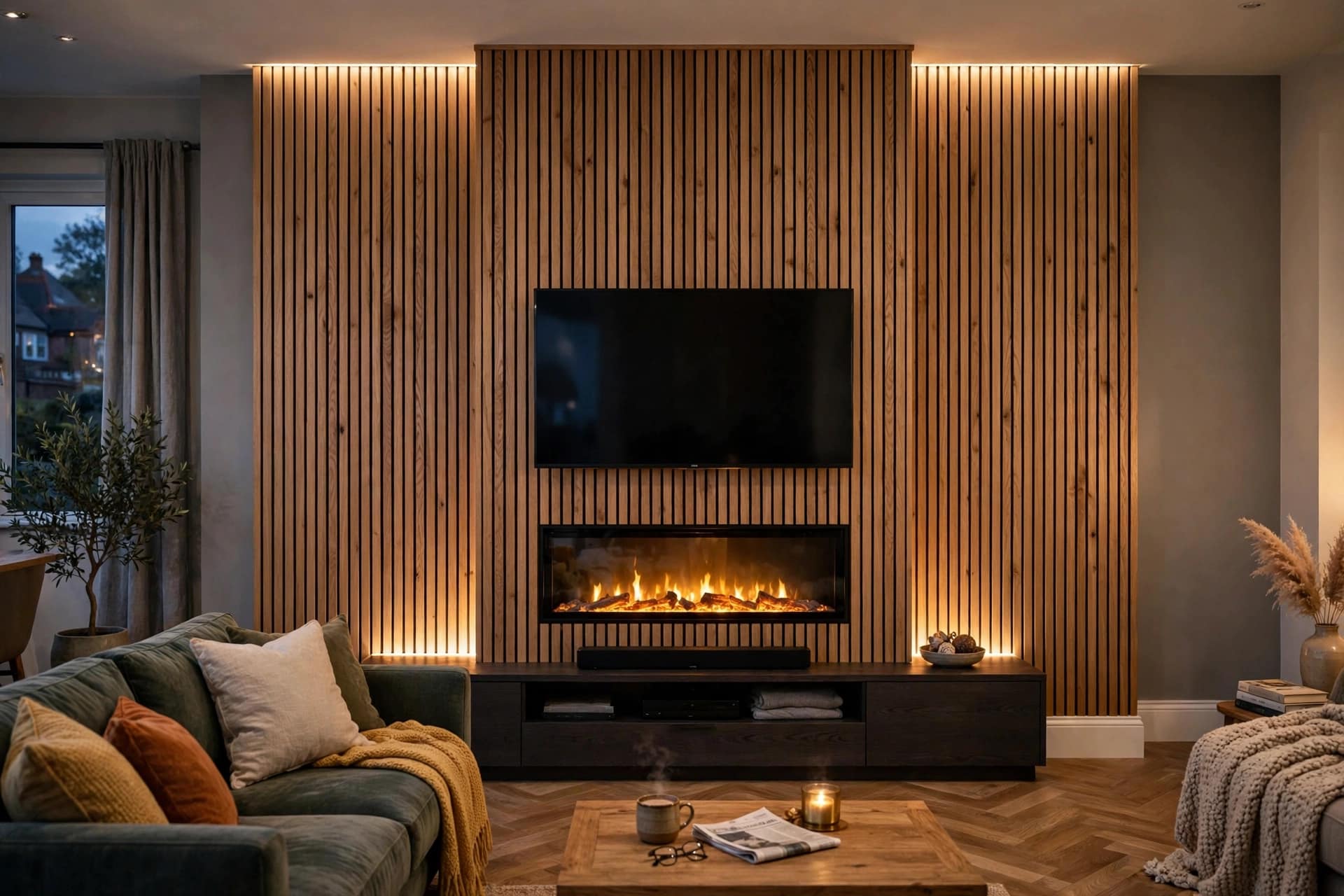
Walnut, oak and darker timber-effect finishes are particularly useful when the room already contains wooden flooring or furniture.
A wood-effect fireplace wall can work with:
- Beige sofas
- Cream walls
- Dark furniture
- Neutral carpets
- Black TV frames
- Brass or bronze accessories
For a darker premium finish, see our Walnut & Dark Wood Media Wall guide.
The key is to repeat the wood tone elsewhere in the room so the media wall feels connected to the rest of the interior.
14. Fireplace Wall With LED Lighting
Lighting can completely change the appearance of a fireplace wall after dark.
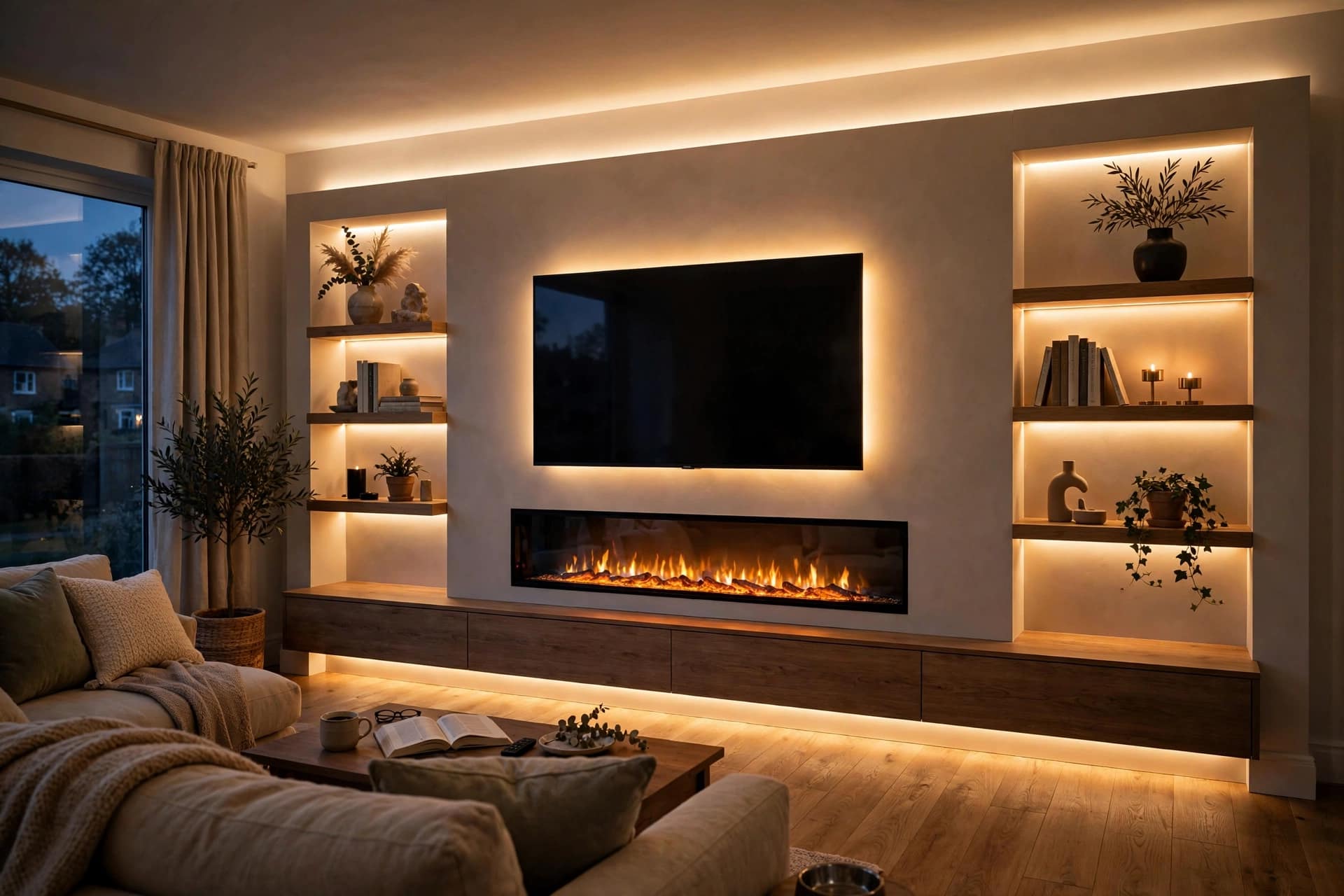
Common options include:
Shelf Lighting
LED strips can be installed inside open shelves.
Backlighting
The TV or surrounding panels can be subtly illuminated.
Recess Lighting
Lighting can be integrated into niches.
Cabinet Lighting
Low-level lighting can create a softer evening effect.
Lighting should complement the flame effect rather than compete with it.
For a complete lighting plan, see our Media Wall Lighting Guide UK .
15. Fireplace Wall With a Black TV
A black television naturally works as a strong visual anchor.
A dark TV can be incorporated into:
- Black feature panels
- Dark wood
- Charcoal walls
- Grey plaster finishes
- Dark fluted panels
Alternatively, a black TV can be deliberately contrasted against a light-coloured wall.
This can create a more graphic, contemporary appearance.
16. Fireplace Wall With a Neutral Colour Palette
Neutral fireplace walls remain versatile because they can work with changing furniture and accessories.
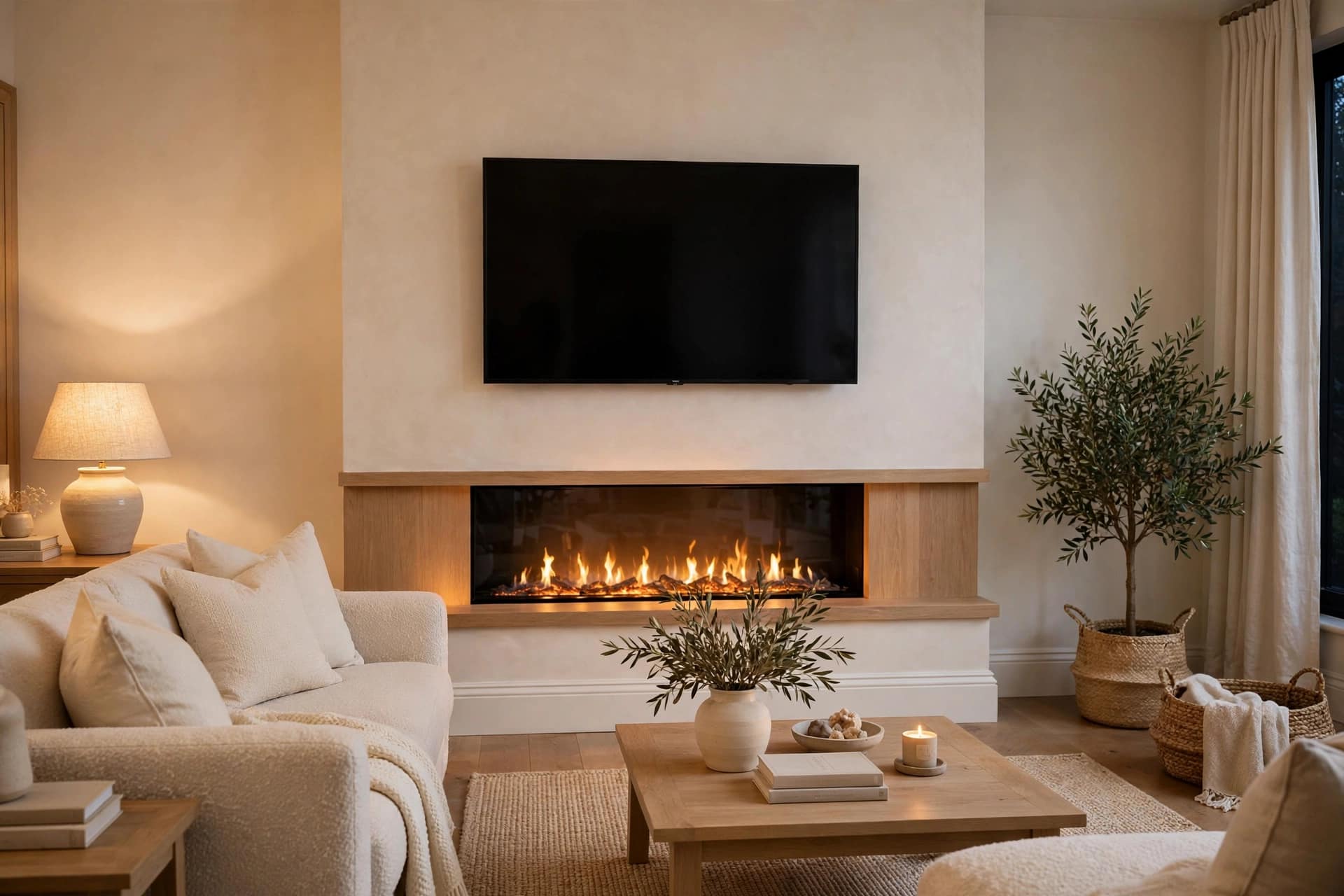
Popular combinations include:
Warm Beige + Oak
Creates a softer, natural appearance.
Greige + Walnut
Adds warmth while maintaining a contemporary look.
White + Light Oak
Works particularly well in Scandinavian-inspired interiors.
Charcoal + Dark Wood
Creates a dramatic cinema-style atmosphere.
For more colour combinations, see our Media Wall Colour Ideas UK guide.
17. Fireplace Wall for a Small Living Room
Small rooms require more careful planning than large rooms.
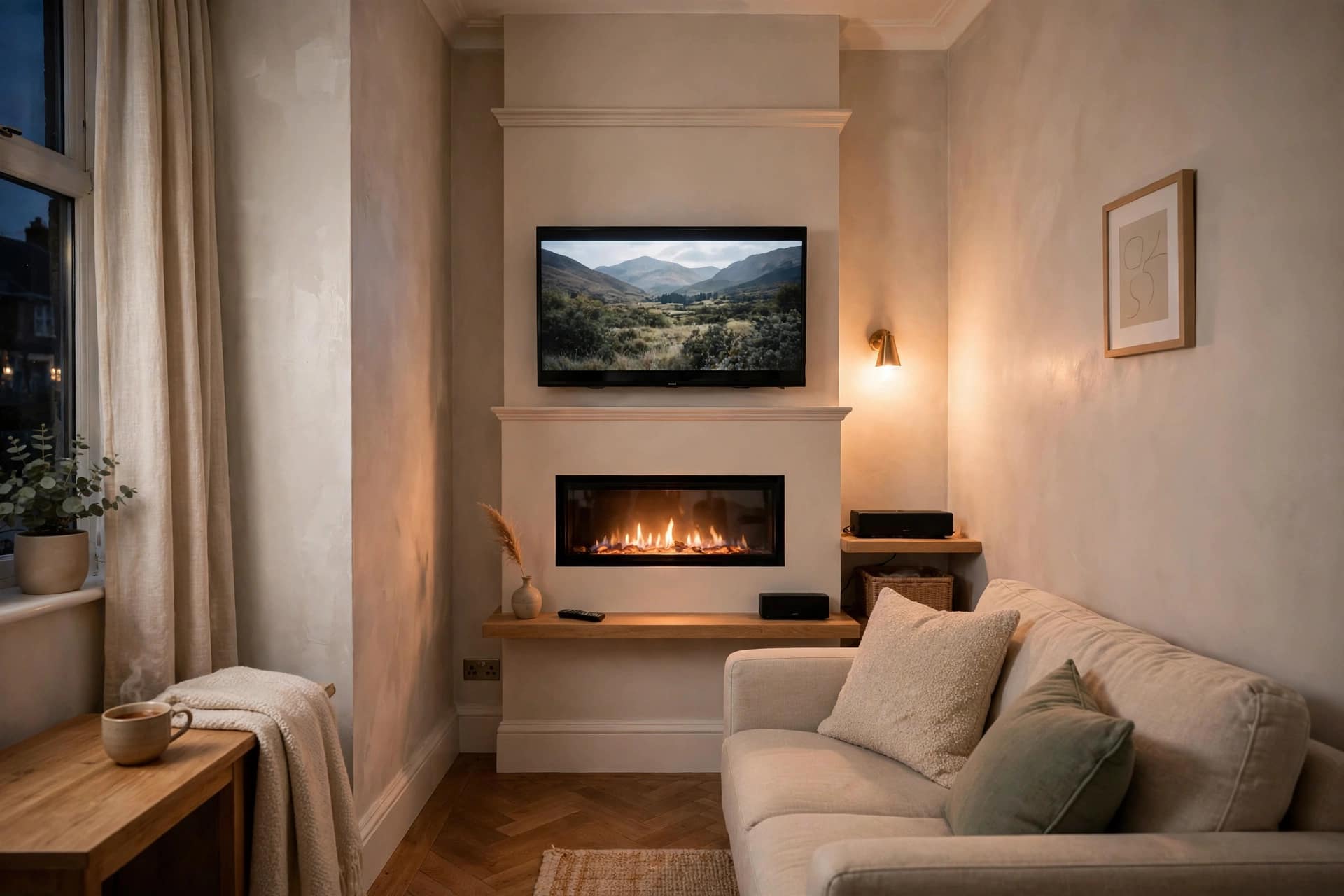
A fireplace wall that projects 300mm or more into the room can have a noticeable effect on usable floor space.
Before construction, measure:
- Sofa-to-wall distance
- Walkway width
- Door opening
- Window position
- Radiator position
- Furniture depth
- Proposed media wall depth
In a smaller living room, a shallow design with carefully integrated storage can be more practical than a large full-width installation.
For additional ideas, see our Small Living Room Media Wall Ideas guide.
18. Fireplace Wall for a Large Living Room
Large rooms give you more flexibility.
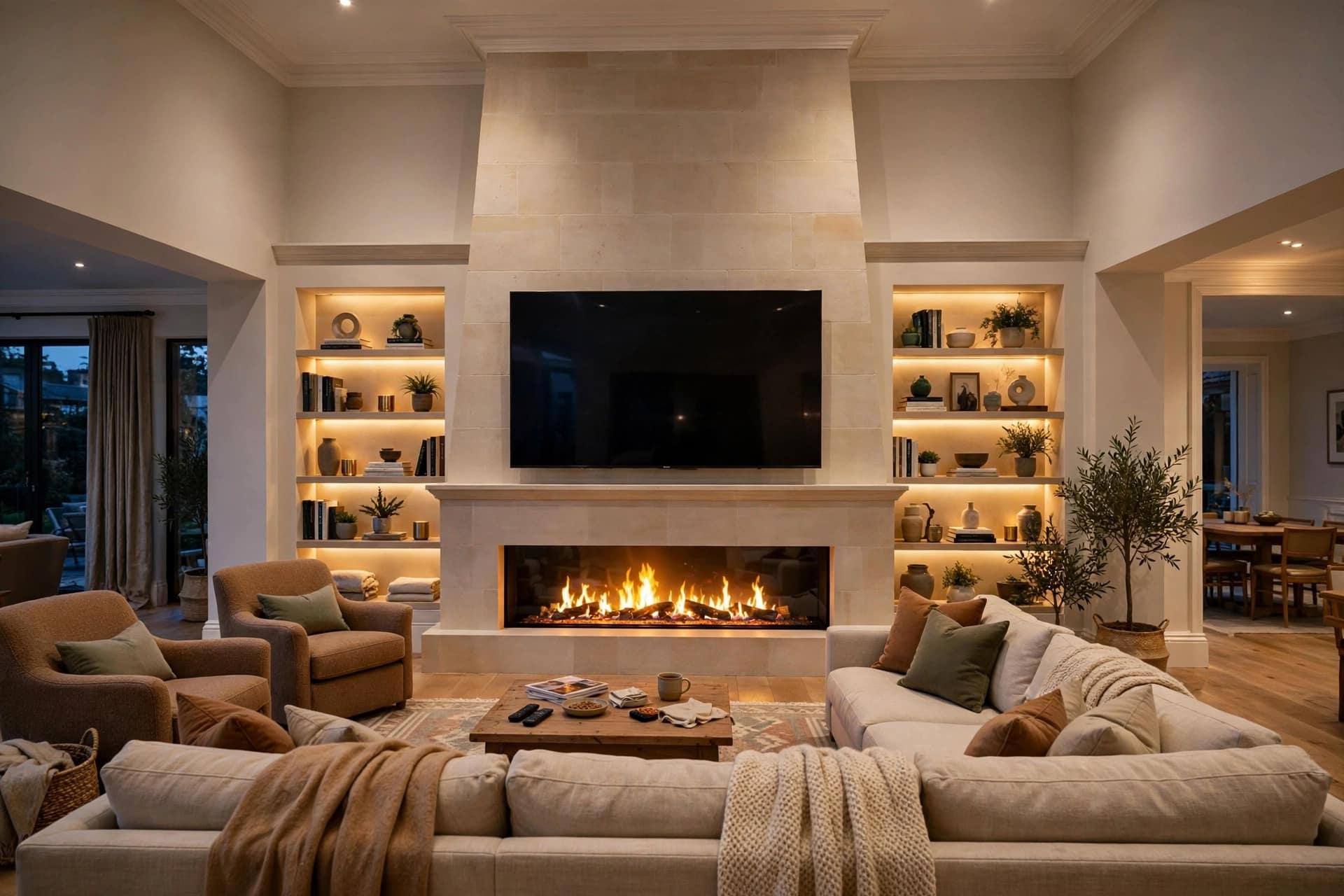
A larger fireplace wall may include:
- Wide panoramic electric fire
- Large TV
- Full-height panels
- Large storage units
- Decorative niches
- Open shelving
- Feature lighting
The main challenge in a large room is avoiding a design that looks too small.
A narrow fireplace beneath a very large television can leave excessive empty space around the feature.
In larger rooms, the complete wall composition should be considered rather than focusing only on the fireplace.
19. Fireplace Wall in an Open-Plan Living Room
Open-plan rooms need additional consideration because the fireplace wall may be visible from several directions.
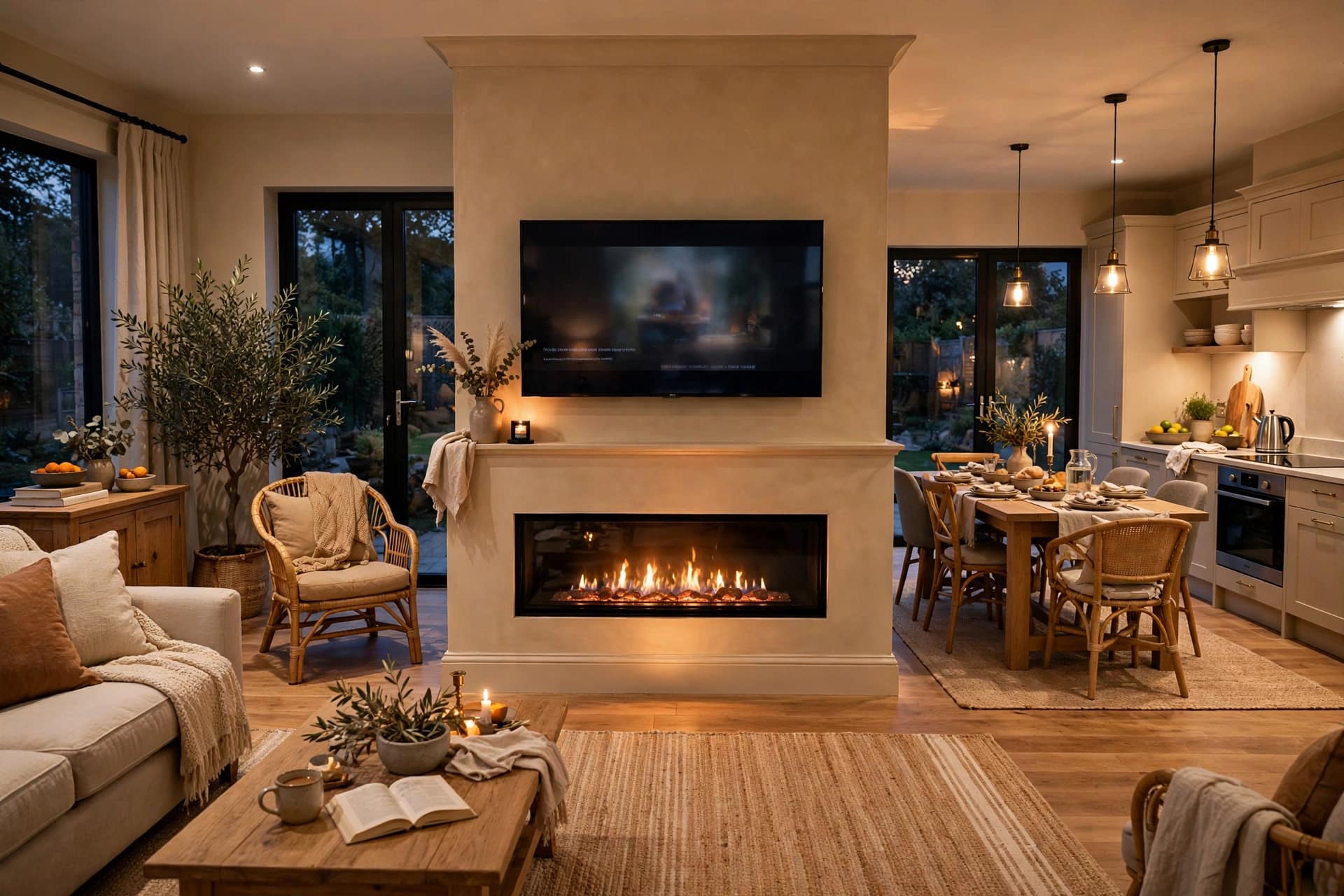
A two-sided or three-sided electric fire can sometimes work well where the wall is positioned between different zones.
For example, the wall might separate:
- Living area
- Dining area
- Kitchen
The fireplace can then become a visual feature from more than one position.
However, the layout should not obstruct movement between zones.
See our Open Plan Media Wall UK guide for more planning ideas.
20. Fireplace Wall Around an Existing Chimney Breast
Older UK homes often have chimney breasts that influence the TV and fireplace layout.
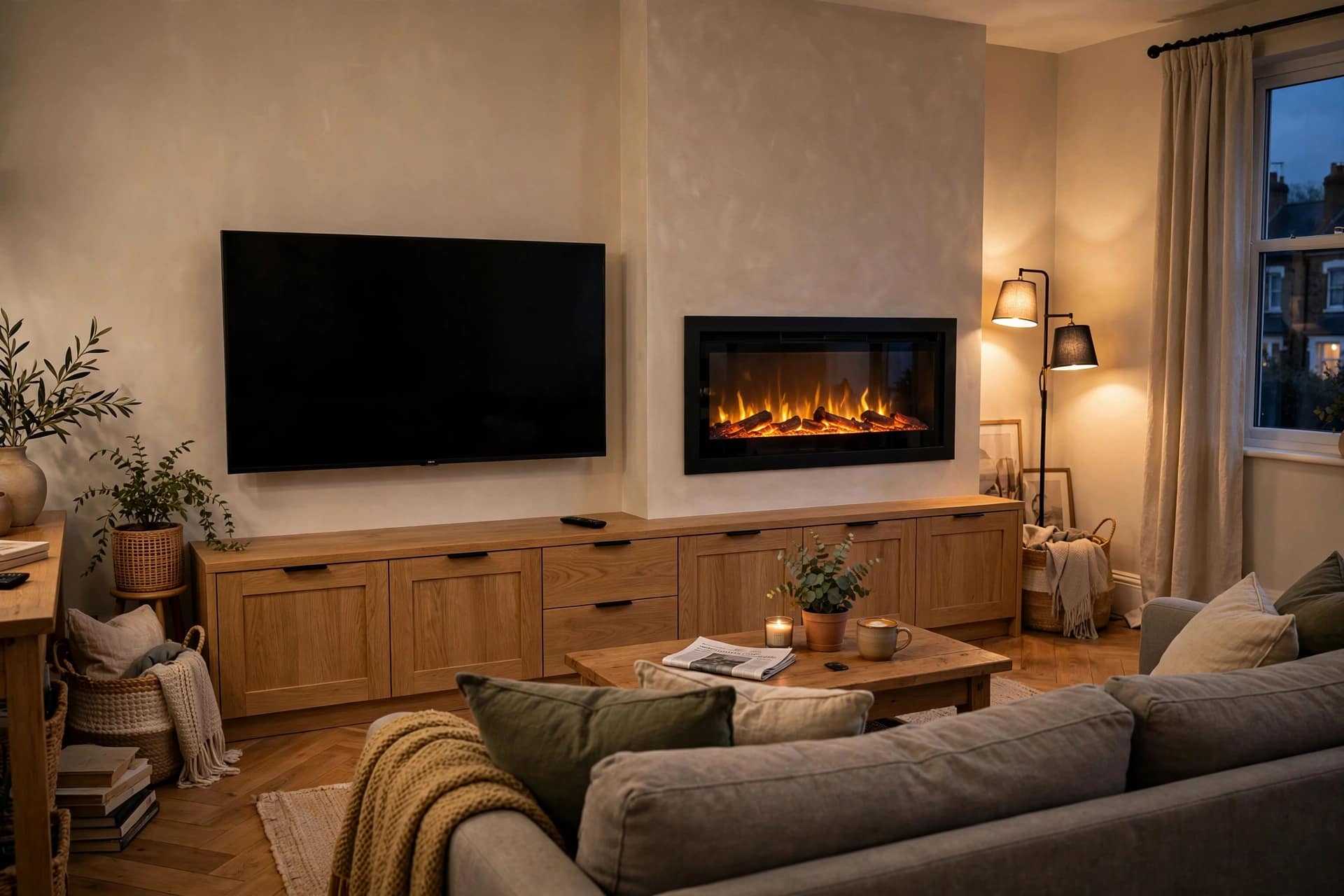
Instead of fighting the existing structure, the design can incorporate it.
Possible approaches include:
- Mounting the TV centrally on the chimney breast
- Building cabinetry into the alcoves
- Installing the electric fire below the TV
- Using the alcoves for shelving
- Creating a symmetrical built-in appearance
This can be particularly effective in Victorian and Edwardian properties where the chimney breast already provides a natural central feature.
21. Fireplace Wall With Alcove Storage
If the room already has alcoves, they can become part of the overall design.
For example:
Alcove storage | TV + Fire | Alcove storage
This creates a strong architectural composition without requiring the entire wall to be rebuilt.
The alcoves can contain:
- Built-in cabinets
- Floating shelves
- Decorative lighting
- Books
- Artwork
For more ideas, see our Alcove Media Wall UK guide.
22. Side-by-Side Fireplace and TV Layout
A side-by-side layout places the TV and fireplace next to each other rather than stacking them vertically.
For example:
TV | Fireplace
This can work when:
- The wall is unusually wide
- The room has a low ceiling
- The TV is intended to remain at a lower height
- The fireplace is designed as a separate feature
However, side-by-side layouts require careful proportioning because the TV and fire compete for visual attention.
A strong horizontal composition can work particularly well in wider contemporary rooms.
23. Stacked Fireplace and TV Layout
The stacked arrangement places the fireplace directly below the TV.
For most traditional media-wall installations, this is the simplest arrangement.
Advantages include:
- Strong central focal point
- Easy furniture orientation
- Efficient use of wall width
- Straightforward cable planning
- Clear visual hierarchy
The main consideration is vertical spacing.
The TV should not be pushed unnecessarily high simply to create a larger gap between the television and fire.
24. Low Fireplace With Wall-Mounted TV
Another option is to place the fireplace lower on the wall while keeping the TV mounted above it.
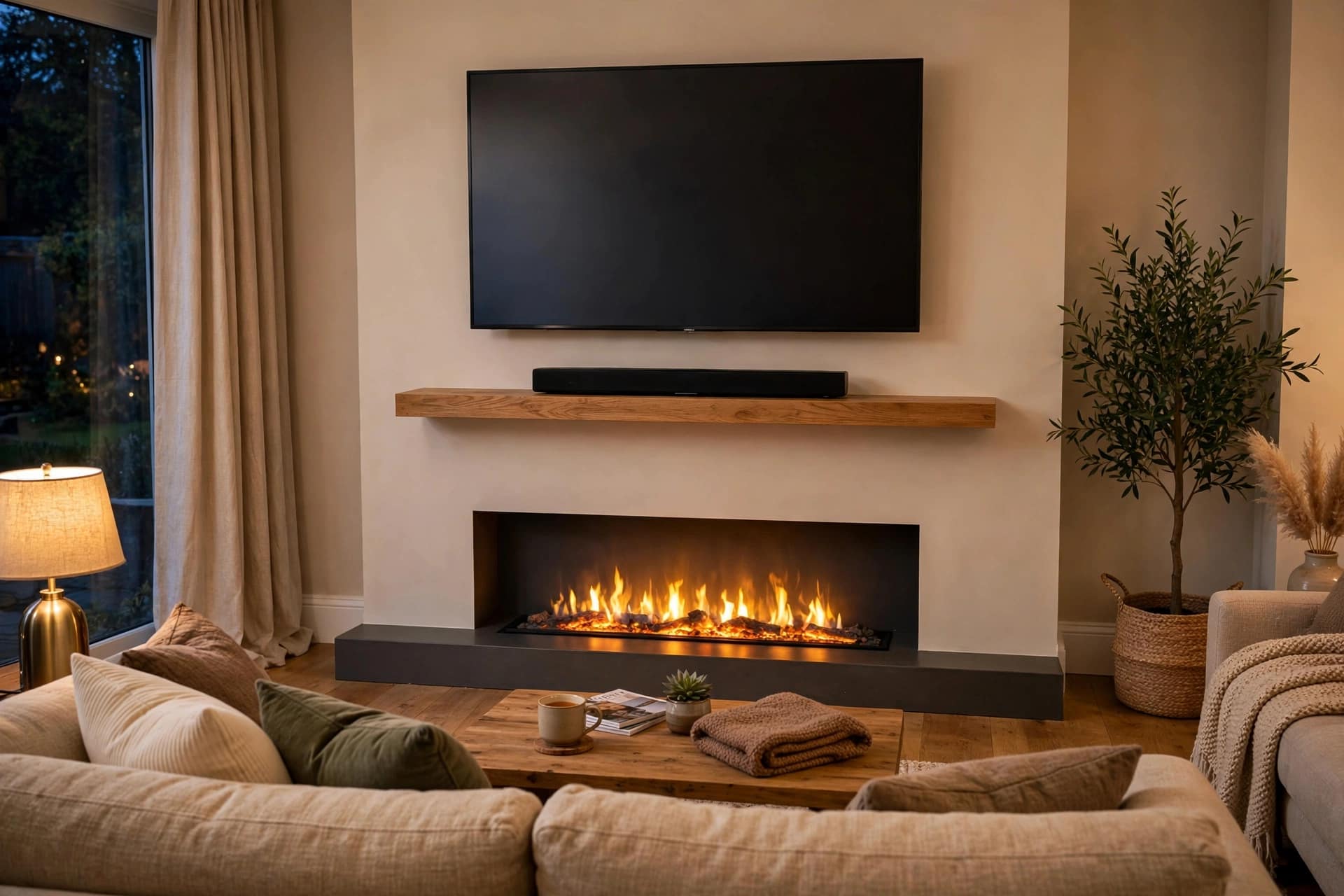
This can create a more relaxed appearance and may help keep the television at a comfortable viewing height.
The final height should be determined by the room, seating position, TV size and fireplace requirements.
Avoid copying an exact height from another room because sofa heights and viewing positions vary.
25. How Wide Should the Fireplace Be Compared With the TV?
A fireplace that is approximately the same width as the TV or slightly wider is a common design approach.
Published UK fireplace guidance gives examples where a 55-inch TV is paired with a 1,300–1,500mm fireplace and a 65-inch TV with a 1,500–1,800mm fireplace. These should be treated as planning examples rather than mandatory dimensions.
Always measure the actual products before construction.
Two different 65-inch TVs can also have slightly different overall dimensions because of differences in bezel design and construction.
26. How Much Space Should Be Between the TV and Fireplace?
There is no single universal gap that works for every fireplace and television.
The correct spacing depends on:
- Fireplace design
- Heat outlet
- TV specifications
- Soundbar
- Viewing height
- Manufacturer requirements
The manufacturer’s installation instructions should take priority over a generic measurement.
If you are planning a TV directly above an electric fire, see our TV Above Fireplace Safety UK guide for the safety considerations that should be checked before installation.
27. Choosing the Right Electric Fire
The fireplace is usually the second major visual element after the TV.
Consider:
- Fire width
- Fire depth
- Flame effect
- Fuel bed
- Heat output
- Flame-only mode
- Remote control
- Smart controls
- One-sided configuration
- Two-sided configuration
- Three-sided configuration
See our Electric Fire for Media Wall UK guide.
An attractive design should never take priority over the manufacturer’s installation requirements.
Before installation, check:
- TV heat limitations
- Fire clearances
- Required cavity dimensions
- Electrical requirements
- Ventilation requirements
- Mounting requirements
- Cable routing
- Finishing materials
For electrical installations in England, the official GOV.UK Approved Documents include guidance relating to electrical safety in dwellings.
For combustion appliances such as gas, oil or solid-fuel appliances, different building-regulation considerations apply under Approved Document J .
This distinction matters because an electric fire should not automatically be treated as if it has the same installation requirements as a gas or solid-fuel fireplace.
29. Fireplace Wall Materials
The surrounding material contributes significantly to the final appearance.
Common options include:
- Painted MDF
- Plasterboard
- Timber-effect panels
- Fluted panels
- Slatted panels
- Stone-effect finishes
- Veneer
- Laminate
The material should be selected according to the fireplace manufacturer’s requirements and the intended location.
For more detail, see our Best Materials for Media Wall UK guide.
30. How to Make a Fireplace Wall Look Premium
A premium appearance usually comes from proportion and consistency rather than simply adding expensive materials.
Focus on:
Consistent Lines
Align the TV, fireplace, cabinets and shelves.
Controlled Lighting
Use lighting to highlight the architecture.
Hidden Cables
Avoid visible wires crossing the feature wall.
Balanced Storage
Do not overload one side of the wall.
Limited Accessories
Allow the main architectural elements to remain visible.
Repeated Materials
Use the same wood, colour or metal finish in several parts of the room.
31. Common Fireplace Wall Design Mistakes
Making the Fireplace Too Small
A very small fire beneath a large TV can make the composition feel top-heavy.
Making the Wall Too Deep
Excessive projection reduces floor space.
Installing the TV Too High
The TV should be planned around the actual viewing position rather than simply centred on the wall.
Forgetting the Soundbar
The soundbar can change the required space between the TV and fireplace.
Ignoring Existing Architecture
Doors, windows, chimney breasts and alcoves should be considered before deciding on a symmetrical design.
Choosing Finishes Too Early
The fire and TV dimensions should be established before finalising the surrounding structure.
Adding Too Much Lighting
Too many LEDs can make a media wall look visually busy.
Filling Every Shelf
Open shelving needs negative space to remain visually clean.
32. Fireplace Wall Planning Checklist
Before construction, check:
- TV model selected
- TV width measured
- Fireplace model selected
- Fireplace dimensions confirmed
- Required cavity confirmed
- TV mounting position planned
- Fireplace position planned
- Soundbar position planned
- Wall depth confirmed
- Storage planned
- Electrical points planned
- Cable routes planned
- Lighting planned
- Decorative finish selected
- Manufacturer instructions checked
The most important rule is simple:
Measure the actual products before building the wall.
Frequently Asked Questions
What is the best fireplace wall layout with a TV?
The TV-above-electric-fire layout is one of the most common arrangements because it creates a clear central focal point. However, side-by-side and asymmetrical layouts can also work depending on the wall and room.
Should the fireplace be wider than the TV?
A fireplace that is the same width as or slightly wider than the TV is a common design approach. The exact proportions should be based on the actual dimensions of both products.
Can you put a TV above an electric fireplace?
It can be possible, but the specific fireplace and TV installation requirements must be followed. Heat, clearances and mounting requirements should be checked before construction.
What size fireplace do I need for a 55-inch TV?
A 1,300–1,500mm fireplace is a commonly used planning range for a 55-inch TV, although the correct size depends on the actual TV and fireplace dimensions.
What size fireplace do I need for a 65-inch TV?
A 1,500–1,800mm fireplace is a commonly published planning range for a 65-inch TV. Always confirm the manufacturer’s dimensions before building.
Is a side-by-side TV and fireplace layout better than a stacked layout?
Both layouts can work. A stacked layout is efficient for a conventional feature wall, while side-by-side designs can work well on wider walls or in rooms where a vertical arrangement is less suitable.
Can I build a fireplace wall around a chimney breast?
Yes, the existing chimney breast and alcoves can be incorporated into the design, subject to the building and installation requirements relevant to the property and appliance.
Can a fireplace wall be too large?
Yes. A wall that is too deep or too visually dominant can reduce floor space and overwhelm a smaller room.
Should I include storage in a fireplace wall?
Storage can be useful for hiding electronics, cables and everyday clutter. Closed cabinets provide a cleaner appearance, while open shelving can be used for display.
What is the best finish for a fireplace wall?
There is no single best finish. Painted panels, wood-effect finishes, fluted panels, slatted panels and stone-effect materials can all work depending on the room’s style.
Final Thoughts
The strongest fireplace wall ideas with TV are not necessarily the most complicated.
A well-designed wall usually comes down to a few fundamentals: correct proportions, suitable fireplace size, sensible TV positioning, controlled storage, hidden wiring and a finish that complements the rest of the room.
Start with the TV and fireplace dimensions, then design the wall around them.
For a small UK living room, keep the projection under control. For a larger room, use the additional wall width for storage, shelving and architectural detail rather than simply making the fireplace larger.
Most importantly, treat the TV, fireplace, soundbar, lighting and cabinetry as one composition.
That is what turns a simple TV-and-fire combination into a properly designed fireplace feature wall.