
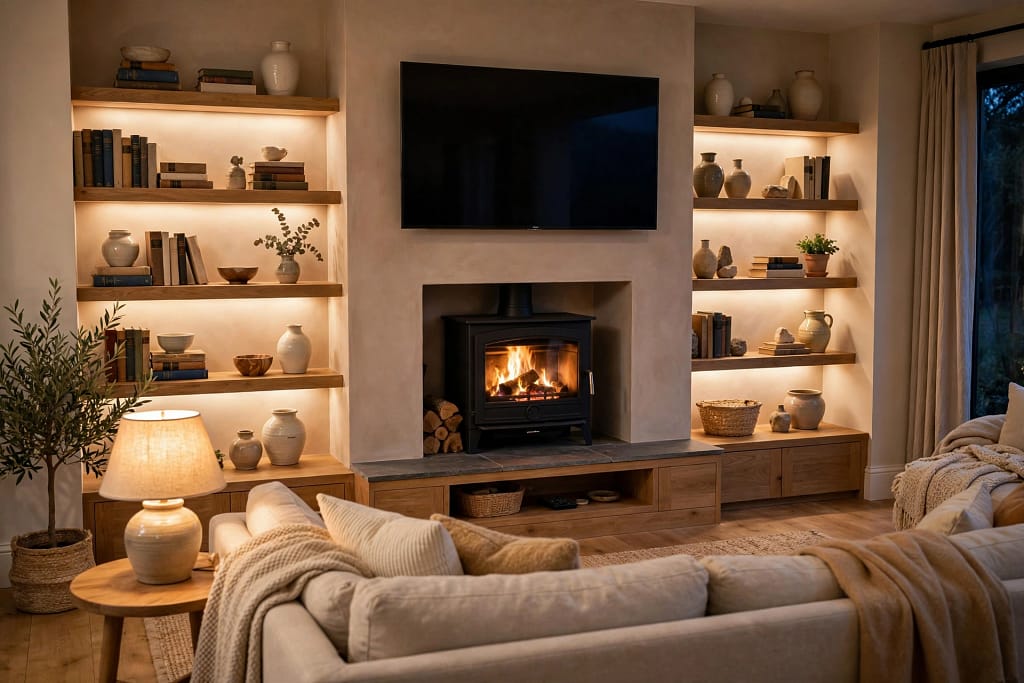
Log Burner Media Wall Ideas UK
A log burner can give a media wall a completely different character from an electric fireplace. Instead of creating a purely decorative feature, a wood-burning stove introduces real heat, a working flue, a hearth and additional ventilation and safety considerations.
That makes a log burner media wall a project that needs much more planning than simply placing a TV above a fireplace.
The finished design can still look modern and beautifully integrated. A stove can sit beneath or beside the television, with a tiled or stone hearth, timber-effect cabinetry, shelving or a rendered chimney breast creating a strong focal point.
However, the television, combustible materials, stove, flue and surrounding construction must all work together.
Quick Answer
The best log burner media wall ideas combine the stove with a properly designed hearth, suitable chimney or flue system, non-combustible materials around the appliance and carefully planned TV positioning.
A typical design may feature a log burner at low level with a TV positioned above or to one side, but the exact arrangement depends on the stove manufacturer’s installation requirements, the chimney or flue route, heat clearances and the construction of the wall.
For a new installation or major alteration in England, Approved Document J is an important starting point because it covers combustion appliances, air supply, discharge of combustion products, hearths, fireplaces, flues and chimneys.
For broader fireplace-media-wall inspiration, see our Media Wall With Fireplace UK .
What Is a Log Burner Media Wall?
A log burner media wall combines a wood-burning stove with a television and, usually, additional architectural or storage elements.
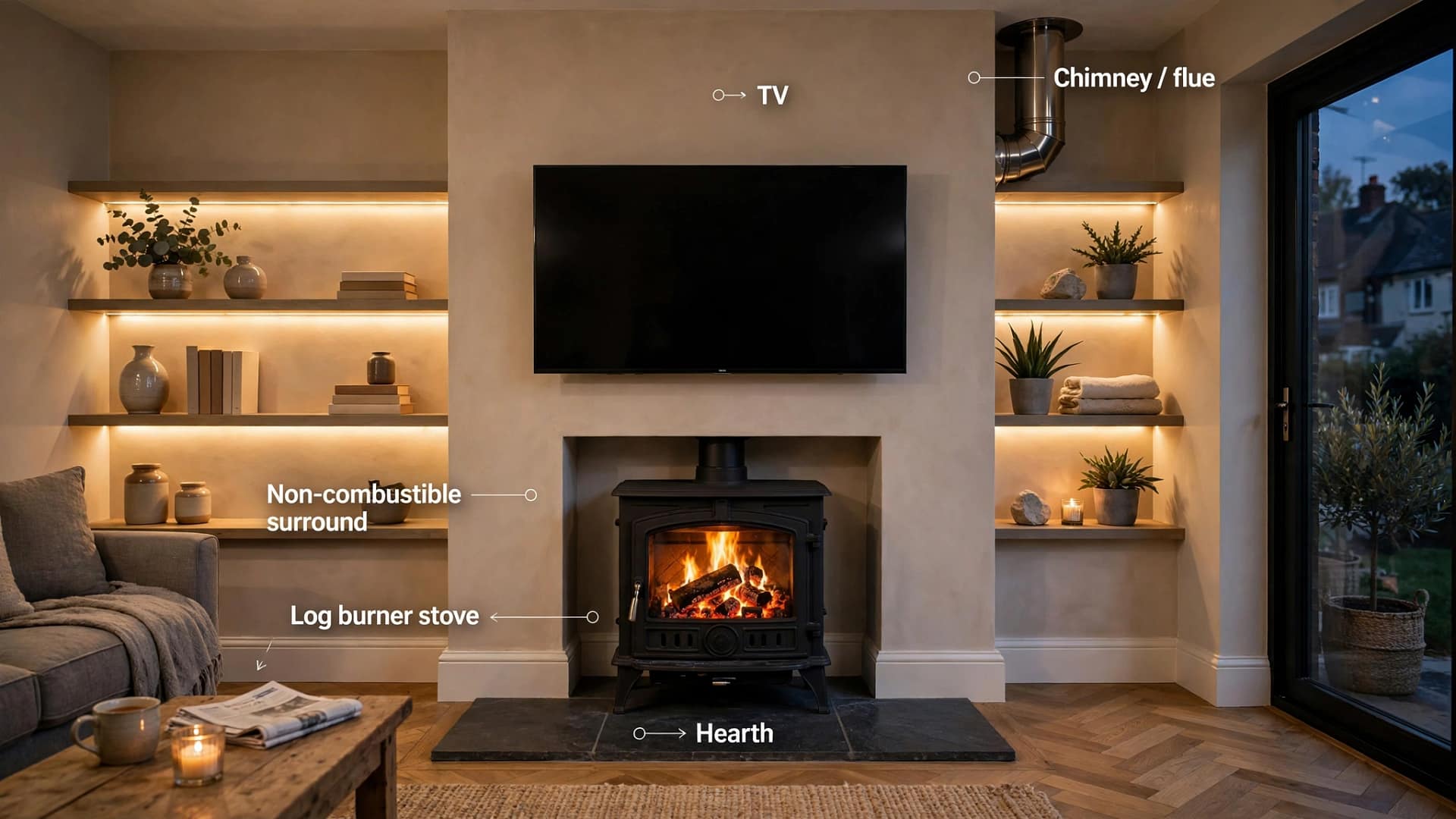
Instead of having a standalone stove and separate TV installation, the two are planned as part of one feature.
A design can include:
- A log burner
- A TV
- A chimney breast or false chimney
- A hearth
- Non-combustible wall protection
- Open shelving
- Closed storage
- Timber or decorative panels away from heat
- Integrated lighting
- Soundbar storage
- Concealed cable routes
The important difference is that a wood-burning stove is a real combustion appliance .
It therefore has requirements that do not apply to a purely electric fireplace.
1. Modern Log Burner Media Wall with TV Above
One of the most popular arrangements is a log burner positioned beneath the television.
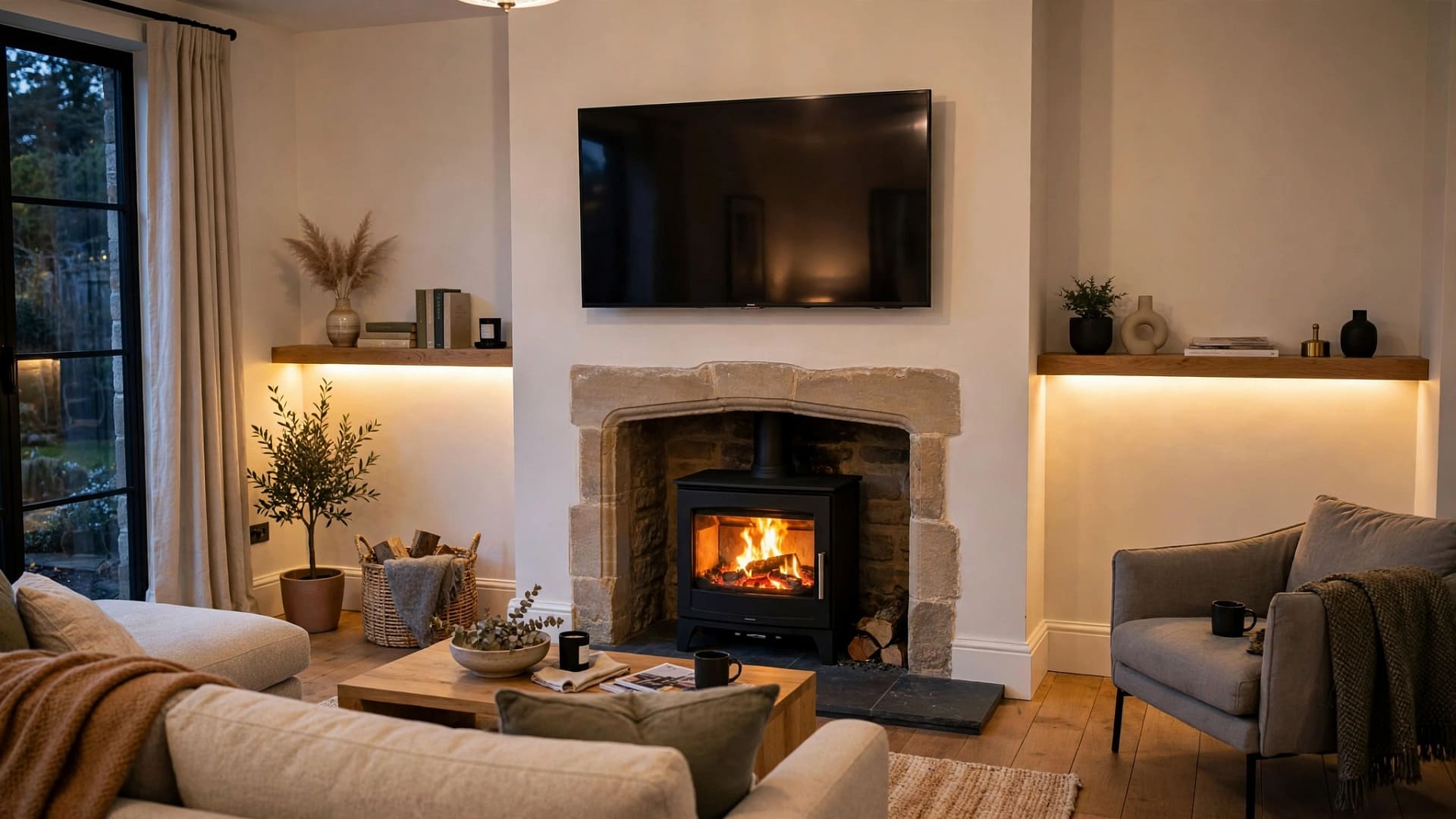
Visually, this creates a strong vertical focal point.
The TV can sit centrally above the stove, while the surrounding wall incorporates:
- Simple plastered finishes
- Stone
- Brick
- Large-format tiles
- Shelving
- Low storage
- Timber-effect details
The exact vertical relationship between the TV and stove should never be chosen purely for appearance.
The stove manufacturer’s instructions and required clearances must determine the safe arrangement.
2. Log Burner with a Traditional Chimney Breast
If the property already has a suitable chimney breast, you may be able to integrate the stove into a more traditional architectural feature.
This can work particularly well in:
- Victorian homes
- Edwardian properties
- Cottages
- Period terraces
- Homes with existing fireplaces
You can retain traditional features such as a stone or timber-style surround while adding a modern television above or beside the fireplace.
However, an existing chimney should not automatically be assumed to be suitable for a new stove.
The chimney and flue arrangement need to be assessed for the intended appliance.
3. Contemporary Log Burner Media Wall
A contemporary design can combine a compact stove with a clean, minimalist wall.
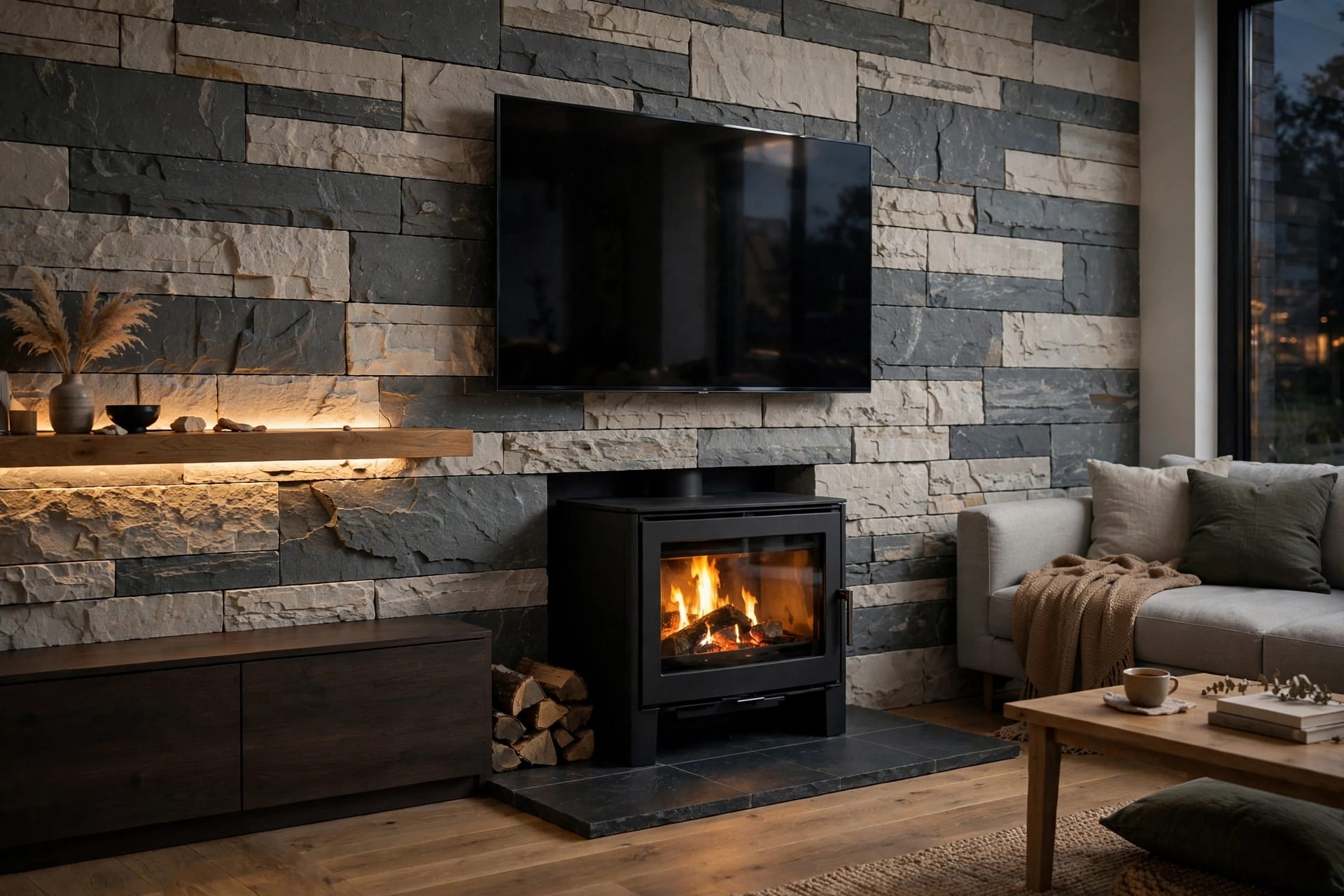
For example, the feature could use:
- A smooth plaster finish
- Large-format porcelain tiles
- Dark stone
- Minimal shelving
- A wall-mounted TV
- Hidden storage
- Simple lighting
The stove then becomes the main architectural feature without making the room look traditionally styled.
This approach can work especially well when the rest of the living room uses contemporary furniture and clean lines.
4. Log Burner Media Wall with Stone
Stone can create a natural visual connection with a wood-burning stove.
Possible finishes include:
- Slate
- Limestone
- Sandstone
- Stone-effect porcelain
- Brick slips
- Textured masonry finishes
The material needs to be suitable for the location and compatible with the stove installation.
Do not select a material simply because it looks heat-resistant. The appliance manufacturer, installer and relevant building requirements should determine what construction is appropriate around the stove.
5. Log Burner with a Brick Feature Wall
Exposed brick or brick slips can create a more rustic appearance.
A brick-effect finish works particularly well with:
- Black stoves
- Oak flooring
- Leather furniture
- Industrial interiors
- Traditional cottages
For a modern version, keep the surrounding cabinetry simple and let the brick section become the visual focus.
6. Log Burner Media Wall with Built-In Shelving
Shelving can balance a stove and TV combination, especially when the wall is wide.
For example, you could have:
Left: open shelving
Centre: TV and log burner
Right: closed storage or shelving
The important consideration is the location of combustible shelving and cabinetry.
Wood-based materials should not simply be installed close to a stove because they look attractive.
The required clearance depends on the appliance and installation, so the stove manufacturer’s instructions need to be followed.
7. Log Burner Beside the TV
The TV does not necessarily have to sit directly above the stove.
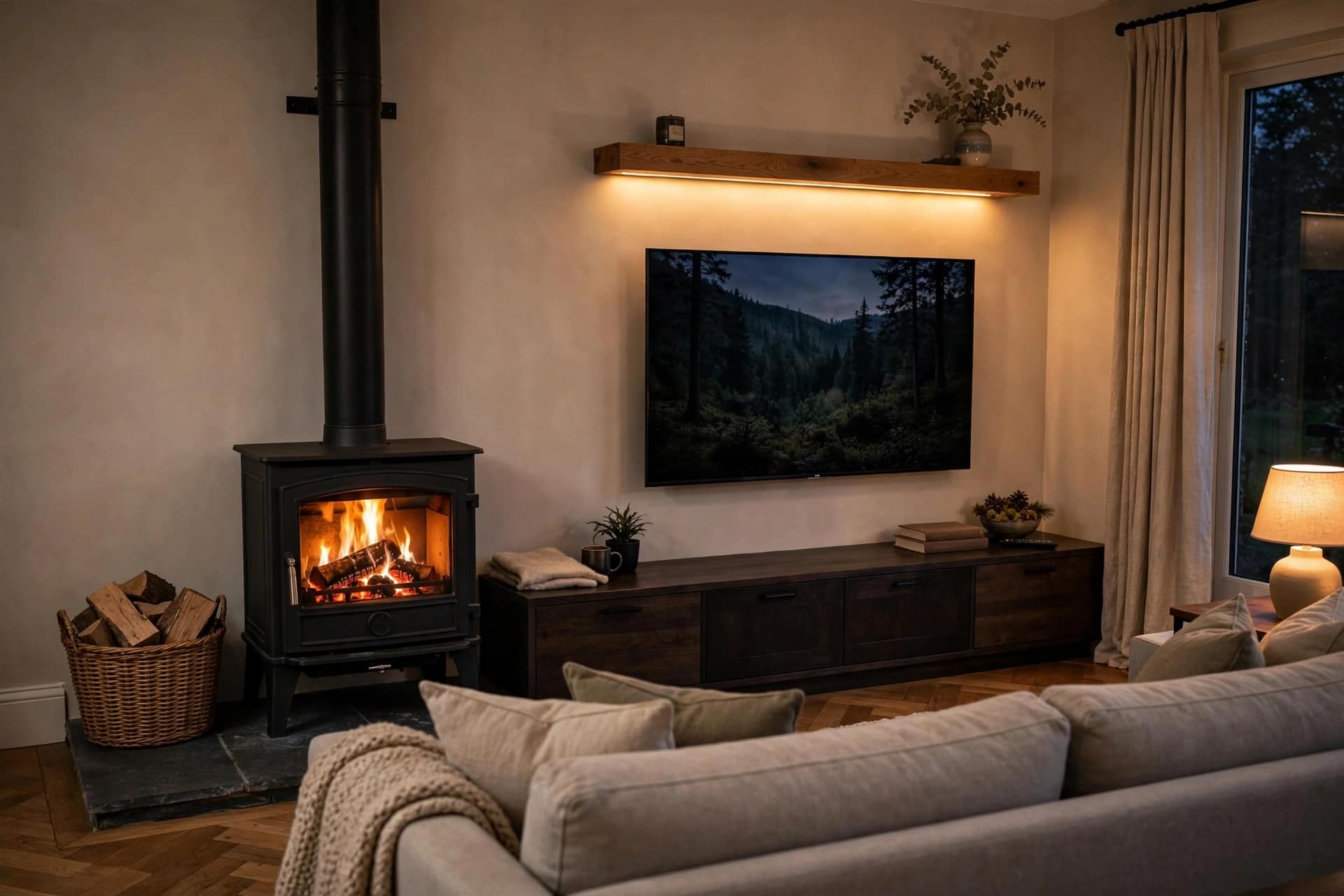
A side-by-side layout can sometimes provide a more flexible design.
For example:
- Stove on the left
- TV on the right
- Low storage connecting the two
This can also reduce the temptation to place the television directly above a heat source.
However, the layout still needs to account for viewing angles, furniture positioning and safe distances around the stove.
8. Log Burner Media Wall in a Small Living Room
A small room requires particularly careful planning.
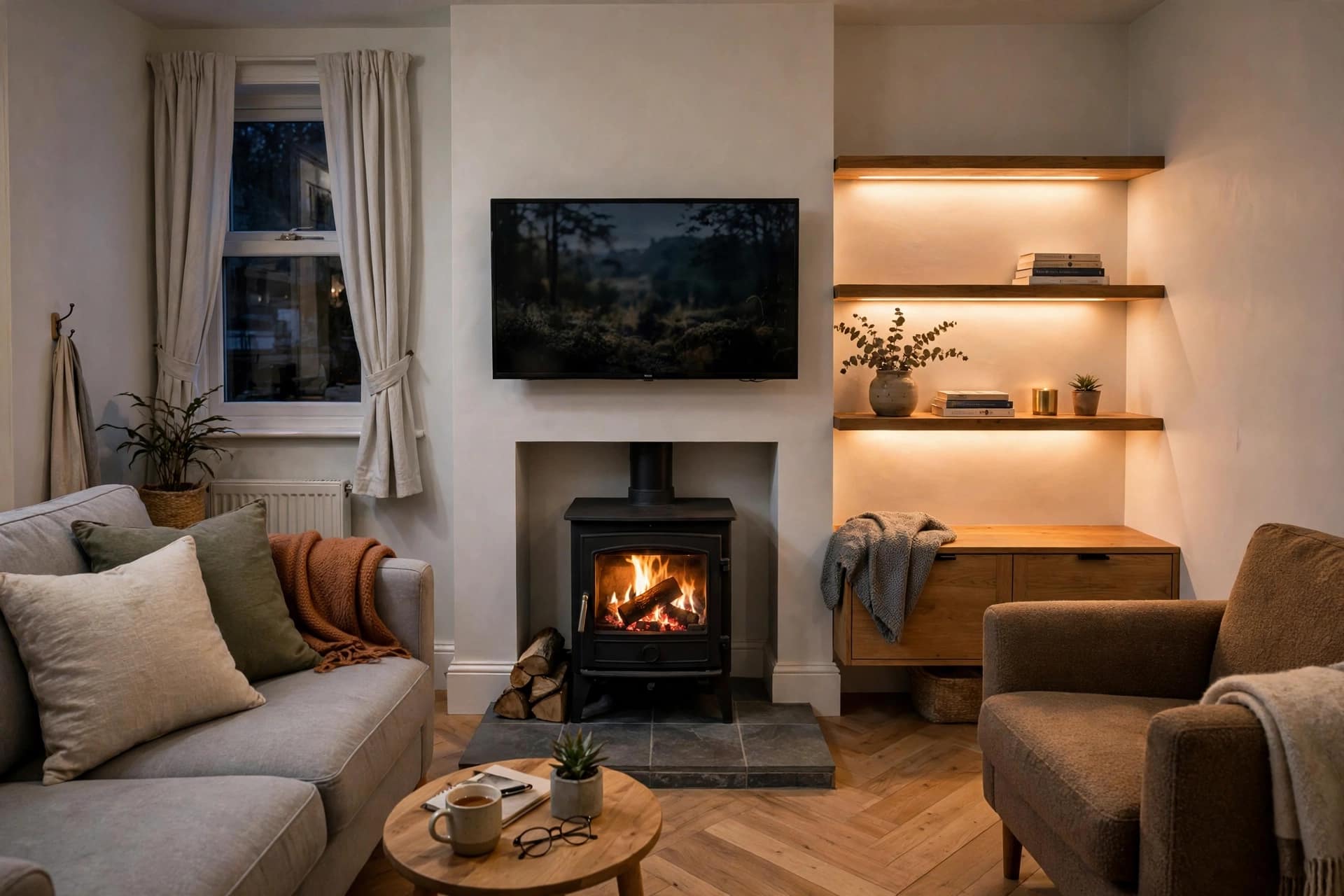
A stove, hearth and chimney structure can consume valuable floor and wall space.
Before building, consider:
- Stove footprint
- Hearth projection
- Flue route
- TV size
- Sofa position
- Door openings
- Walkways
- Storage depth
- Required clearances
A smaller stove does not automatically mean you can ignore clearance requirements.
If your room is compact, our Small Living Room Media Wall Ideas guide can help with the wider space-planning side of the project.
9. Log Burner Media Wall with a Traditional Hearth
The hearth is both a design feature and an important part of the installation.
A traditional design might use:
- Slate
- Stone
- Tiled hearth
- Brick
- Concrete-effect finishes
The hearth should be designed around the appliance and the applicable requirements rather than treated as a decorative platform added at the end.
GOV.UK’s Approved Document J provides guidance relating to hearths, fireplaces, flues and chimneys, including requirements intended to protect the building and surrounding furnishings from heat.
10. Minimalist Black Stove Media Wall
A black stove against a neutral wall can create a clean modern appearance.

Pairing it with:
- Warm white walls
- Natural oak
- Stone
- Light flooring
- Minimal shelving
can prevent the fireplace from making the room feel too dark.
The TV can then be visually integrated using a dark backing panel or simple painted wall.
11. Log Burner with Oak and Natural Materials
Wood tones can complement a log burner particularly well.
Oak-effect cabinets, natural timber shelving and neutral stone can create a warm interior without making the room look overly rustic.
However, timber and other combustible materials must be kept at the required distance from the stove and flue.
The design should therefore distinguish between the visual wood-effect zone and the heat-sensitive zone .
Can You Put a TV Above a Log Burner?
A TV can sometimes be positioned above a log burner, but it should never be assumed to be safe simply because the arrangement is common in photographs.
The actual installation depends on:
- Stove model
- Stove output
- Manufacturer clearances
- Flue configuration
- Chimney arrangement
- Wall construction
- Heat reaching the TV
- TV manufacturer’s requirements
Heat can damage electronics, cables and surrounding materials.
Before fixing the television, check both the stove manufacturer’s installation instructions and the TV manufacturer’s requirements.
For additional guidance on the general issue of positioning TVs above fireplaces, see our TV Above Fireplace Safety UK guide.
How Much Clearance Does a Log Burner Need?
There is no single clearance measurement that applies to every stove.
Required distances can vary according to:
- Stove design
- Heat output
- Installation type
- Flue arrangement
- Surrounding materials
- Manufacturer requirements
- Applicable building regulations
This is why copying a clearance measurement from another media wall can be dangerous.
The appliance manufacturer’s installation instructions should be checked for the exact model.
Where combustible materials are involved, the installation needs particular care.
What About the Chimney and Flue?
The flue is one of the biggest differences between a log burner media wall and an electric-fire media wall.
A wood-burning stove needs a suitable route for combustion gases.
Depending on the property, this may involve:
- An existing chimney
- A refurbished chimney
- A new insulated flue
- A twin-wall flue system
- A roof-level termination
The correct solution depends on the building and appliance.
Do not build the media wall first and attempt to work out the flue route afterwards.
The flue should be part of the initial design.
GOV.UK’s Approved Document J specifically covers the discharge of combustion products and provides guidance relating to flues and chimneys.
Can You Use an Existing Chimney?
Sometimes, yes.
An existing chimney may be suitable for a new stove installation, but it needs to be assessed for the intended appliance and flue requirements.
Factors can include:
- Chimney condition
- Flue dimensions
- Chimney height
- Previous use
- Lining requirements
- Appliance output
- Location
- Terminal arrangement
Never assume that because an old fireplace worked previously, the chimney is automatically suitable for a modern wood-burning stove.
For related planning considerations, our Planning Your Media Wall UK guide can help you organise the wider project.
Do You Need a Chimney for a Log Burner?
A conventional wood-burning stove needs an appropriate flue system to safely discharge combustion gases.
If a property does not have a usable masonry chimney, a suitable purpose-designed flue system may be possible depending on the building and appliance.
This is one of the reasons a log burner installation should be designed with a competent installer before construction begins.
A false chimney can hide part of the flue arrangement, but it does not remove the technical requirements of the appliance.
HETAS and Log Burner Installation
For UK homeowners, HETAS is an important name to understand when researching solid-fuel installations.
HETAS operates competent-person schemes for heating installations and provides certification and installer-related information for solid-fuel appliances.
When choosing an installer, check what certification and notification route applies to your particular project and location.
Do not select an installer solely because they have built attractive media walls.
A good media wall installer and a competent solid-fuel appliance installer are not necessarily the same specialist.
For a log burner project, the combustion appliance and flue installation should be treated as specialist work.
Log Burner Media Wall Materials
The materials around the stove deserve more attention than ordinary TV-wall construction.
Potential materials include:
Stone
Stone can create a traditional or contemporary appearance and is commonly associated with fireplace surrounds.
Slate
Slate provides a dark, natural finish that works particularly well with black stoves.
Porcelain tiles
Large-format porcelain can create a modern appearance while providing a practical surface, provided the chosen system is appropriate for the installation.
Brick
Brick can create a traditional or industrial character.
Plasterboard and decorative boards
These may be appropriate in parts of the media wall away from the heat zone, but their suitability should be determined by the actual construction and appliance requirements.
Timber
Timber can look excellent in a media wall but should not be placed where the appliance or flue exposes it to unacceptable heat.
The key principle is simple: do not choose materials around a log burner based on appearance alone.
Log Burner Media Wall Cable Management
The television side of the wall still needs proper cable planning.
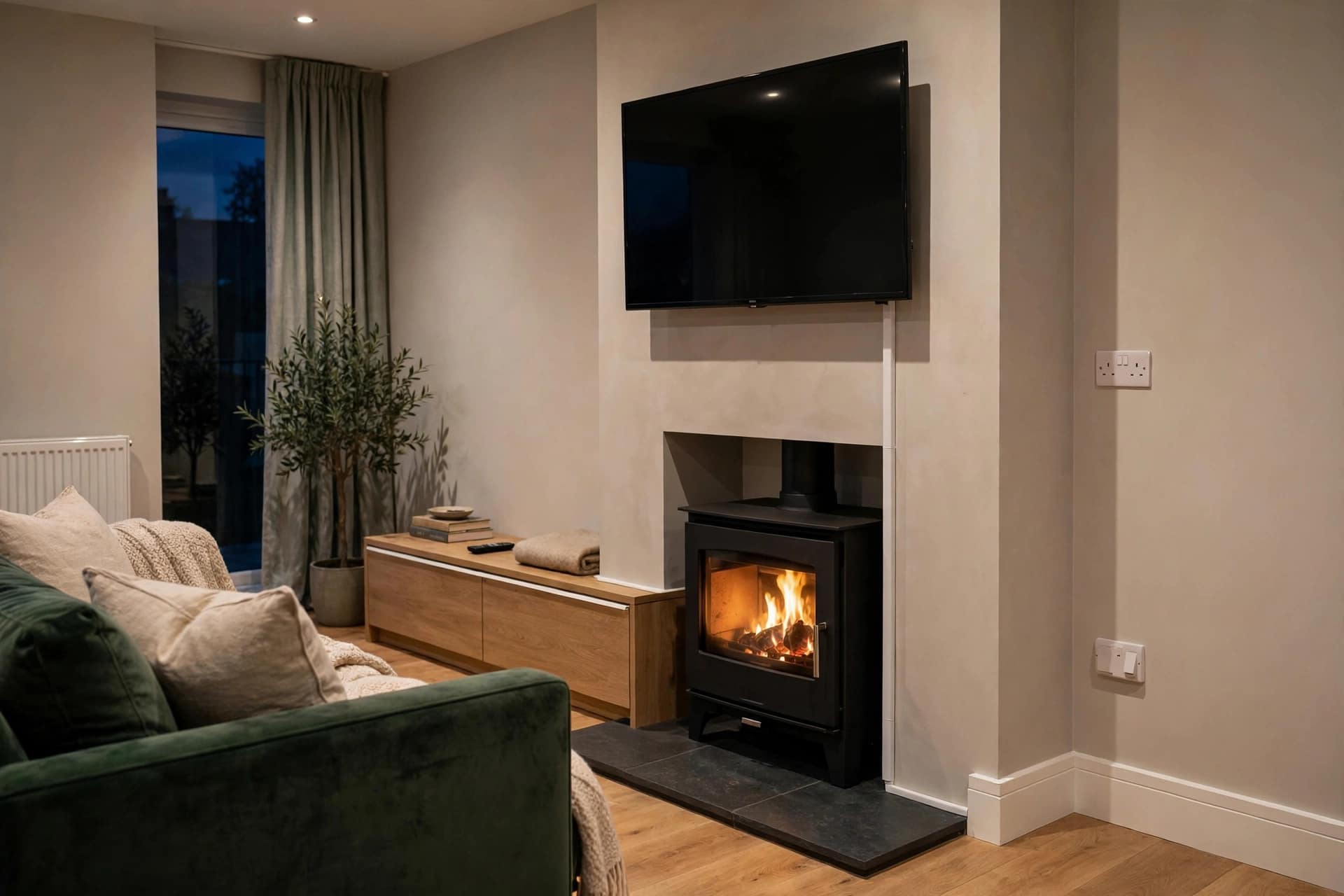
Think about:
- TV power
- HDMI cables
- Ethernet
- Soundbar cables
- Games consoles
- Streaming devices
- Aerial connections
Keep electrical cables and electronic equipment away from the heat-producing parts of the installation.
Our Media Wall Wiring & Cable Management UK guide covers the cable-management side in more detail.
Electrical work should also be planned properly rather than improvised after the wall is constructed.
Log Burner Media Wall Lighting
Lighting can make a fireplace media wall look excellent after dark.
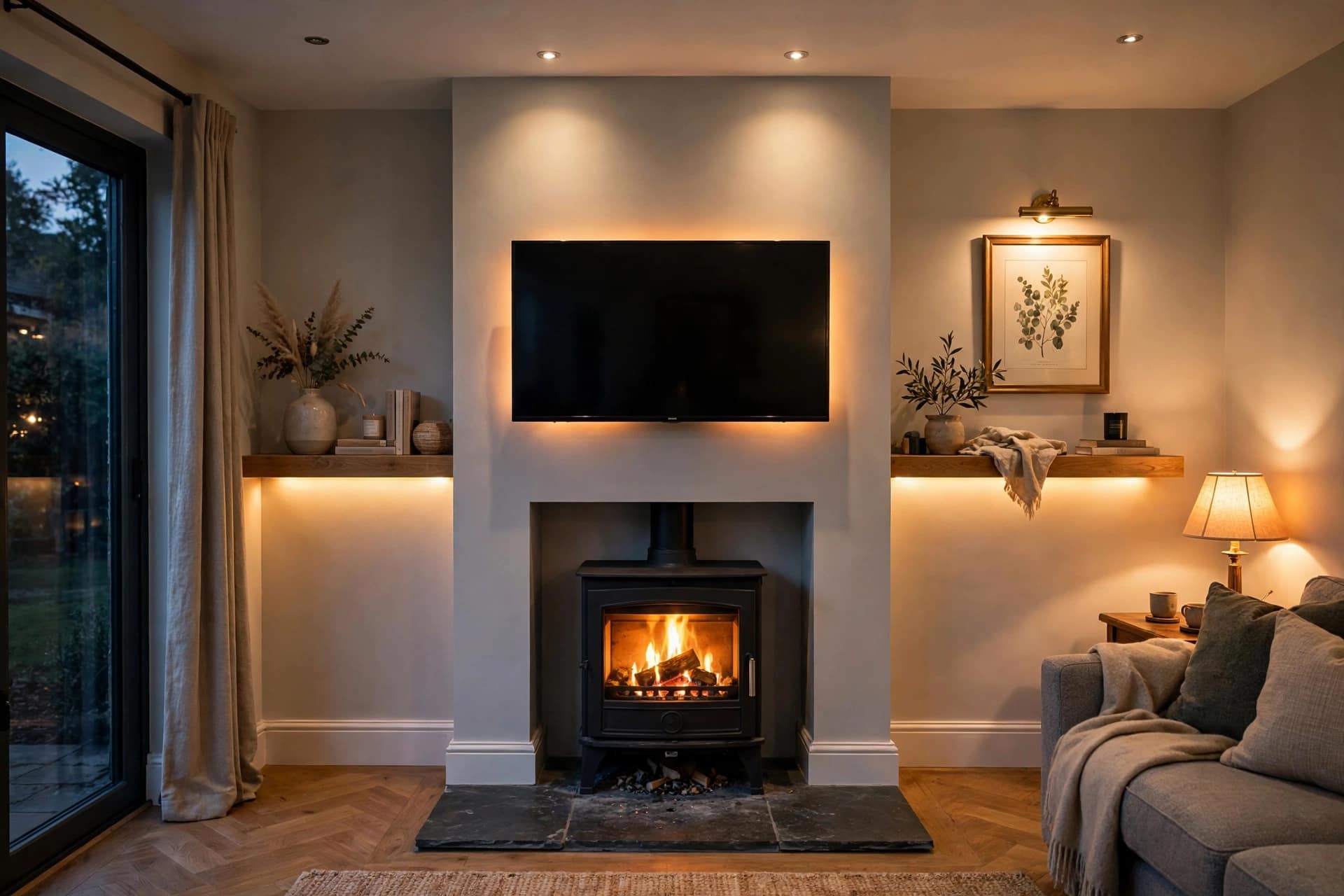
Useful options include:
- Warm LED shelf lighting
- Low-level cabinet lighting
- Wall-wash lighting
- Recessed lighting
- Subtle backlighting around the TV
Avoid positioning lights where they create distracting reflections on the screen.
With a real stove, the fire itself already provides visual warmth, so the lighting does not need to be overly bright.
Log Burner Media Wall Costs UK
The total cost can vary significantly because a log burner installation is more technically involved than a simple decorative media wall.
Your budget may need to cover:
- Stove
- Hearth
- Chimney or flue work
- Flue liner or twin-wall system where required
- Building work
- Non-combustible materials
- Media wall construction
- Electrical work
- TV mounting
- Storage
- Plastering
- Decorating
- Certification or notification requirements
A project using an existing suitable chimney can have a very different cost from a property requiring a completely new flue route.
For a broader breakdown of media wall pricing, see our Media Wall Cost UK .
What Makes a Log Burner Media Wall More Expensive?
The biggest cost differences usually come from the technical side rather than the TV wall itself.
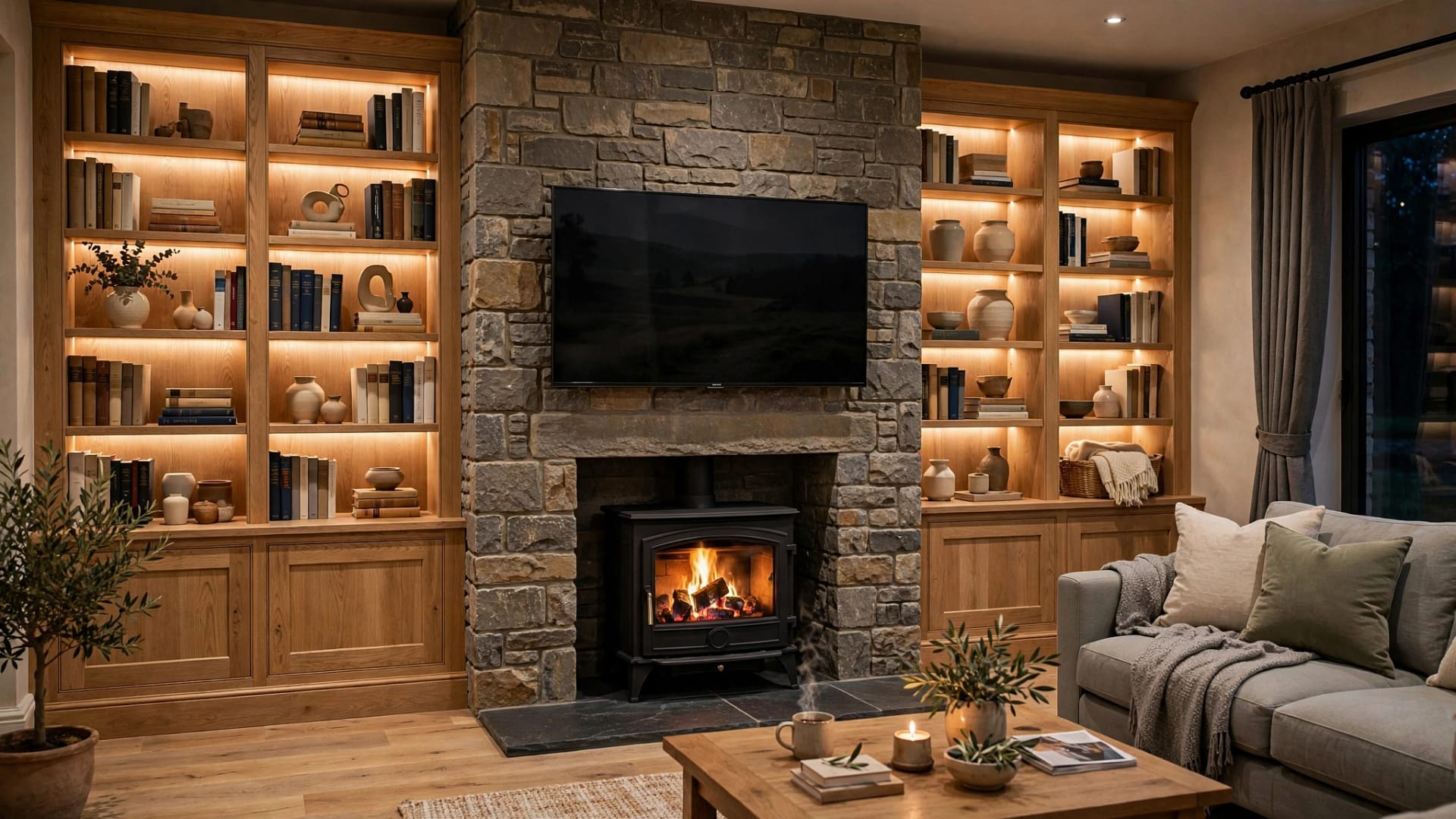
Costs can increase when you need:
- New flue installation
- Chimney alterations
- Chimney lining
- Roof-level work
- Structural modifications
- Premium stone
- Bespoke cabinetry
- Complex plastering
- Additional electrical work
- Specialist installation
This is why it is useful to establish the stove and flue requirements before obtaining a final media-wall quote.
Log Burner Media Wall vs Electric Fire Media Wall
The two designs can look similar, but the installation requirements are very different.
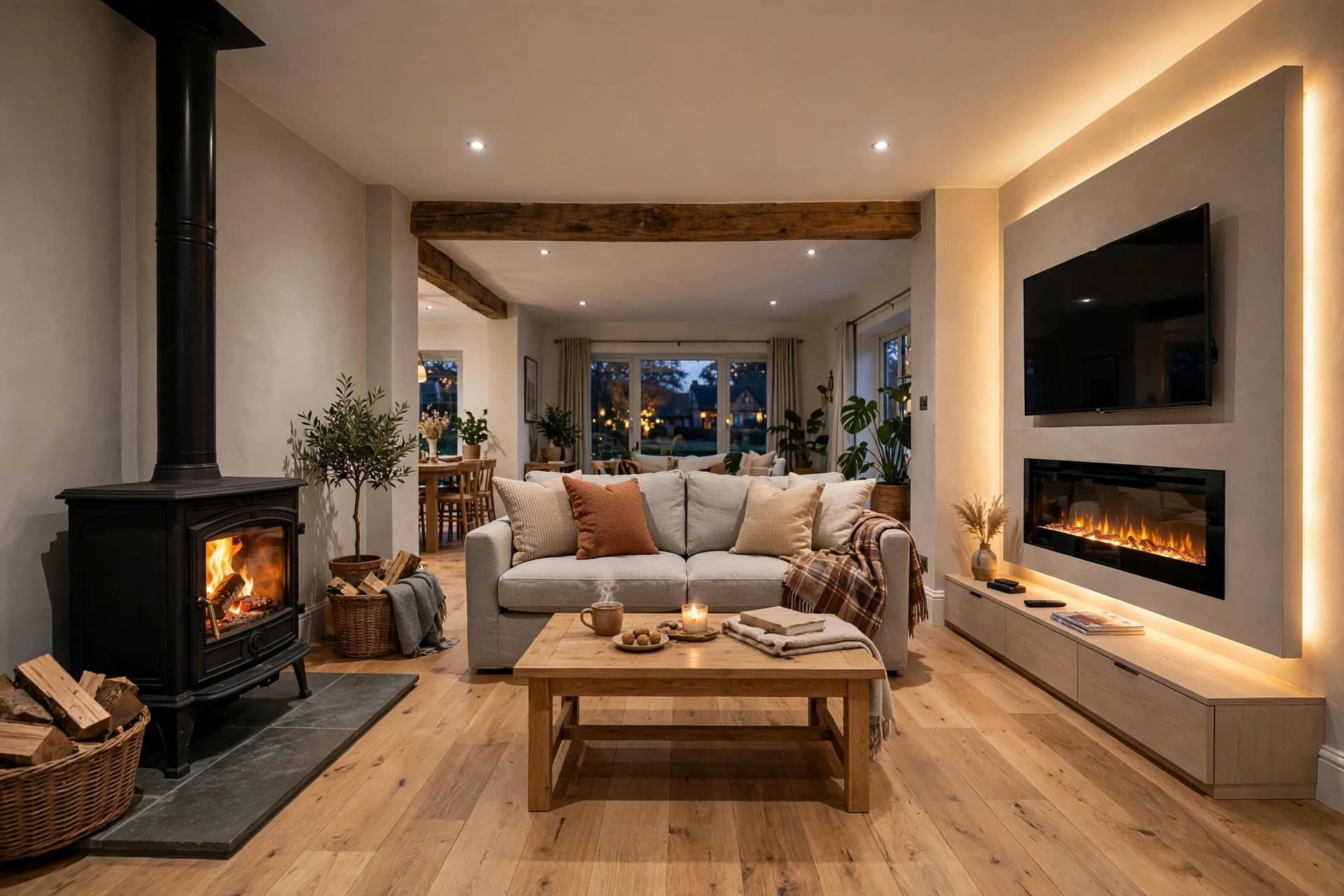
Log burner
- Burns real fuel
- Produces real heat
- Requires combustion-gas discharge
- Requires suitable flue/chimney arrangements
- Requires careful hearth and clearance planning
- Creates real flames and embers
- Needs fuel storage and regular maintenance
Electric fire
- Does not burn wood
- Does not produce combustion gases
- Usually has simpler installation requirements
- Can often be installed without a traditional chimney
- Offers flame effects without solid fuel
For electric-fire projects, see our Electric Fire for Media Wall UK guide when that page is live.
Carbon Monoxide Safety
A log burner is a fixed combustion appliance, so carbon monoxide safety needs to be taken seriously.
In England, Approved Document J covers carbon monoxide alarm provisions associated with combustion appliances. GOV.UK guidance states that the amended provisions came into effect on 1 October 2022.
For rented homes in England, GOV.UK also explains specific landlord requirements for carbon monoxide alarms in rooms containing fixed combustion appliances.
Use a suitable carbon monoxide alarm and follow the manufacturer’s installation instructions.
Log Burner Media Wall Safety Checklist
Before construction begins, check:
- Exact stove model selected
- Manufacturer installation instructions available
- Stove output confirmed
- Hearth requirements confirmed
- Required clearances confirmed
- Chimney assessed
- Flue route planned
- Flue system specified
- Combustible materials identified
- TV position checked
- TV manufacturer’s requirements checked
- Cable routes planned
- Electrical work planned
- Carbon monoxide alarm planned
- Suitable installer identified
- Building-regulation requirements checked
- Required certification/notification route confirmed
Common Log Burner Media Wall Mistakes
1. Building the media wall before choosing the stove
Different stoves have different dimensions and installation requirements.
2. Treating the flue as an afterthought
The flue needs to be part of the design from the beginning.
3. Copying clearances from another project
Clearances vary between appliances and installations.
4. Putting timber too close to the stove
Decorative timber may look attractive but can become a problem if it is positioned within an unsuitable heat zone.
5. Mounting the TV without checking heat
The television needs to remain within an acceptable temperature environment.
6. Assuming an existing chimney is suitable
The chimney needs to be assessed for the intended appliance.
7. Forgetting access for maintenance
The final media wall should allow appropriate access to components that may need inspection or servicing.
8. Choosing the installer based only on the media wall
A beautiful finish does not replace specialist knowledge of solid-fuel appliances and flues.
Do You Need Building Regulations Approval?
The exact requirements depend on the work being carried out and the property.
In England, Approved Document J provides statutory guidance for combustion appliances and fuel storage systems, including solid-fuel appliances, air supply, combustion-product discharge, hearths, fireplaces, flues and chimneys.
You can check the official GOV.UK Approved Document J Combustion Appliances and Fuel Storage Systems – Approved Document J before starting the project.
The wider GOV.UK Approved Documents Building Regulations and Approved Documents index is also useful because other parts of the Building Regulations may apply depending on the work being undertaken.
For projects outside England, check the relevant rules for Scotland, Wales or Northern Ireland rather than assuming English guidance applies.
Frequently Asked Questions
Can you have a log burner in a media wall?
Yes, a log burner can form part of a media wall, but the design must accommodate the stove’s hearth, clearances, heat, flue and ventilation requirements.
Can you put a TV above a log burner?
It can be possible, but the arrangement should only be used when the stove installation, heat levels, manufacturer requirements and TV requirements have been properly considered.
Does a log burner need a chimney?
A wood-burning stove needs a suitable flue system to discharge combustion products. This may involve an existing chimney or a purpose-designed flue system depending on the property.
Can I build a media wall around an existing log burner?
Potentially, but the existing stove and flue installation need to be considered before adding new cabinetry, panels or other materials.
What materials are best around a log burner?
Non-combustible materials such as suitable stone, slate or other appropriately specified materials are commonly considered around heat-producing areas, but the exact construction should follow the stove manufacturer’s requirements and applicable regulations.
How much does a log burner media wall cost?
There is no single price because the project can range from a relatively straightforward installation using an existing suitable chimney to a major build involving a new flue, chimney work, bespoke cabinetry and specialist materials.
Do I need a HETAS installer?
The appropriate certification and notification route depends on the installation and location. HETAS is an important UK competent-person scheme for solid-fuel heating work, so it is worth checking installer credentials and what certification your project requires.
Do log burners need a carbon monoxide alarm?
Carbon monoxide safety is an important part of solid-fuel appliance installation. In England, Approved Document J includes carbon monoxide alarm provisions for fixed combustion appliances.
Can I use normal MDF around a log burner?
Do not assume that ordinary MDF or other combustible boards are suitable close to a stove. The material and its distance from the appliance need to be assessed against the stove manufacturer’s installation requirements and the construction being used.
Final Thoughts
A log burner media wall can become one of the strongest features in a UK living room, combining the atmosphere of a real wood-burning stove with the clean appearance of a modern television installation.
But unlike an electric fireplace media wall, the design cannot be based on appearance alone.
Start with the stove, flue and hearth requirements . Then work out the TV position, wall construction, storage, materials, lighting and cable routes around them.
The safest approach is to involve the appropriate solid-fuel specialist before construction starts, rather than trying to adapt a finished media wall around a stove afterwards.
For a wider overview of fireplace media-wall designs, explore our Media Wall With Fireplace UK guide, then use the specialist planning information above to develop the log-burner part of the design.