
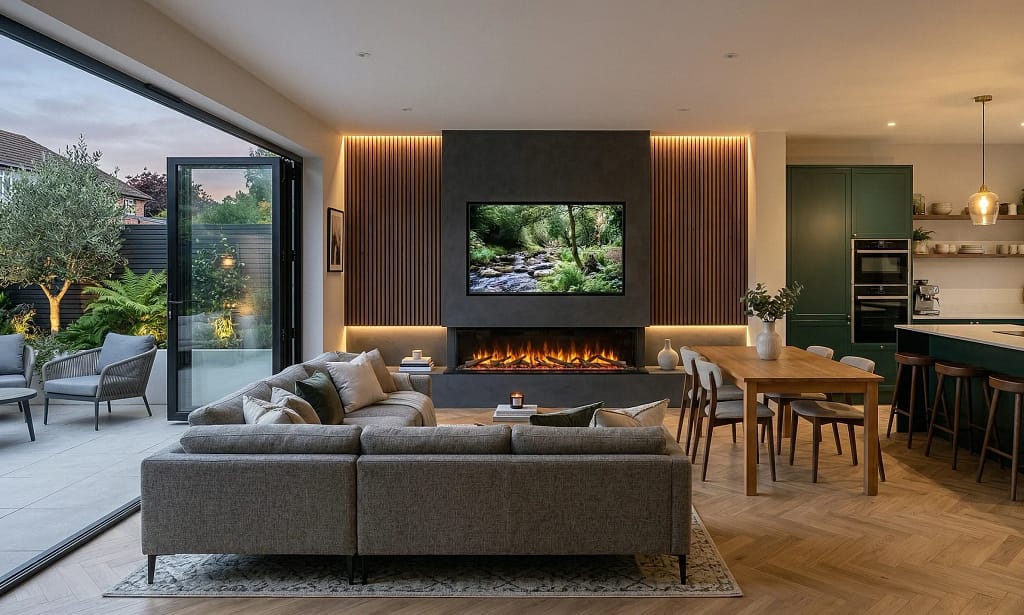
 An open plan media wall is a built-in entertainment structure designed to solve the TV placement, zoning, and acoustic challenges specific to combined kitchen-diner-living spaces.
Building one sounds straightforward until you are actually standing in the space. You have knocked the wall through, the kitchen-diner flows into the living area, it looks great — and then you realise there is nowhere obvious to put the TV.
An open plan space has fewer usable perimeter walls than a closed room, and the ones that exist are often the wrong ones — facing garden bifolds, sitting adjacent to the hob, or so far from the sofa that they create a different problem entirely.
This guide covers five types of open plan media wall, the TV placement rules that apply specifically to this layout, how to manage acoustics, and what everything costs in the UK in 2026. If you are still exploring styles and finishes, our full media wall ideas guide covers the broader picture — but if you know you need an open plan solution, this is where to start.
Key takeaways:
- Open plan spaces have five distinct media wall build options — each solves a different layout problem
- TV placement in open plan requires different rules to a standard room, including full-motion mounts and glare management from bifold doors
- A professional build with fireplace costs £4,500–£8,000 in the UK; any new electrical circuit must comply with Part P of the Building Regulations
Why open plan spaces make TV placement genuinely difficult
Most TV placement advice is written for a standard closed living room — four clear walls and an obvious screen wall directly opposite the sofa. Open plan kitchen-diners do not work like that, and applying standard advice to an open plan layout is where most of the problems begin.
The wall shortage problem: fewer perimeter walls means fewer options
When you remove an internal wall to create an open plan space, you gain light and flow. What you lose is a wall surface. In a typical rear extension kitchen-diner, the back wall is all glass. The side wall belongs to the kitchen zone. The only clear option is often the far internal wall — which forces the sofa to face directly away from the kitchen, disconnecting the cook from everyone else in the room.
This is not a styling problem. It is a structural one, and it needs a structural answer.
Sofa orientation vs kitchen sightlines: the impossible triangle
In a traditional living room, there is one audience and one screen. In an open plan kitchen-diner, the TV is being watched from three positions simultaneously: seated on the sofa, sitting at the dining table, and standing at the kitchen island.
No single fixed wall position satisfies all three without compromise. Getting this right requires choosing a build type specifically designed for the layout — not just picking the nearest available wall.

Bifold doors, afternoon sun and TV glare: a UK-specific problem
Most UK kitchen extensions built in the last decade include bifold or large sliding patio doors facing south or west. In the afternoon, direct sunlight floods through those doors and lands on the exact wall where a homeowner would naturally want to put the screen.
Anti-reflective coatings on modern TVs help at the margins — they are not designed for direct sunlight. The practical fix is to position the media wall perpendicular to the bifold doors rather than opposite them. If the layout makes that impossible, a full-motion swivel bracket lets the screen angle away from the light source during the worst hours without changing the seating arrangement.
The 5 types of open plan media wall — and which one fits your layout
Most articles treat a media wall as a single object. In an open plan space, there are five genuinely different build types, each solving a different version of the placement problem.

1. Perimeter wall build (the standard — and why it often fails in open plan)
The perimeter wall build sits against one of the room’s outer walls. It is the simplest structure, the fastest to build, and the least expensive. In the right layout — one where a clear, well-positioned outer wall exists away from windows and the kitchen zone — it works well.
In most open plan kitchen-diners, that wall does not exist in the right position. The back wall is glass. The kitchen wall is too close to steam and cooking smells. The remaining wall often puts the sofa in an orientation that cuts the cook off from the rest of the room.
If your open plan has a suitable perimeter wall, use it.
2. Chimney breast integration (the easiest win in period UK homes)
Victorian and Edwardian terraces — a large proportion of UK housing stock — almost always have a chimney breast in the back reception room. When that room becomes part of an open plan kitchen-diner, the chimney breast becomes a natural anchor for the media wall.
The chimney breast already projects into the room, giving you the depth needed to recess both a TV and an electric fireplace without building a new false wall from scratch. The alcoves on each side provide natural shelving zones that match the aesthetic of the original structure.
Check two things before starting. If the chimney breast is still active, it needs to be lined and capped by a HETAS-registered engineer. If any part of it has been previously removed, a structural engineer should assess what remains before additional weight is placed on the structure.

3. Peninsula or island media wall (the solution most people don’t consider)
If no perimeter wall works, stop looking for an existing wall and build one where the layout needs it. A peninsula media wall projects out from one side of the room rather than spanning its full width. It creates a TV-facing surface in exactly the position the layout requires.
The TV mounts on the outward face, pointing toward the sofa. The back face — toward the kitchen or dining zone — is finished with shelving, tiles, or panelling, so it looks finished from every angle. The structure typically stops below the ceiling, keeping the open feel and letting light pass over the top.
This build suits L-shaped or wide rectangular open plan spaces where the kitchen and living zones run side by side.

4. Double-sided divider wall (TV on one face, shelving or art on the other)
A double-sided media wall sits in the middle of the open plan space with the TV on the living room face and a decorative finish on the kitchen-diner face. This creates the clearest zone separation of all five options without physically closing the space off.
The living zone gets a defined focal point. The kitchen-diner does not have to look at the back of a TV unit. Both zones gain something from the same structure.
For this build to work structurally, the wall needs to be tied into the floor and ceiling and fixed to at least one perimeter wall or RSJ at the side. A structural engineer may be needed if the floor is timber and the wall is of significant weight. The electrical supply runs through the internal void with the TV connection on the living side and a secondary circuit available for lighting on the kitchen face if needed.

5. Floating partial wall (open feel preserved, placement problem solved)
A floating partial wall stops 600–900mm below the ceiling rather than running full height. It provides a TV mounting surface and creates a sense of zoning without blocking sight lines or natural light flow.
Because it does not reach the ceiling, it reads as an architectural feature rather than a room division. The gap above keeps the space feeling open and lets light move through freely.
The trade-off is reduced acoustic separation and less storage capacity than a full build. It suits spaces where the zones are physically far enough apart that noise and cooking smells are not a daily problem, and where the zoning is primarily visual.

TV placement rules every open plan kitchen-diner homeowner needs to know
Once the build type is chosen, four specific placement rules apply differently in open plan than in a standard room.
The 42-inch rule: correct TV height for seated viewing
The centre of the TV screen should sit at approximately 42 inches — 107cm — from the floor when measured to the screen’s midpoint. This puts it at natural eye level for an adult seated on a standard UK sofa.
The most common error in open plan builds is mounting the TV higher — often above a fireplace — to make it visible from the kitchen zone. Watching a screen at 60 to 70 inches from the floor for two hours causes measurable neck strain. A full-motion swivel bracket solves the multi-zone sightline problem without sacrificing seated viewing comfort.

Viewing distance by screen size
Open plan spaces are physically larger than closed rooms, and a screen that looked right in a showroom can look small once installed. As a working guide for the UK:
| Screen size | Minimum viewing distance | Minimum wall width |
| 55 inch | 2.0m | 1.3m |
| 65 inch | 2.4m | 1.6m |
| 75 inch | 2.8m | 1.9m |
| 85 inch | 3.2m | 2.2m |
If your open plan is on the compact side, our small living room media wall ideas guide covers shallow-depth builds and sizing strategies for tighter layouts.
Why you need a full-motion swivel mount in open plan — not a fixed bracket
A fixed bracket locks the screen into one angle. In an open plan space, you need to view the screen from at least two positions — seated on the sofa and standing at the kitchen island. A full-motion articulating mount covers both positions and adds minimal cost to the overall build.
For 75-inch or larger screens, reinforce the mounting zone with 18mm plywood behind the plasterboard before boarding up. A large TV pulling away from an under-specified mount is one of the most common and most avoidable media wall failures.
Can you see the TV from the kitchen island? Sightline planning explained
Before the stud frame goes up, stand at the hob and kitchen island position and trace a line to where the screen will be. The maximum comfortable viewing angle is 45 degrees from the screen’s centreline. Beyond that, picture quality on most LCD panels degrades and neck position becomes uncomfortable over a long cooking session.
If the sightline from the kitchen is beyond 45 degrees, a swivel bracket is the fix. If it is steeper than 60 degrees, relocating the kitchen island or reorienting the sofa may be a better long-term answer than compromising the build position.
The open plan acoustic problem — and how your media wall can fix it
This is the challenge that surprises most open plan homeowners more than anything else.
Why open plans echo and what causes it
A closed living room has four walls, a floor, and a ceiling. Those surfaces absorb sound, diffuse it, and contain it within the room. An open plan kitchen-diner has none of that.
Large glass bifold doors reflect sound back across the space. Hardwood or tiled floors — the standard choice in open plan extensions — are acoustically hard surfaces that amplify echo. The result is a room that reverberates significantly more than any individual material would suggest, making TV audio sound thin and hollow and raising ambient noise across the whole space.

Extractor fan vs TV volume: the noise competition nobody warns you about
This is the most widely reported complaint from UK open plan homeowners. An extractor fan running at full speed is typically rated at 60–70dB — effectively competing with a TV at normal volume, particularly at the distances involved in a large kitchen-diner.
Invest in an extractor fan rated below 40dB. Use a soundbar with directional audio rather than the TV’s built-in speakers. Position the seating zone as far from the kitchen as the layout allows.
Acoustic panel finishes on your media wall: how they work and what to specify
Integrating acoustic panels into the face of the media wall absorbs sound energy before it bounces off the hard kitchen surfaces behind the sofa. This is most effective when the media wall faces toward the kitchen zone, where most of the reflective surfaces are concentrated.
Acoustic wood slat panels — felt-backed MDF or timber slats — install directly over a standard plasterboard face and present a clean architectural finish that works with both contemporary and traditional kitchen aesthetics. The open slat structure absorbs mid and high frequencies, which are the ones that make speech intelligibility and TV audio difficult to follow.
For more pronounced treatment, acoustic plasterboard can replace standard plasterboard in the stud frame itself during the build — particularly worthwhile for a double-sided divider wall serving as a partial acoustic barrier between zones.

Soundbar placement in open plan spaces
A single soundbar below the TV works adequately in a closed room. In a large open plan space, it can struggle to fill the volume and compete with background kitchen noise.
For kitchen-diners above roughly 25 square metres, a soundbar with rear channel support delivers effective surround coverage without rear speaker cables. Systems including the Sonos Arc and Bose Smart Soundbar 900 support Dolby Atmos ceiling bounce, which suits open plan spaces where running physical cables to the rear wall is impractical.
Design and zoning: how to use the media wall to structure your open plan
A media wall in open plan is the primary architectural tool for defining the living zone — and done well, it makes the difference between a space that feels purposeful and one that feels like an undifferentiated large room.
The broken plan concept — and why UK designers now prefer it
“Open plan” has largely given way to “broken plan” in UK interior design. A broken plan space has the light and flow of open plan but uses partial walls, different floor levels, or architectural features to define each area without closing it off physically.
A peninsula build, a double-sided divider, or a floating partial wall each creates a visual anchor for the living zone that reads as a room within a room — without the disruption and cost of a full structural alteration.
Matching your media wall to the kitchen aesthetic
In an open plan space, every surface is visible from every other surface. The media wall’s materials, finishes, and colour need to work with the kitchen rather than against it.
The dominant shift in 2025–26 is away from grey and white toward warmer, richer tones. Deep green, charcoal, walnut veneer, and terracotta are appearing across both media wall and kitchen designs, often using the same tone across both surfaces to create visual continuity.
For a detailed breakdown of which finishes are performing best in UK open plan spaces right now, our media wall colour ideas guide covers the current shift alongside timeless options.

Lighting zones: warm dim living vs cool bright kitchen
The kitchen needs cool, bright task lighting — typically 4,000K colour temperature. The living zone needs warm, dim ambient light — typically 2,700–3,000K.
LED strips integrated into the media wall structure — behind the TV panel, inside alcoves, and beneath floating shelves — create a warm pool of light around the seating zone that signals a different space from the kitchen. Paired with dimmable downlights on a separate circuit in the living area, this achieves effective zoning through light alone.

Electric fireplaces in open plan: 1-sided, 2-sided and tunnel options
In an open plan space, a 2-sided or tunnel fireplace has a specific advantage over the standard single-face model — the flame is visible from both the living zone and the kitchen-diner simultaneously, reinforcing the sense of a shared hearth without two separate installations.
A tunnel fireplace suits a double-sided divider wall build particularly well. Running costs at full heat are approximately 40–60p per hour at current UK electricity rates. Flame-only mode costs a few pence.
What does an open plan media wall cost in the UK in 2026?
Cost breakdown: basic build to luxury bespoke
| Build type | DIY materials only | Professional installation |
| Basic perimeter wall, no fireplace | £700–£1,100 | £2,000–£3,000 |
| Perimeter wall with electric fireplace | £1,200–£2,000 | £3,500–£5,500 |
| Peninsula or island build | £1,400–£2,200 | £3,800–£6,000 |
| Double-sided divider wall | £1,600–£2,500 | £4,500–£7,500 |
| Luxury bespoke with stone or Venetian plaster | — | £6,000–£10,000+ |
Add £300–£600 for acoustic panel finishes. Add £200–£400 for electrical work if a new circuit or socket is required. Costs in London and the South East are typically 20–35% higher than in the Midlands and North.

DIY vs professional: when to hire and what to expect
The studwork, boarding, and basic finishing of a media wall is within reach of a confident DIYer. A straightforward perimeter wall build with no fireplace and no new electrical circuit can be completed in a long weekend.
The moment a fireplace enters the build, the calculation changes. A correctly recessed electric fire needs fire-rated plasterboard above the unit, correct ventilation gaps around the casing, and minimum clearance between the fire and the TV screen. Getting this wrong causes overheating.
For a double-sided or peninsula structure, a joiner familiar with open plan builds is worthwhile. The framing needs to be tied into the floor and ceiling correctly, and a poorly anchored freestanding media wall in a household with children is a safety risk.
UK building regulations: Part P electrics, fire-rated board, and structural checks
Adding a new socket or dedicated circuit falls under Approved Document P of the UK Building Regulations. This requires the work to be carried out by a registered electrician, or formally notified to local building control before it starts.
As the homeowner, legal responsibility for compliance sits with you, not the contractor. Electrical Safety First explains which tasks require a registered professional and what documentation — an Electrical Installation Certificate — you are legally entitled to receive on completion.
To find a Part P-compliant electrician, NICEIC’s registered electrician search lists government-approved contractors who can self-certify their own work, removing the need to separately notify building control.
If the build involves removing or modifying a loadbearing wall, structural engineer sign-off and building control notification are required before work starts. A media wall built on a non-loadbearing partition or as a freestanding peninsula does not trigger this requirement.
7 open plan media wall mistakes that are easy to avoid if you plan ahead

- Mounting the TV too high. Placing the screen above a fireplace at 70 inches from the floor is the most common error. Keep the screen centre at 107cm and use a full-motion mount to extend sightlines to the kitchen zone.
- Using a fixed wall bracket. A fixed mount locks you into one viewing position. A full-motion articulating bracket covers the sofa, dining table, and kitchen island with one installation at minimal extra cost.
- Ignoring glare until it is too late. Spend time at the proposed wall position in the afternoon before committing. Direct sunlight through bifold doors can make a screen unwatchable for two to three hours daily — something a morning site visit will not reveal.
- Building too close to the cooking zone. Within 1.5 metres of the hob, grease particles and steam reach the screen and wall cavity. Use moisture-resistant plasterboard for any build within two metres of the kitchen zone.
- Not planning cable access. Once the wall is plastered, changes are expensive. Include a brush plate access panel or conduit routed to a service cupboard so future upgrades do not require opening the wall.
- Skipping acoustic planning. A flat plasterboard face does nothing for the reverb open plan spaces generate. Acoustic panel finishes cost little extra and make a measurable difference to everyday TV watching.
- Building the TV recess for today’s screen size. Build the recess 100–150mm wider than your current TV. A cavity sized for a 65-inch screen will not take the 75-inch model you will want in a few years without opening the wall.
An open plan media wall is a different problem that needs a different approach from the start. Get the build type right for your layout, plan the acoustics before the stud frame goes up, and make sure the electrical work is signed off properly. Do those three things and the result is a space that works as well in real daily life as it looks on day one.
Frequently asked questions
Where should I put the TV in an open plan kitchen-diner?
Start with your primary seating position and work backwards. The best wall is usually perpendicular to the bifold or patio doors to avoid afternoon glare. If no suitable perimeter wall exists, a peninsula or island build positioned in the room itself is the cleanest solution.
Can a TV near the kitchen in an open plan room get damaged?
Yes if it is too close. Grease particles build up on screens over time without strong extraction. Keep the media wall at least 1.5 metres from the hob and use moisture-resistant plasterboard within two metres of the kitchen zone.
Does a media wall need planning permission in the UK?
No. It is an internal alteration. However, any new electrical circuit must comply with Part P of the Building Regulations and be carried out by a registered electrician. Removing a loadbearing wall requires structural engineer sign-off and building control notification.
How do you deal with extractor fan noise when watching TV in an open plan room?
Use an extractor rated below 40dB, a soundbar with directional audio, and position the sofa as far from the kitchen as the layout allows. Acoustic panel finishes on the media wall face also absorb background kitchen noise before it reaches the listening position.
Can a media wall work as a room divider in an open plan space?
Yes — a double-sided build gives you the TV on the living room face and shelving on the kitchen face. A floating partial wall zones the space visually while keeping sightlines and light open. Both are core to the broken plan approach UK designers now consistently recommend.