
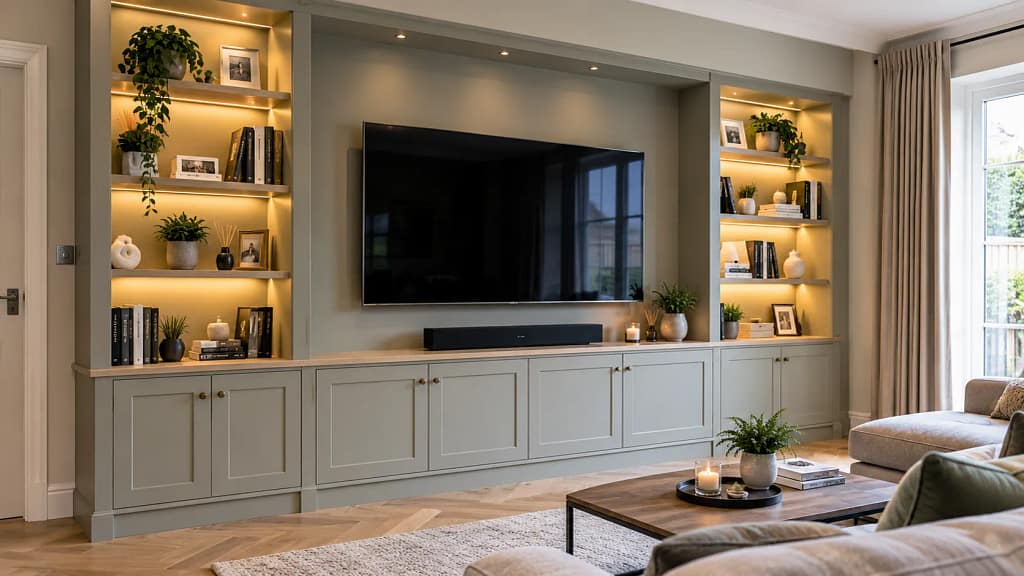
What Is the Best TV Wall Idea for a UK Living Room?
Quick Answer
A TV wall can make your living room look neat, stylish and organised.You can keep it simple with a wall-mounted TV, or add panelling, shelves or storage.For small rooms, choose a simple design that saves space.For a bigger or more modern room, a built-in TV wall can create a stronger feature.
The best TV wall design depends on your room size, property style, budget and storage requirements.
- For a small living room , choose a slim wall-mounted TV with concealed cables and shallow furniture.
- For a modern home , consider painted panelling, a floating TV unit or a streamlined media wall.
- For a traditional property , use built-in cabinetry, alcove shelving or a chimney-breast design.
- For extra storage , combine the television with cupboards, bookshelves or fitted joinery.
- For a luxury finish , use a full-width TV wall with integrated lighting and concealed equipment.
- For a budget-friendly update , paint the wall, hide the cables and add one well-proportioned shelf or console.
- If you want to include a fireplace , plan the TV position, heat protection and electrical work before installation.
A well-designed TV wall should balance comfortable viewing, practical storage and visual proportion . The screen should not be mounted so high that you have to tilt your head upwards, and the surrounding wall should not feel overcrowded.
Stylish Designs for Every Home
A television is often the most-used feature in a living room, but it is not always the easiest element to incorporate into your interior design. A large black screen can dominate a small lounge, compete with a period fireplace or make an otherwise carefully decorated room feel unfinished.
The good news is that a TV wall does not need to be complicated or expensive. With the right combination of positioning, colour, storage, lighting and materials, your television can become a considered part of the room rather than an unwanted focal point.
From simple wall-mounted televisions and painted feature walls to built-in storage, panelling and media walls with fireplaces, these living room TV wall ideas UK homeowners can use in flats, new-builds, Victorian terraces, semi-detached houses and larger open-plan spaces.
Living Room TV Wall Ideas UK Homeowners Can Try
1. Simple Wall-Mounted TV on a Painted Wall
The simplest TV wall idea is often the most effective. Mount the television directly onto a clean painted wall and keep the surrounding area uncluttered.

This works particularly well when:
- The room is small.
- You prefer a minimalist interior.
- You already have attractive furniture elsewhere.
- You do not need extensive storage.
- You want to avoid building a full media wall.
Choose a warm neutral such as soft white, beige, taupe or light greige for a calm appearance. If the television looks too stark against the wall, use a deeper shade such as charcoal, navy or muted green to help the screen blend into the background.
The important detail is cable management. A wall-mounted TV with visible wires can look less finished than a television sitting on a simple stand. Electrical Safety First’s TV safety guidance also recommends following the manufacturer’s installation instructions and keeping equipment away from excessive heat or moisture.
2. Dark TV Feature Wall
A dark feature wall can make a television look more intentional. Charcoal, deep green, navy and warm brown are particularly effective because the black screen blends into the darker background when the TV is switched off.
This approach is suitable for:
- Contemporary living rooms.
- Open-plan spaces.
- Rooms with pale sofas and natural timber.
- Homes with strong daylight.
- Larger televisions that might otherwise dominate the wall.
Avoid choosing a dark colour only because it is fashionable. Test paint samples in both daylight and artificial light, as the same colour can look very different in a north-facing room compared with a bright south-facing room.
For a more cohesive result, repeat the wall colour in cushions, curtains, artwork or a rug.
3. TV Wall with Vertical Slatted Panelling
Vertical slatted panelling adds texture and makes the wall feel taller. It is a popular choice for modern UK interiors because it creates architectural interest without requiring a complicated layout.
You can use:
- Natural oak-effect slats.
- Painted MDF panels.
- Dark walnut tones.
- Acoustic wood panels.
- Narrow vertical battens.
- Slatted panels behind only the television.
Vertical lines are particularly useful in rooms with low ceilings. They draw the eye upwards and can make the wall feel more substantial.
Keep the rest of the room relatively calm. If the wall already has strong texture, avoid combining it with too many patterned furnishings.
4. Painted Panelled TV Wall
Traditional wall panelling is ideal for homeowners who want a more classic finish. Picture-frame moulding, shaker-style panels and simple rectangular mouldings can make a television feel more integrated into a period property.

This style works especially well in:
- Victorian terraces.
- Edwardian houses.
- Georgian-inspired interiors.
- Cottage-style living rooms.
- Homes with original fireplaces and ceiling details.
Paint the panelling in the same colour as the wall for a subtle effect, or use a slightly darker shade to create depth.
For a modern interpretation, use simple large panels rather than many small decorative sections. This prevents the wall from becoming visually busy around the screen.
5. TV Wall with a Floating Console
A floating TV unit creates a clean, contemporary appearance. Because the furniture is raised from the floor, more of the flooring remains visible, making the room feel lighter and easier to clean.
A floating console can conceal:
- Streaming boxes.
- Games consoles.
- Remote controls.
- Broadband equipment.
- DVD or Blu-ray players.
- Extra cables and chargers.
Choose a unit that is wide enough to balance the television. A very narrow console beneath a large screen can make the entire wall look top-heavy.
Allow ventilation around electronic equipment and ensure that doors or panels do not block remote-control signals.
6. TV Wall with a Low-Level Cabinet
A low-level cabinet is a practical alternative to a floating unit. It provides storage while keeping the television at a comfortable height.
This is a good choice when:
- You have children and need closed storage.
- You prefer a relaxed, furniture-led look.
- The television is not very large.
- You want to avoid a floor-to-ceiling installation.
- You live in a rented property and cannot make major alterations.
Choose a cabinet with a simple front, such as slab doors, shaker doors or push-to-open panels. Avoid placing too many ornaments directly beneath the screen, as this can make the wall look cluttered.
7. Full-Width Built-In TV Wall
A full-width built-in TV wall can transform a blank living room into a cohesive architectural feature. The design may include the television, closed cupboards, open shelves, lighting and decorative panels.
This is particularly effective in larger rooms where a small TV unit would look lost.

A full-width design can provide space for:
- Books.
- Board games.
- Toys.
- Speakers.
- Decorative objects.
- Media equipment.
- Household storage.
However, built-in furniture needs careful planning. Include access panels, ventilation and removable sections so that future repairs or television upgrades do not require the entire wall to be dismantled.
For more inspiration, explore our guide to media wall ideas .
8. TV Wall with Open Shelving
Open shelves can soften the appearance of a television and give the eye other details to focus on.
Use shelves to display:
- Books.
- Framed photographs.
- Ceramics.
- Plants.
- Artwork.
- Baskets.
- Small lamps.
The key is to avoid filling every shelf. Leave some empty space so the arrangement feels considered rather than crowded.
If the TV wall is narrow, one shelf above or below the screen may be enough. In a larger room, shelves on both sides can create a balanced composition.
9. TV Wall with Closed Storage
Closed storage is often the better choice for busy family living rooms. It hides visual clutter and keeps the TV wall looking calm.
Consider closed cupboards for equipment that you do not want on display, while using one or two open sections for decorative items.
A combination of open and closed storage is usually more flexible than either option alone. Open shelves add character, while cupboards hide the everyday items that can make a living room look untidy.
10. TV Wall with a Fireplace
A TV wall with a fireplace is one of the most popular modern living room layouts. An electric fire can create a focal point while providing warmth and atmosphere without the need for a traditional chimney.
However, the design must be planned carefully. The fireplace, television, wall construction and ventilation requirements all need to work together.

Before choosing this layout, consider:
- The manufacturer’s required clearances.
- The heat produced by the fire.
- The height of the television.
- Access to cables and sockets.
- Ventilation for media equipment.
- Whether the wall needs a suitable non-combustible finish.
Read our guide to the media wall with fireplace before making a final decision.
11. TV Above an Electric Fire
Mounting the TV above an electric fire can create a symmetrical arrangement, but it is not automatically suitable for every appliance or room.
The television should not be positioned too high simply to make the layout look balanced. Comfortable viewing should remain the priority.
Always follow the fireplace manufacturer’s instructions. Heat can damage sensitive electronics, and the required clearance can vary between models. A professional installer should confirm whether the proposed arrangement is safe.
For more detailed planning, see our guide to TV-above-fireplace safety guide .
12. TV Wall with a Chimney Breast
A chimney breast can provide a natural location for a television, particularly in Victorian and Edwardian properties.
There are several ways to use the existing structure:
- Mount the TV directly onto the chimney breast.
- Build shallow shelving into the alcoves.
- Add a low cabinet beneath the screen.
- Use a painted panelled finish.
- Create a bespoke media wall around the chimney breast.
Check the condition of the wall before mounting a heavy television. Older properties may have uneven plaster, hidden flues or masonry that requires specialist fixings.
If you are working around a chimney breast, explore our guide to alcove media wall ideas .
13. TV Wall with Alcove Shelving
Alcoves beside a chimney breast are useful for creating a balanced TV wall. You can place the television centrally and use the alcoves for storage or decoration.

Built-in shelves can be painted in the same colour as the wall for a seamless appearance. Alternatively, use contrasting cabinetry to make the alcoves a stronger feature.
This layout works well in traditional homes because it respects the room’s existing architecture rather than trying to hide it.
14. TV Wall in a Small Living Room
Small living rooms require careful proportion. A large media wall can reduce usable floor space and make the room feel enclosed.
For a compact space:
- Mount the TV directly onto the wall.
- Use shallow furniture.
- Choose a wall-mounted console.
- Avoid deep shelving.
- Keep the area beneath the screen uncluttered.
- Use one consistent colour across the wall.
- Consider a corner layout if the main wall is unsuitable.
A slim TV wall can look more sophisticated than a large built-in structure that overwhelms the room.
For more ideas, read our guide to small living room media wall ideas .
15. Corner TV Wall
A corner TV wall can solve difficult layouts where the main wall is interrupted by windows, doors or a fireplace.
A corner installation can work well in:
- Narrow terraces.
- Open-plan rooms.
- Small flats.
- Living rooms with multiple doorways.
- Rooms where the sofa faces diagonally.
Use a corner cabinet or a bespoke angled unit to avoid leaving awkward gaps behind the television.
Make sure the viewing angle works from the main seating position. A corner TV should not require everyone to twist their necks to watch it.
16. TV Wall Next to a Door
A television positioned next to a door can be practical, but the design needs to protect the room’s circulation route.

Avoid placing bulky furniture where it narrows the doorway or creates a trip hazard. A shallow wall-mounted unit may be more suitable than a deep cabinet.
If the door opens towards the TV wall, check that handles and furniture do not collide. The television should also be positioned far enough from the opening to avoid accidental impact.
17. TV Wall with a Gallery Arrangement
A gallery wall can make the television feel like one element within a larger collection.
Use a mixture of:
- Framed artwork.
- Family photographs.
- Small prints.
- Mirrors.
- Decorative objects.
- Wall-mounted shelves.
The arrangement should be planned around the size and shape of the screen. Avoid placing fragile or heavy objects directly above the television.
A gallery wall is best suited to rooms with a relaxed, collected style. In a minimalist room, a single large artwork may be more effective.
18. TV Hidden Behind Artwork
If you do not want the television to be visible when it is not in use, consider concealing it behind artwork or a sliding panel.
Possible solutions include:
- Sliding artwork.
- Folding panels.
- A cabinet door.
- A framed television.
- A bespoke hinged panel.
- A decorative screen.
This approach is more expensive than a simple wall mount, but it can be worthwhile in formal sitting rooms or open-plan spaces where the TV competes with other features.
Make sure the design allows ventilation and easy access to the television.
19. TV Wall with a Frame-Style Television
A frame-style television is designed to resemble artwork when it is not being used. It can be particularly effective in traditional or design-led living rooms where a black screen would look out of place.

Use a suitable frame and display artwork that complements the room’s colour palette.
This option works best when:
- The television is positioned at a comfortable height.
- The surrounding wall is not overly busy.
- The artwork is changed occasionally.
- Cables are fully concealed.
- The screen is not exposed to excessive glare.
20. TV Wall with Exposed Brick
Exposed brick can create an industrial or rustic TV wall. It is particularly suitable for loft apartments, converted buildings and contemporary homes with natural materials.
However, real brick is not always practical. Removing plaster can reveal damaged or uneven masonry, and older brickwork may require repair or sealing.
If you want the appearance without major building work, consider:
- Brick slips.
- Brick-effect tiles.
- Textured wallpaper.
- Brick-effect panels.
- Painted faux-brick finishes.
Keep the rest of the wall design simple so the brick remains the main feature.
21. TV Wall with Timber
Timber brings warmth and texture to a TV wall. Oak, walnut and smoked wood finishes can work with both contemporary and traditional furniture.
Timber can be used as:
- A full wall covering.
- A narrow panel behind the television.
- A floating shelf.
- A cabinet finish.
- A slatted feature.
- A frame around the screen.
Natural wood works particularly well with cream, beige, olive, charcoal and soft blue interiors.
If using real timber, consider how the colour may change over time and whether the finish is suitable for the room’s light levels.
22. TV Wall with Colour Drenching
Colour drenching means using one colour across several surfaces, such as the wall, woodwork, shelving and cabinetry.

This can make a TV wall feel more integrated because the television becomes part of a single visual composition.
Good colour-drenching choices include:
- Warm white.
- Mushroom.
- Deep green.
- Dusty blue.
- Clay.
- Muted brown.
- Soft black.
- Rich navy.
A consistent colour scheme is especially useful when the wall includes multiple materials or storage sections.
For more colour inspiration, see our guide to media wall colours .
23. TV Wall with Soft Neutral Colours
If you want a calm and timeless living room, use neutral colours around the television.
Suitable shades include:
- Cream.
- Stone.
- Oatmeal.
- Greige.
- Mushroom.
- Warm beige.
- Soft taupe.
Avoid choosing a cold grey simply because it is neutral. Some grey tones can make a room feel flat or chilly, particularly in north-facing UK rooms.
Add warmth through timber, woven baskets, linen curtains, wool rugs and soft lighting.
24. TV Wall with LED Lighting
Integrated lighting can make a TV wall feel more luxurious, especially in the evening.
Popular options include:
- LED strips beneath shelves.
- Backlighting behind the TV.
- Recessed shelf lighting.
- Low-level cabinet lighting.
- Vertical lighting channels.
- Dimmable wall lights.
Use warm white lighting rather than an overly blue tone. The lighting should support the room’s atmosphere without creating glare on the screen.
Lighting should be installed with access for future maintenance. Avoid sealing LED drivers or transformers inside inaccessible cavities.
25. TV Wall with a Soundbar
A soundbar can be incorporated beneath the television, inside a low cabinet or within a purpose-built recess. If you are planning the layout around one, see our guide to soundbar placement on a media wall .

The soundbar should not be hidden behind a solid cupboard door unless the manufacturer confirms that the sound will not be affected.
Allow enough space for:
- The soundbar.
- Power cables.
- HDMI connections.
- Ventilation.
- Remote-control access.
- Future equipment upgrades.
If you are designing a built-in wall, decide where the soundbar will go before the joinery is made.
26. TV Wall Without a Media Wall
You do not need a full media wall to create an attractive TV area.
A simple TV wall can include:
- A painted background.
- A wall-mounted television.
- One floating shelf.
- A low cabinet.
- A framed print.
- A pair of wall lights.
- Concealed cables.
This is often the best option for renters, smaller rooms and homeowners who want to avoid a major renovation.
A TV wall and a media wall are not the same thing. A TV wall may simply be a designed area around the television, while a media wall usually incorporates additional construction, storage, lighting or a fireplace.
Read media wall ideas if you are unsure which approach is right for your room.
27. TV Wall with a False Wall
A false wall can conceal cables, create a recessed television and provide space for lighting or storage.
It may be useful when:
- The existing wall is uneven.
- You want to hide cables without chasing into masonry.
- You need space for a soundbar.
- You want a built-in appearance.
- You are creating a fireplace feature.
- The television needs to sit within a larger design.
A false wall does take up floor space, so it should be carefully measured in small rooms. It must also be constructed securely and leave suitable access for wiring and equipment.
28. TV Wall with a Traditional Fireplace
A traditional fireplace can remain the main architectural feature while the television is positioned elsewhere on the wall or within an adjacent built-in unit.

This is often more comfortable than mounting the TV directly above a high fireplace.
Possible layouts include:
- TV in one alcove.
- TV on a side wall.
- TV inside fitted cabinetry.
- TV on a low unit opposite the fireplace.
- TV concealed behind artwork.
- Fireplace and TV balanced within a full-width joinery design.
This approach is ideal for period homes where preserving the character of the fireplace is important.
29. TV Wall in a New-Build Home
New-build living rooms often have clean walls, open layouts and fewer architectural details. A TV wall can add character without making the room feel traditional.
Good options include:
- Simple painted panelling.
- A floating console.
- Vertical slats.
- A full-width storage unit.
- A dark feature wall.
- A minimal fireplace-free media wall.
Keep the design proportional to the room. In many new-builds, a full floor-to-ceiling structure can look too heavy unless the room is large enough to support it.
30. Bespoke TV Wall with Hidden Storage
The most complete solution is a bespoke TV wall designed around your exact room, television and storage needs.
A bespoke design can include:
- Concealed wiring.
- Cupboards.
- Open shelving.
- A fireplace.
- Decorative panelling.
- Integrated lighting.
- Soundbar storage.
- Alcove furniture.
- A recessed television.
- A combination of open and closed storage.
The main advantage is that every element can be proportioned to the room. The disadvantage is cost and installation time, so it is worth preparing a detailed design before commissioning the work. If you are deciding between doing the work yourself and hiring a professional, compare the options in our DIY vs professional media wall cost guide .
TV Wall or Media Wall: Which Should You Choose?
A TV wall is usually a designed area around the television. It may involve paint, panelling, shelving or a simple cabinet.

A media wall is generally more substantial and may combine:
- A television.
- A fireplace.
- Built-in storage.
- Recessed shelving.
- Lighting.
- Cable management.
- Decorative finishes.
- A false wall or joinery structure.
Choose a simple TV wall if you want a low-cost update or have limited space. Choose a media wall if you need additional storage, want a fireplace or are planning a major renovation.
The best design is not necessarily the largest one. A smaller, well-proportioned TV wall will usually look better than an oversized media wall that reduces the room’s usable space.
Best TV Wall Ideas by Room Size


Small Living Rooms
Prioritise floor space and visual simplicity.
The best choices are:
- Wall-mounted TV.
- Shallow console.
- Light or medium wall colours.
- Minimal shelving.
- Concealed cables.
- Compact storage.
- Corner positioning where necessary.
Avoid deep units, excessive panelling and too many decorative objects. If you are unsure how much wall space your layout needs, try our media wall layout calculator .
Medium-Sized Living Rooms
A medium room offers more flexibility. You can combine the television with a low cabinet, shelves or a panelled background.
A balanced design might include:
- A TV mounted centrally.
- A console beneath.
- One shelf on either side.
- A painted or panelled background.
- A few carefully chosen accessories.
Large Living Rooms
Large rooms can accommodate full-width joinery, a fireplace, tall shelving and larger storage units.
However, do not make the TV wall unnecessarily wide. The design should relate to the sofa, rug, fireplace and other architectural features.
A full-height wall can work particularly well in an open-plan room because it creates a clear focal point and helps define the living area. For more ideas, see our guide to open-plan media walls .
Best TV Wall Ideas for Different UK Property Types

Victorian and Edwardian Houses
Use the property’s original features as a starting point. Chimney breasts, alcoves, picture rails and decorative mouldings can all influence the design.
Good options include:
- Alcove shelving.
- Painted panel moulding.
- Built-in cabinetry.
- TV inside a bookcase.
- Low-level furniture.
- A traditional fireplace with a separate TV position.
New-Build Houses
New-builds often suit:
- Slatted panelling.
- Floating consoles.
- Simple media walls.
- Dark feature walls.
- Integrated lighting.
- Minimalist storage.
Flats and Apartments
In flats, avoid designs that take up too much floor space. Check wall construction before mounting a heavy television, particularly if the wall is plasterboard.
A slim wall-mounted TV and compact cabinet may be all you need.
Cottages and Older Homes
Natural materials, muted colours and simple cabinetry usually work better than highly glossy finishes.
Consider timber, lime-inspired paint colours, shaker doors and carefully integrated shelving.
How High Should a TV Be Mounted?
The centre of the television should generally be close to seated eye level. The exact height depends on:
- Sofa height.
- TV size.
- Viewing distance.
- Whether the TV is above a fireplace.
- The height of any cabinet beneath it.
- The room’s main seating position.
Avoid mounting the TV high simply because the wall looks more balanced that way. A television positioned too high can cause neck discomfort during long viewing sessions.
Before drilling, sit in the main viewing position and mark the proposed screen centre on the wall. Check the position from every commonly used seat.
How to Hide TV Cables
Cable management is one of the most important details in a successful TV wall. For more detailed routing options, see our media wall wiring guide .
Possible solutions include:
- Running cables inside a purpose-built false wall.
- Using a recessed cable management box.
- Installing trunking that matches the wall colour.
- Routing cables through built-in furniture.
- Positioning sockets behind the television.
- Creating a cable channel behind panelling.
- Using a wall-mounted console to conceal equipment.
Do not drill into a wall until you know where electrical cables and pipes are located. Electrical Safety First advises against drilling or fixing where hidden cables may be present. If you are unsure, use a competent professional.
Electrical Safety First advises homeowners to avoid drilling or fixing near hidden cables and to use suitable safety precautions when carrying out DIY electrical-related work.
TV Wall Lighting: What Works Best?
Lighting should enhance the wall without reflecting directly onto the screen. For more detailed layouts, see our media wall lighting guide .
Good choices include:
- Warm LED strips.
- Dimmable wall lights.
- Shelf lighting.
- Low-level cabinet lighting.
- Side lighting.
- Soft lamps positioned away from the screen.
Avoid placing bright lights directly opposite the television. Glare can make the screen difficult to watch and may encourage you to increase the brightness.
TV Wall with a Fireplace: Important Safety Points
A fireplace and television can work well together, but heat must be considered before installation.

Always check:
- The fireplace manufacturer’s clearance requirements.
- The maximum permitted temperature around the TV.
- Whether the wall requires heat-resistant materials.
- Whether the television warranty permits the proposed position.
- Whether the fireplace needs specialist installation.
- Whether the TV and electrical equipment can be accessed later.
A television should not be placed above a hot appliance without confirming that the arrangement is suitable. Heat rises, and excessive heat can damage sensitive electronics; for appliance-specific guidance, see Stovax & Gazco’s advice on TVs above fires .
For fuel-burning appliances, carbon monoxide protection is also essential. The London Fire Brigade’s carbon monoxide safety guidance explains where alarms are needed and why they matter.
DIY or Bespoke TV Wall?
DIY TV Wall
 DIY TV Wall
 A DIY TV wall may be suitable if you are:
- Painting the wall.
- Installing decorative moulding.
- Adding removable panelling.
- Fitting a freestanding cabinet.
- Installing simple shelves.
- Using surface-mounted cable management.
DIY becomes more complex when the project involves structural changes, new electrical points, recessed wiring or a fireplace.
Bespoke TV Wall
Choose a professional installer if you need:
- Built-in joinery.
- A false wall.
- New electrical circuits.
- A fireplace.
- Heavy wall-mounted equipment.
- Complex cable routes.
- Structural alterations.
- Integrated lighting.
In England, certain domestic electrical work is subject to Part P requirements. The GOV.UK guidance on competent person schemes explains when registered installers can self-certify eligible building work, while GOV.UK’s guidance on third-party certification for domestic electrical work covers relevant electrical certification routes.
How Much Does a TV Wall Cost in the UK?
The cost depends on the design and the amount of building work involved. For a broader breakdown, see our media wall cost guide .
Budget TV Wall
A budget design may include:
- Paint.
- A wall-mounted bracket.
- Basic cable management.
- A simple shelf.
- An existing TV cabinet.
This is the most suitable option for renters or homeowners who want a quick visual improvement. If you are working to a tighter budget, see our budget media wall ideas for more ways to control the spend.
Mid-Range TV Wall
A mid-range design may include:
- Decorative panelling.
- A new console.
- Concealed wiring.
- Floating shelves.
- Integrated lighting.
- A more substantial storage unit.
Bespoke Media Wall
A bespoke media wall may include:
- Custom joinery.
- A false wall.
- An electric fire.
- Recessed shelving.
- LED lighting.
- New electrical work.
- Specialist installation.
Before accepting a quote, confirm whether it includes materials, plastering, painting, electrical work, fireplace installation, waste removal and final decoration. Our guide to planning a media wall can help you work through the specification before requesting quotes.
Common TV Wall Mistakes to Avoid
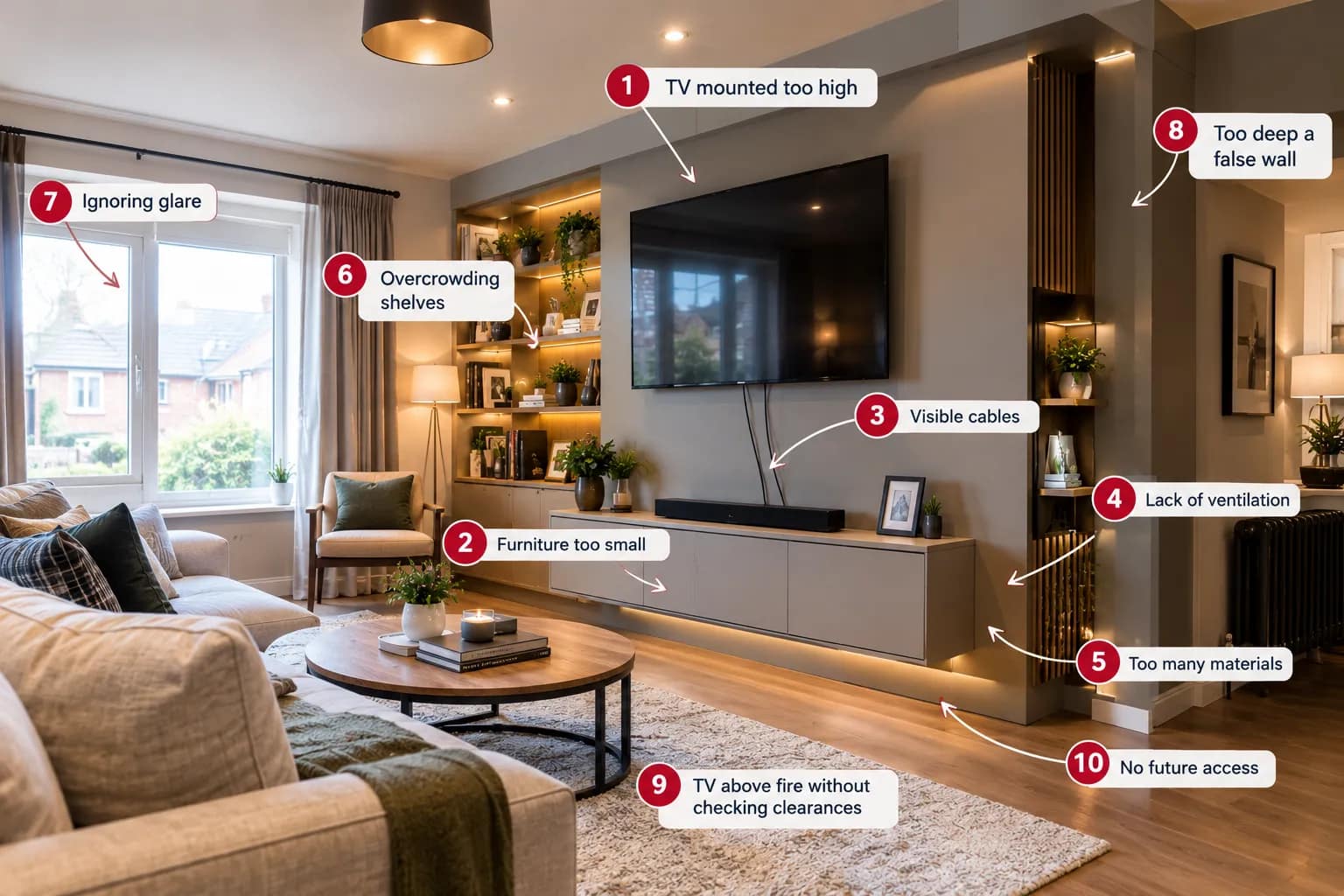
1. Mounting the TV Too High
A high television may look impressive in photographs but can be uncomfortable to watch.
2. Choosing Furniture That Is Too Small
A narrow cabinet beneath a large television can make the wall look unbalanced.
3. Ignoring Cable Management
Visible cables can undermine an otherwise attractive design.
4. Forgetting Ventilation
Media equipment, soundbars and games consoles need adequate airflow.
5. Using Too Many Materials
Combining panelling, brick, bold paint, lighting and shelving can make the wall feel chaotic.
6. Overcrowding Shelves
Leave breathing space around books and accessories.
7. Ignoring Glare
Check the TV wall at different times of day before choosing its final position.
8. Building Too Deep a False Wall
A deep structure can make a small living room feel noticeably narrower.
9. Placing the TV Above a Fire Without Checking Clearances
Never assume that every electric fire is suitable for a television above it.
10. Forgetting Future Upgrades
Leave enough access to replace the television, cables, soundbar or streaming equipment later.
FAQs
What is the most popular TV wall idea in the UK?
Painted panelling, floating TV units, slatted wood finishes and media walls with electric fireplaces are popular choices. The best option depends on the room’s size and the style of the property.
Is a media wall worth it in a small living room?
It can be, but a full media wall may take up valuable floor space. In a small room, a shallow TV wall with concealed cables and compact storage is often more practical.
Should a TV be mounted above a fireplace?
It can be possible, particularly with a suitable electric fire, but the height and heat requirements must be checked carefully. Comfortable viewing should remain the priority.
What colour is best behind a TV?
Dark charcoal, navy and deep green can help a black screen blend into the wall. Warm neutrals create a softer, calmer appearance. Always test colours in your own room before painting.
Can I create a TV wall without building a media wall?
Yes. A painted wall, simple panelling, floating shelf, low cabinet and concealed cables can create an attractive TV wall without major construction.
How can I make a TV wall look more expensive?
Focus on proportion and finishing details. Hide the cables, choose a properly sized cabinet, use consistent materials, add subtle lighting and avoid overcrowding the wall.
Is panelling suitable behind a wall-mounted TV?
Yes. Panelling can frame the television and add texture. Ensure the wall remains strong enough for the bracket and that the panel design allows access to cables and fixings.
Can a TV be mounted on a chimney breast?
Often, yes, but the wall must be checked for strength, hidden flues and suitable fixings. Older chimney breasts may require specialist assessment.
Final Thoughts
The best living room TV wall ideas UK homeowners can use are not necessarily the most elaborate. A successful design combines comfortable viewing with good proportions, practical storage and a finish that suits the property.
A simple painted wall may be perfect for a small flat, while a Victorian terrace may benefit from alcove shelving or built-in cabinetry. Larger homes can accommodate a full media wall with storage, lighting and an electric fireplace.
Start with the television’s position, then plan the furniture, cables, lighting and decorative finish around it. When the practical details are resolved first, the final TV wall will look more polished, function better and remain useful for years to come.