
Introduction
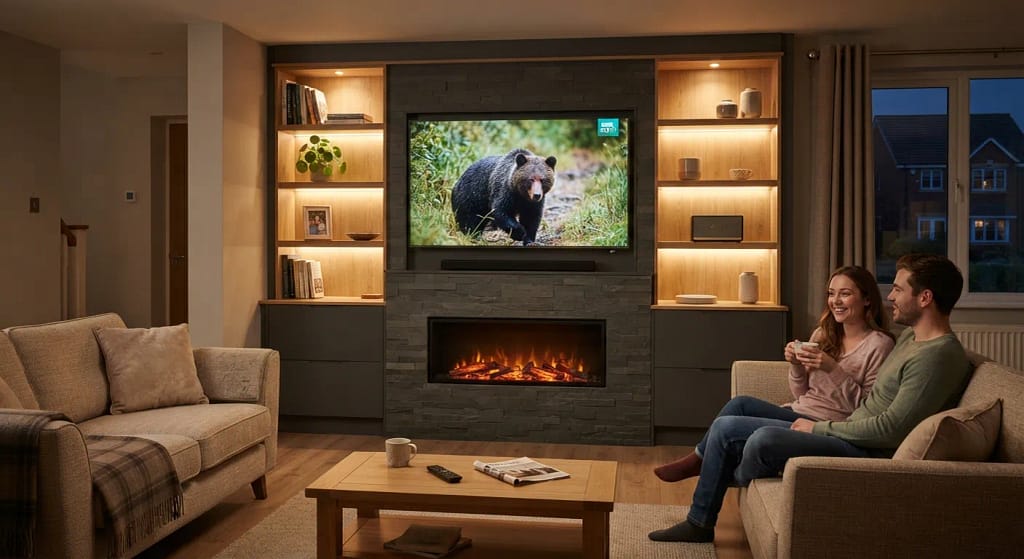
A media wall is a purpose-built wall or feature installation that brings your TV and entertainment equipment together in one organised area.
Unlike simply mounting a television on a wall, a media wall is normally designed around the equipment and the room as a whole. It can hide cables, provide storage, accommodate speakers and consoles, add lighting, and create a finished focal point for a living room.
A typical media wall might include:
- A wall-mounted or recessed TV
- Concealed power and HDMI cables
- A soundbar or surround-sound equipment
- Built-in cupboards or drawers
- Open shelving
- LED or ambient lighting
- Decorative panelling
- An electric fireplace
- Space for game consoles and streaming equipment
The exact combination is flexible.
That’s why two media walls can look completely different. One might be a minimalist TV panel with hidden wiring, while another could run across an entire wall and include an electric fire, cupboards, shelves and lighting.
The fireplace is optional. It is a popular feature in UK media wall designs, but it isn’t what makes something a media wall.
If you’re looking for visual inspiration before deciding on a layout, see our guide to Media Wall Ideas for UK Homes.
Quick Answer
A media wall is a built-in feature wall designed around a TV and other entertainment equipment. It can combine a television, concealed cables, storage, shelving, lighting, speakers and, optionally, an electric fireplace into one integrated installation.
A media wall does not have to include a fireplace. Some are simple TV-and-storage installations, while others are full-width bespoke walls with an electric fire, cabinetry and decorative lighting.
In the UK, the cost can range from a relatively simple DIY installation to several thousand pounds for a professionally built bespoke design. The final price depends on wall size, construction method, storage, electrical work, the fireplace, finishes, and labour.
For most homeowners, the key decisions are what the wall needs to contain, how it will be constructed, how cables and ventilation will be managed, and whether any electrical, structural or fireplace work needs professional involvement.
What Is the Purpose of a Media Wall?
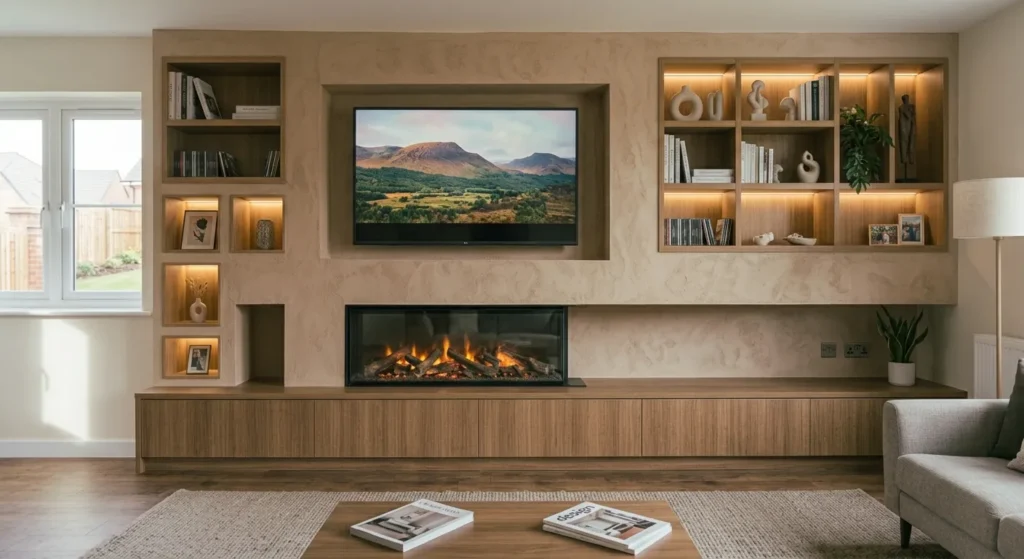
A well-designed media wall normally serves three purposes at the same time.
1. Entertainment
It creates a dedicated area for the TV and associated equipment.
2. Organisation
Cables, consoles, sound equipment, and other devices can be planned into the installation rather than left around the room.
3. Interior Design
The TV becomes part of a larger feature instead of looking like a separate screen attached to an otherwise empty wall.
This combination is what makes a media wall different from simply buying a TV stand.
What Does a Media Wall Include?
There is no fixed specification for a media wall. Some elements are essential to the installation, while others are optional.
| Component | Purpose | Is it essential? |
| TV | Main entertainment display | Usually |
| TV bracket or mounting system | Supports the TV | Usually |
| Cable management | Keeps power and AV cables organised | Strongly recommended |
| Storage | Holds consoles, devices and household items | Optional |
| Shelving | Display or storage space | Optional |
| Soundbar/speakers | Improves audio | Optional |
| LED lighting | Creates ambient or decorative lighting | Optional |
| Electric fireplace | Adds warmth and a focal point | Optional |
| Decorative panels | Adds texture and visual interest | Optional |
| Cabinets | Creates a more furniture-like finish | Optional |
The best design starts with the equipment and the way you actually use the room, rather than adding features simply because they look good in photographs.
Do Media Walls Have to Have a Fireplace?
No. A media wall does not need a fireplace.
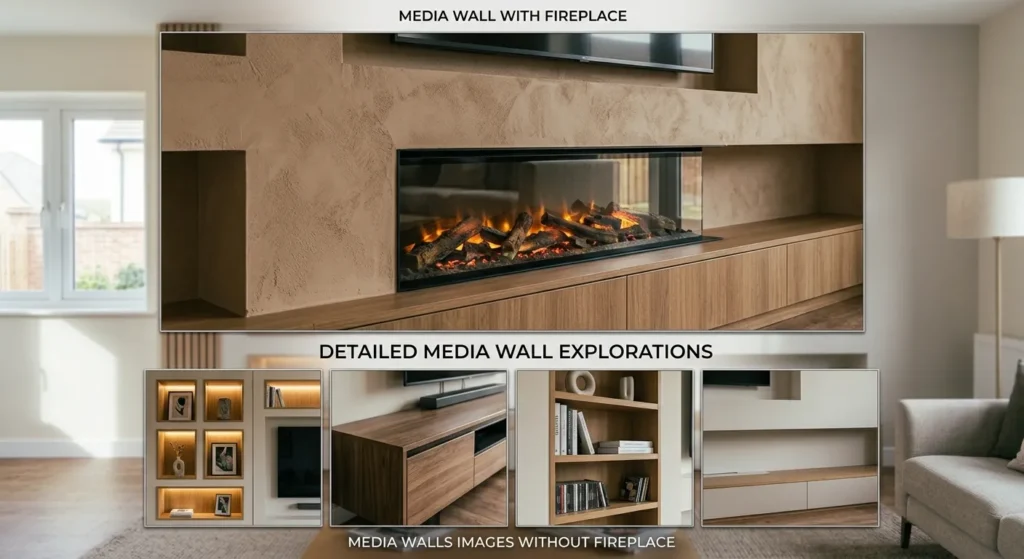 This is one of the most common misconceptions surrounding media walls.
Media Wall With a Fireplace
An electric fireplace can make the TV wall feel more like a traditional living-room focal point. It can also provide a visual centre to a symmetrical design.
However, adding a fireplace introduces additional considerations, including:
- The size and position of the fire
- Required clearances
- Ventilation or airflow requirements
- Electrical supply
- The relationship between the fire and TV
- Manufacturer installation instructions
- Additional installation cost
We’ve covered the subject in more detail in our guide to media walls with fireplaces .
If the TV will sit directly above the fireplace, also read our TV above fireplace safety guide before finalising the layout.
Media Wall Without a Fireplace
A fireplace isn’t necessary if your priority is the TV, storage and overall appearance.
A no-fireplace media wall can be particularly useful when you want :
- A simpler design
- More storage
- A lower installation cost
- A minimalist appearance
- More flexibility around the TV
- No additional heating feature
The important thing is to decide early whether a fireplace is part of the design because its dimensions and installation requirements can affect the rest of the wall.
What Are the Different Types of Media Wall?
There isn’t one standard construction or layout. The best option depends on the room, wall dimensions, storage requirements, and budget.
Full-Width Media Wall
The installation spans most or all of the available wall.
This is useful when you want a strong focal point and plenty of room for storage, shelving, or a fireplace.
Chimney Breast Media Wall
The design is built around an existing chimney breast or creates a chimney-breast-style projection.
This can work particularly well in period properties where the chimney breast already provides a natural centre point.
Alcove Media Wall
The TV and storage are integrated around existing alcoves.
This can make better use of awkward living-room layouts without requiring the entire wall to be rebuilt.
For examples of this approach, see our Alcove Media Wall Guide .
Floor-to-Ceiling Media Wall
The design extends vertically rather than stopping around TV height.
This can create a dramatic built-in appearance, particularly when combined with tall storage.
Minimalist TV Media Wall
This is the simplest approach: usually a decorative panel or shallow structure around the TV with concealed wiring.
It can be a good option if you don’t need extensive storage.
Luxury & Minimalist Media Walls
Media Wall With Built-In Storage
Cupboards, drawers, and shelves are incorporated into the design to provide practical storage alongside the TV.
Fireplace Media Wall
An electric fire is incorporated below or beside the television as part of the overall design.
Media Wall vs TV Unit vs Feature Wall
These terms are often used interchangeably, but they aren’t quite the same.
| Feature | Media Wall | TV Unit | Feature Wall |
| Designed around TV | Yes | Yes | Not necessarily |
| Built-in storage | Often | Usually | Usually not |
| Concealed cables | Usually | Sometimes | Limited |
| Fireplace | Optional | Sometimes | Optional |
| Built into wall | Often | Usually furniture | Usually surface finish |
| Custom construction | Common | Less common | Varies |
| Main purpose | Entertainment + design + storage | Storage + TV | Decoration |
A TV unit is generally a piece of furniture.
A feature wall is primarily about the appearance of the wall.
A media wall combines entertainment with the wall’s design and, often, built-in storage.
There can still be overlap between the three, which is why the terminology is sometimes confusing.
Best TV Mount for Media Wall UK
How Are Media Walls Built?
The construction method depends on the design and the existing wall.
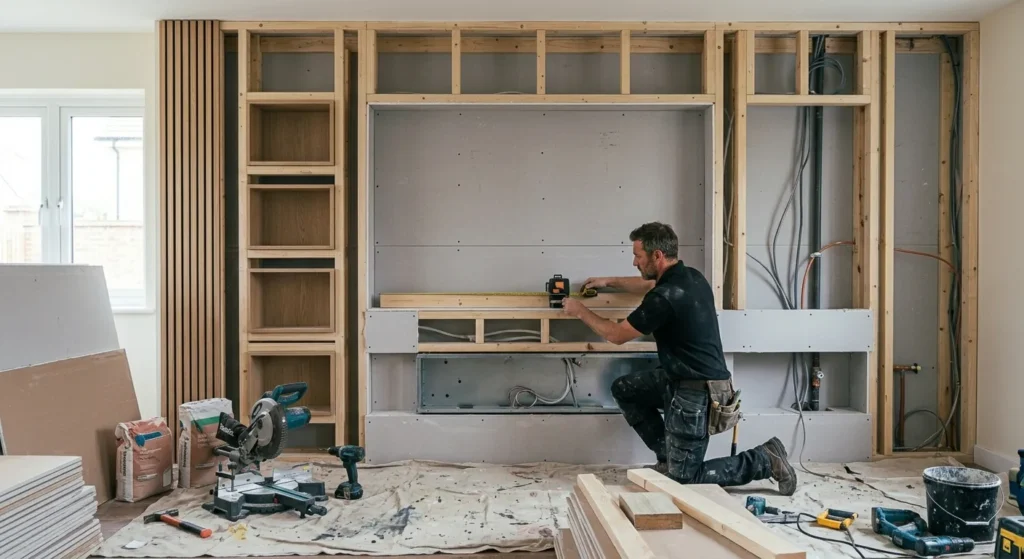
A media wall may be constructed using a timber or metal stud framework, plasterboard, MDF or cabinetry, decorative panels, or a combination of these.
A typical built installation might follow this general sequence:
- Measure the wall and room.
- Decide on the TV position and screen size.
- Plan storage, speakers, lighting, and any fireplace.
- Plan electrical sockets and cable routes.
- Build the framework or supporting structure.
- Install required electrical and AV infrastructure.
- Add plasterboard, cabinetry, or decorative finishes.
- Plaster, paint, or panel the surface.
- Install the TV, fireplace, and entertainment equipment.
- Test the finished installation.
The exact sequence varies depending on the construction method and work involved.
Stud-Frame Media Wall
A stud framework creates a new structure in front of the existing wall.
This approach provides space to route cables and create recesses for TVs, fireplaces, lighting and storage.
Cabinet-Based Media Wall
A more furniture-like installation can use cupboards, shelving and panels to create the media area.
This can be useful when storage is as important as the TV itself.
Decorative-Panel Media Wall
If you mainly want the appearance of a feature wall and don’t need substantial depth, a shallower panel-based solution may be enough.
The important point is that a media wall should be designed around the equipment and services it needs to contain.
Building the structure first and trying to work out the cables, sockets and TV mounting afterwards can create expensive problems.
If you’re considering a DIY build, our how-to-build a media wall guide is the natural next step.