
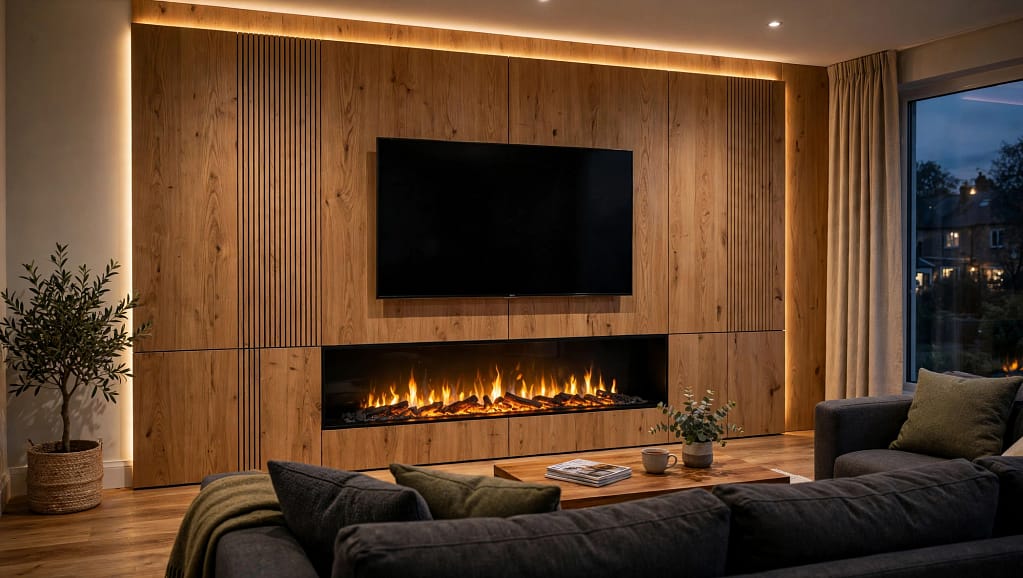
Electric Fire for Media Wall UK
Choosing the right electric fire for a media wall is about much more than picking a flame effect you like. The fire needs to work with your TV size, available wall width, room proportions, media-wall depth, electrical layout and the manufacturer’s installation requirements.
For UK homes, the best starting point is to choose the fire and its installation dimensions before the stud wall is built. A small measurement error can leave you with a recess that is too narrow, a TV positioned too high or a media wall that takes more floor space than you expected.
Quick Answer
The best electric fire for a media wall is one that fits the available wall space, works proportionally with your TV and meets the manufacturer’s installation and clearance requirements. In most media-wall designs, built-in inset fires are used, with 1-sided, 2-sided and 3-sided models available for different layouts. As a general planning principle, the fire is usually the same width as or wider than the TV, but the exact dimensions should always be checked against the specific TV and fire models before construction. Current media-wall buying guidance also commonly recommends matching the fire width closely to the TV rather than allowing the screen to visually overpower the fireplace.
What Is an Electric Fire for a Media Wall?
An electric fire for a media wall is an electric fireplace designed to form part of a built-in feature wall, normally alongside a television, storage, shelving or decorative panelling.
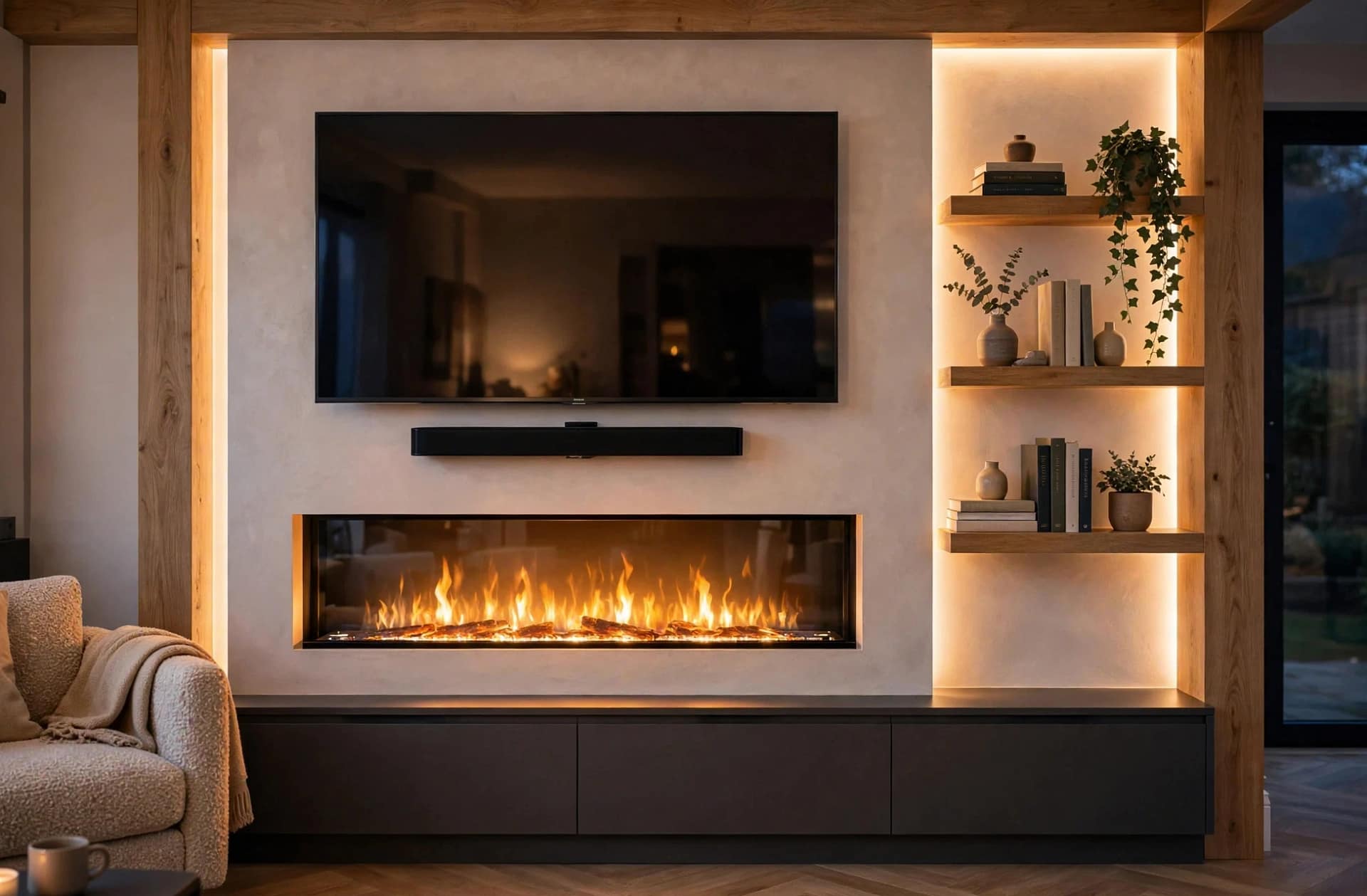
Unlike a traditional chimney fireplace, an electric fire does not require a conventional chimney or flue. This makes it particularly useful when creating a contemporary feature wall in a UK living room.
A typical media wall may combine:
- A wall-mounted TV
- A built-in electric fire
- Shelving or cupboards
- LED lighting
- Cable management
- Decorative panelling
- Soundbar storage
- Recessed storage
The exact construction depends on the room and the appliances being installed.
If you are still deciding what overall style to create, our guide to media wall with fireplace ideas is a useful starting point.
Which Type of Electric Fire Is Best for a Media Wall?
There is no single fire type that works for every room. The right choice depends on the position of the media wall, how much of the flame you want to see and how the wall is being constructed.

1-Sided Electric Fire
A 1-sided fire has a front-facing viewing area and is usually the simplest option for a standard media wall.
It works particularly well when:
- The wall is viewed mainly from the front
- The fire sits centrally below the TV
- You want a clean, symmetrical appearance
- You are working with a relatively straightforward stud-wall design
For many conventional living rooms, this is the most straightforward layout.
2-Sided Electric Fire
A 2-sided fire exposes the flame effect from the front and one side.
This can work well where:
- The media wall sits near a corner
- The room is viewed from an angle
- You want the flame effect to remain visible from another seating position
- The media wall has a more architectural design
The side opening needs to be incorporated into the construction, so check the manufacturer’s installation dimensions before framing.
3-Sided Electric Fire
A 3-sided panoramic fire exposes the flame effect from the front and both sides.
It can create a more substantial focal point and is particularly effective when the media wall can be viewed from several directions.
However, a 3-sided design normally requires more careful planning than a standard front-facing fire.
Some current media-wall electric fires are specifically designed to support 1-, 2- or 3-sided installation, demonstrating how important configuration is when choosing the appliance.
Wall-Mounted Electric Fire
Not every media-wall look requires a deeply recessed appliance.
Some electric fires can be wall-mounted, which can be useful for shallower designs or situations where a full built-in recess is not practical.
Always check whether the particular model is approved for wall mounting before designing around it.
What Size Electric Fire Do I Need for a Media Wall?
Fire size is one of the most important decisions you will make.
A common mistake is to choose the TV first and then try to squeeze a fireplace underneath it. For a new media wall, it is much safer to work backwards from the actual appliance dimensions.
The basic planning sequence should be:
TV size → fire width → media-wall width → recess dimensions → frame construction.
A fire that is too narrow can look lost underneath a large television, while an oversized fire can dominate a small room.
Electric Fire and TV Size Guide
The following is a planning guide rather than a universal rule . TV dimensions vary between models, and manufacturers have different fire sizes available.
| TV Size | Approx. TV Width | Typical Fire Planning Range |
| 43″ | ~953mm | 1000–1100mm |
| 50″ | ~1107mm | 1200–1300mm |
| 55″ | ~1217mm | 1300–1500mm |
| 60″ | ~1328mm | 1400–1500mm |
| 65″ | ~1440mm | 1500–1800mm |
| 75″ | ~1661mm | 1800–2000mm |
| 85″ | ~1882mm | 2000mm+ |
These figures broadly reflect current published media-wall sizing guidance, but they should be treated as starting points only. The actual TV width and actual fire dimensions must be checked before construction.
For example, a 65″ television is approximately 1440mm wide, so a 1500mm fire can create a balanced starting point. However, a different 65″ TV model or a different fireplace design may require a different combination.
Should the Electric Fire Be Wider Than the TV?
In many media-wall designs, yes.
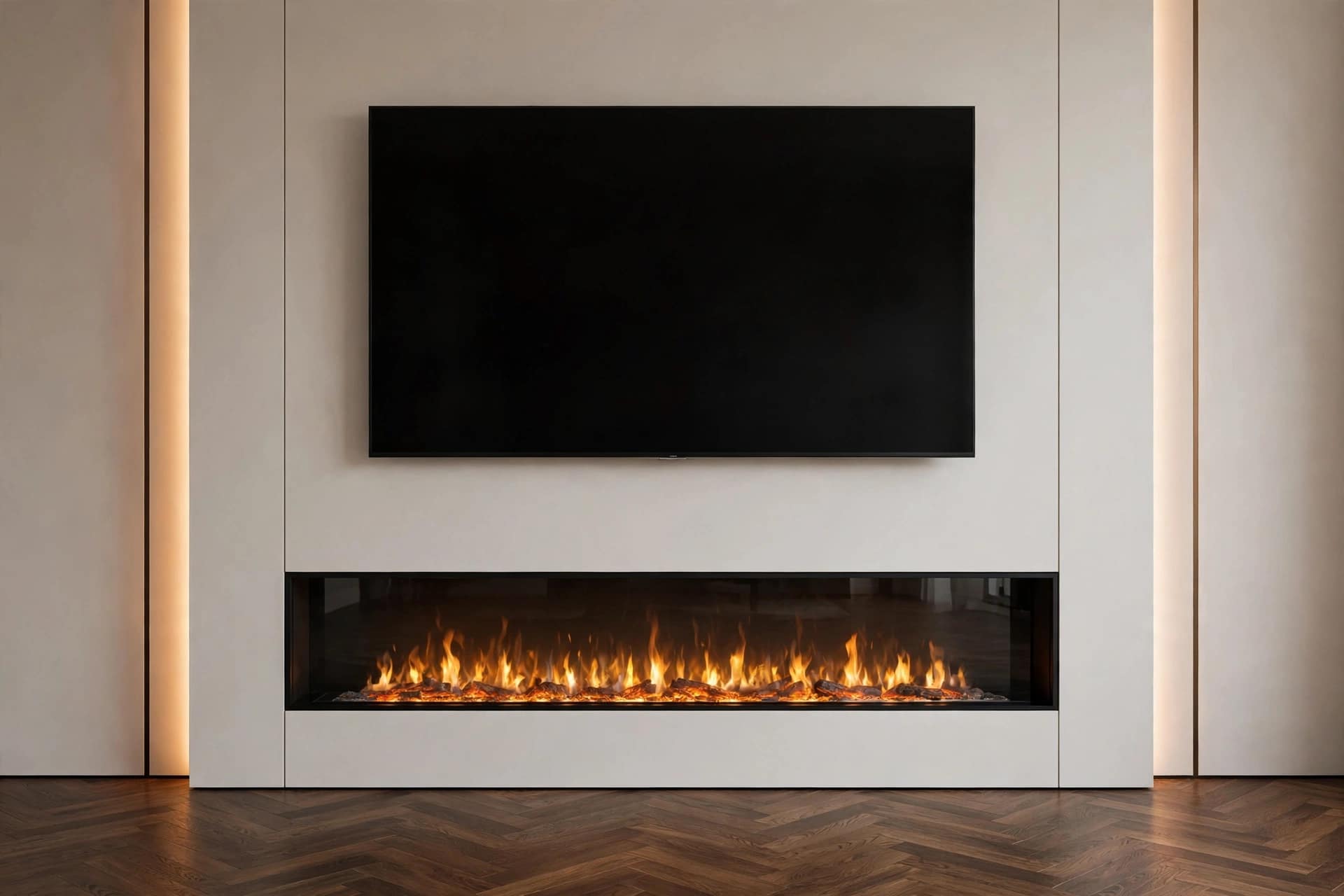
A fireplace that is the same width as, or slightly wider than, the television often creates a visually balanced arrangement. Current specialist media-wall guidance commonly uses this relationship when recommending fire and TV combinations.
Think about the media wall as a visual composition.
If the TV is substantially wider than the fire, the screen can dominate the lower section of the wall. If the fire is dramatically wider than the TV, the fireplace may become disproportionate to the room.
The goal is not to follow one fixed mathematical ratio. It is to create a balanced relationship between:
- TV width
- Fire width
- Media-wall width
- Ceiling height
- Room size
- Viewing distance
How Wide Should the Media Wall Be?
The media wall should not be designed around the fire alone.
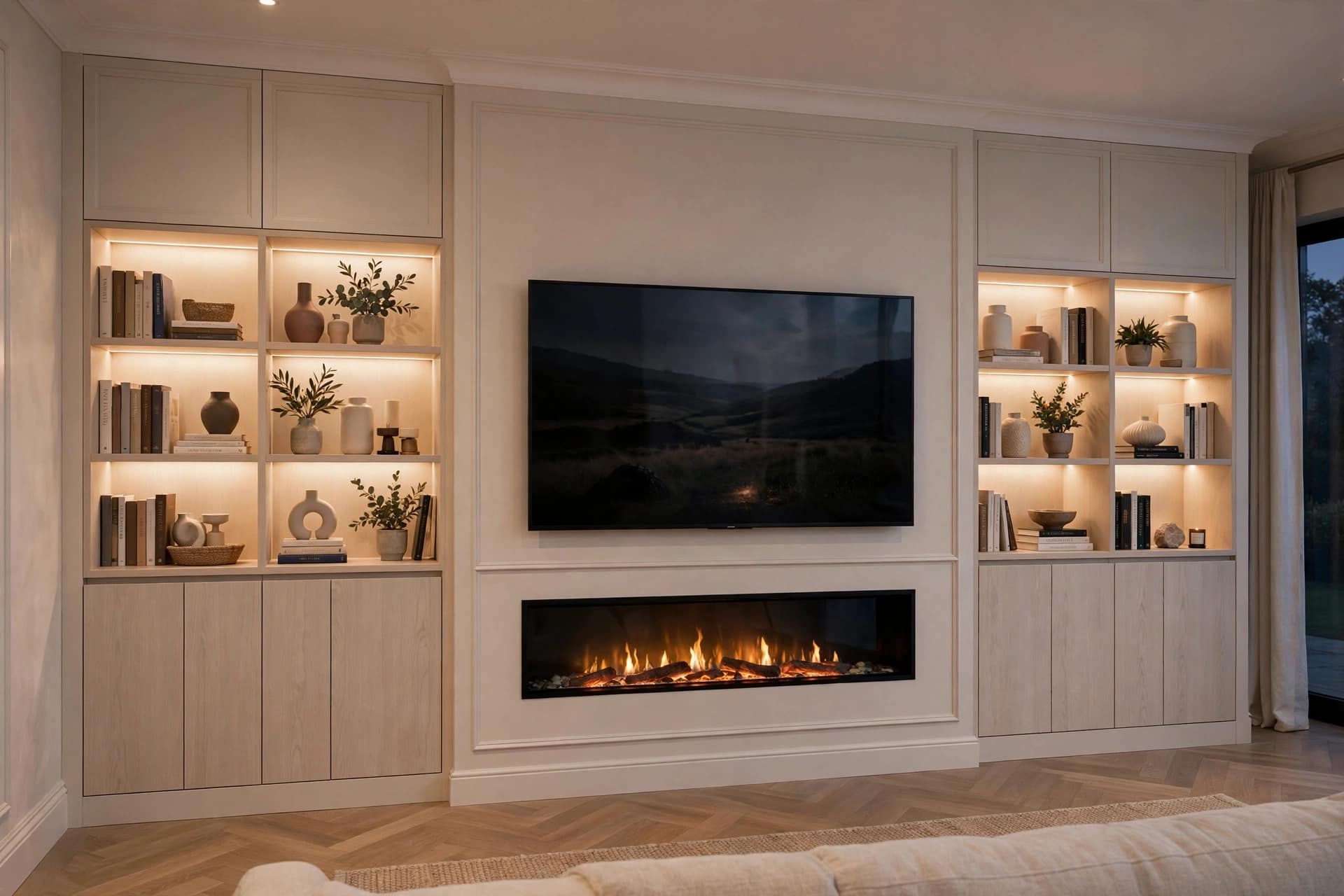
You also need to consider the space available on either side of the TV and fireplace.
For example, a compact wall with a 1500mm fire may look very different from the same fire installed on a 3.5m-wide feature wall.
Before deciding the final width, measure:
- The complete wall
- Skirting boards
- Door openings
- Windows
- Radiators
- Existing sockets
- Furniture clearance
- TV viewing position
- Fire dimensions
- Any shelving or storage you want to add
For more detailed room and wall proportions, see our media wall size guide when planning the overall build.
How Deep Should a Media Wall Be for an Electric Fire?
This is one of the measurements that causes problems during media-wall construction.
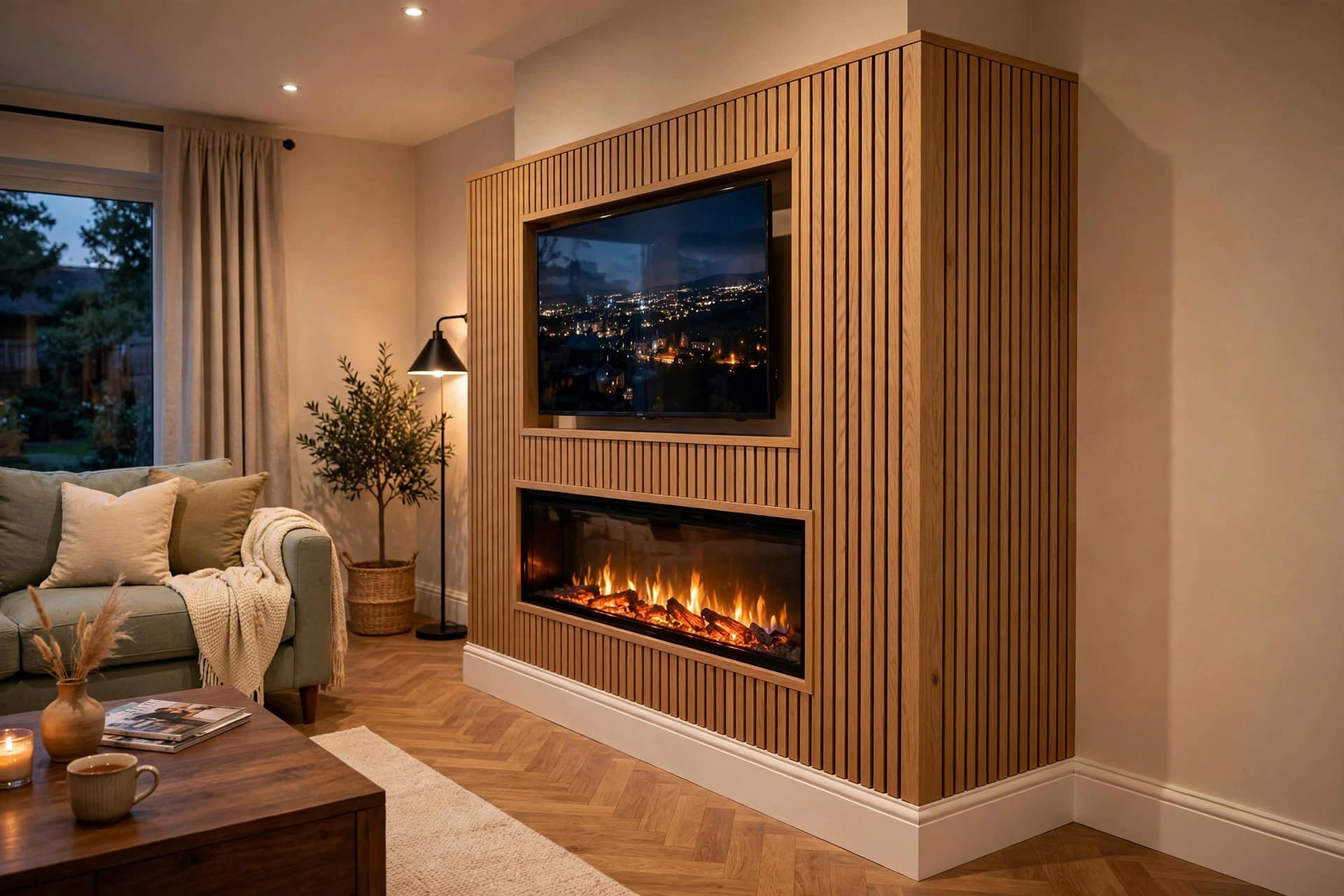
There is no single universal depth for every electric fire.
The required depth depends on the particular appliance, the way it is installed and the construction around it.
Your total media-wall depth may need to accommodate:
- The fire body
- Manufacturer-specified clearances
- Studwork
- Plasterboard or MDF
- Finishing materials
- Electrical cables
- Sockets
- TV cables
- TV mounting hardware
- Soundbar equipment
- Ventilation or heat-management requirements where specified
This is why you should never build the media wall from a generic depth figure and then try to find a fire that fits afterwards .
Measure the appliance first.
Then work out the construction depth around the manufacturer’s installation requirements.
For a broader look at construction materials, see our guide to best materials for a media wall .
Can You Put a TV Above an Electric Fire?
Yes, many electric fires are specifically designed to form part of a media-wall arrangement with a television above them.
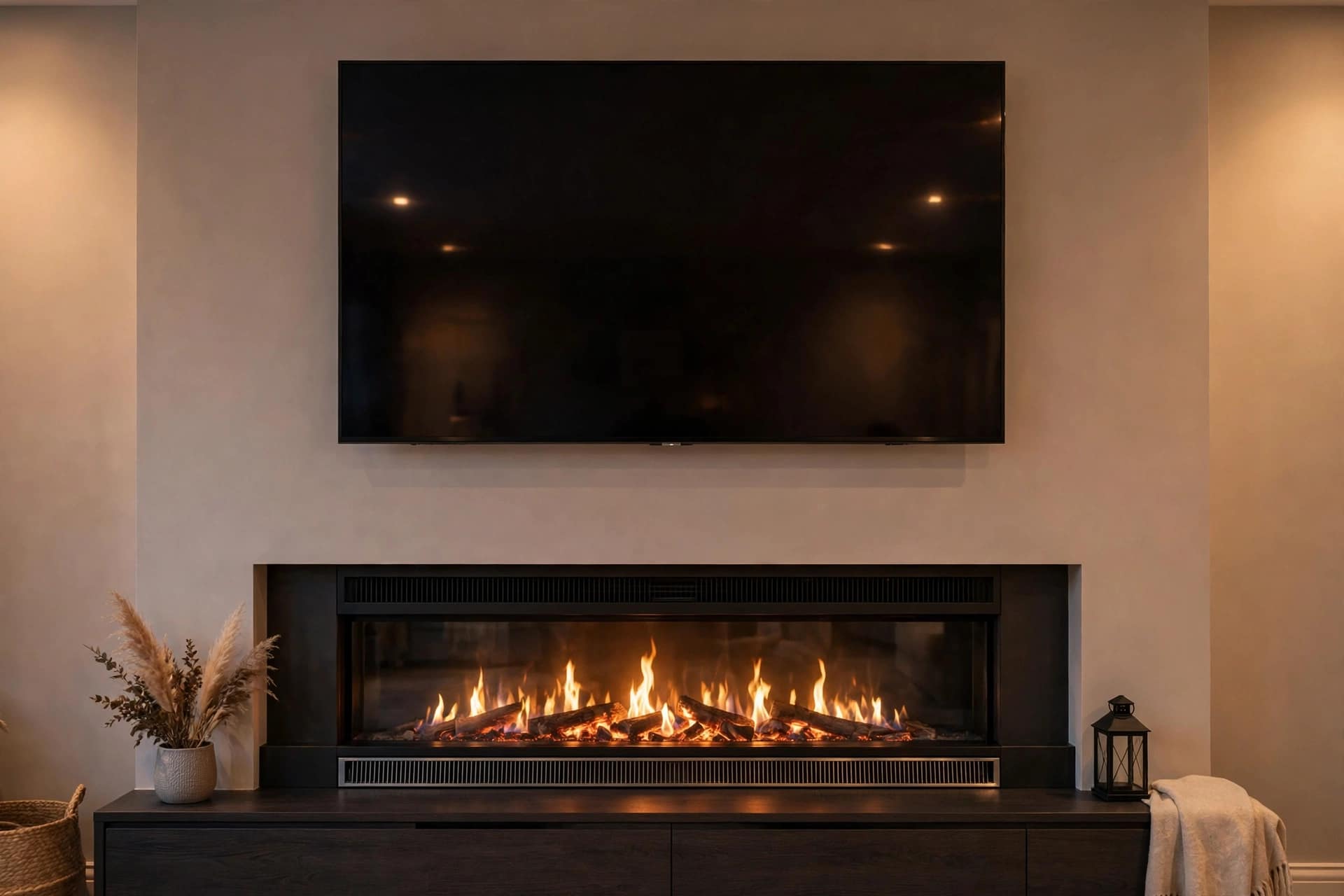 However, this does not mean every electric fire can be installed directly below every TV in exactly the same way.
The manufacturer’s installation instructions should determine:
- Required clearances
- Minimum distances
- Heat outlet position
- Installation orientation
- Recess dimensions
- Ventilation requirements
- Electrical requirements
Your TV also has its own installation requirements.
Electrical Safety First advises consumers to follow manufacturers’ instructions carefully and keep televisions away from heat sources.
That makes the exact fire model important.
Do not assume that because one media-wall fire can be installed below a TV, another model will have identical requirements.
For a more detailed look at this issue, see our guide to TV above fireplace safety .
How Much Heat Does an Electric Media Wall Fire Produce?
Electric media-wall fires vary considerably in their heat output.
Many models offer one or more heat settings, while some also provide a flame-only mode.
For example, current media-wall products on the market include models with heat outputs around 1.4kW to 1.6kW, while other products offer different heating levels.
When comparing fires, look at:
- Maximum heat output
- Lower heat setting
- Thermostatic control
- Timer
- Flame-only operation
- Remote control
- App control
- Noise level
- Installation requirements
Do not choose a fire purely because it has the highest wattage.
The heating requirement of a room depends on the room itself, insulation, glazing, layout and other factors.
For some households, the flame effect may be the main reason for buying the fire, with central heating providing most of the room’s heat.
Can You Use a Media Wall Fire Without Heat?
Many electric fires offer a flame-only setting.
This allows you to use the visual effect without running the heater, which can be useful when you want the atmosphere of a fire without adding heat to the room.
This feature is particularly useful during warmer months.
Some current media-wall models explicitly promote flame-only operation as part of their feature set.
When comparing models, check whether flame-only operation is available and whether the controls allow you to operate the flame effect independently of the heater.
How Much Does an Electric Media Wall Fire Cost to Run?
Running cost depends mainly on the fire’s power consumption , how long it operates and your electricity tariff.
The basic calculation is:
Electricity cost = power in kW × hours used × electricity price per kWh
For example, a 2kW heater running continuously for one hour consumes approximately 2kWh.
If your electricity tariff were 30p per kWh, that would be:
2 × £0.30 = £0.60 per hour
That is an example calculation, not a fixed UK running cost. Your actual tariff and appliance settings will determine the real figure.
Flame-only mode can use substantially less electricity than operating the heater, but the exact consumption depends on the individual model.
What Features Should You Look For?
The appearance of the flames is important, but there are several practical features worth checking.
Flame Effects
Look for:
- Multiple flame colours
- Adjustable brightness
- Realistic flame movement
- Independent flame control
Fuel Bed
Some models offer:
- Logs
- Crystals
- Pebbles
- Mixed fuel beds
- Coloured LED effects
Controls
Depending on the model, you may find:
- Remote control
- Touch controls
- App control
- Wi-Fi
- Smart-home integration
- Voice control
Heating Controls
Useful options can include:
- Thermostat
- Timer
- Multiple heat levels
- Flame-only mode
The exact feature set varies considerably between manufacturers, so compare the specification rather than relying only on product photographs.
Electric Fire Depth vs Media Wall Depth: What Is the Difference?
This is worth explaining because the two measurements are often confused.
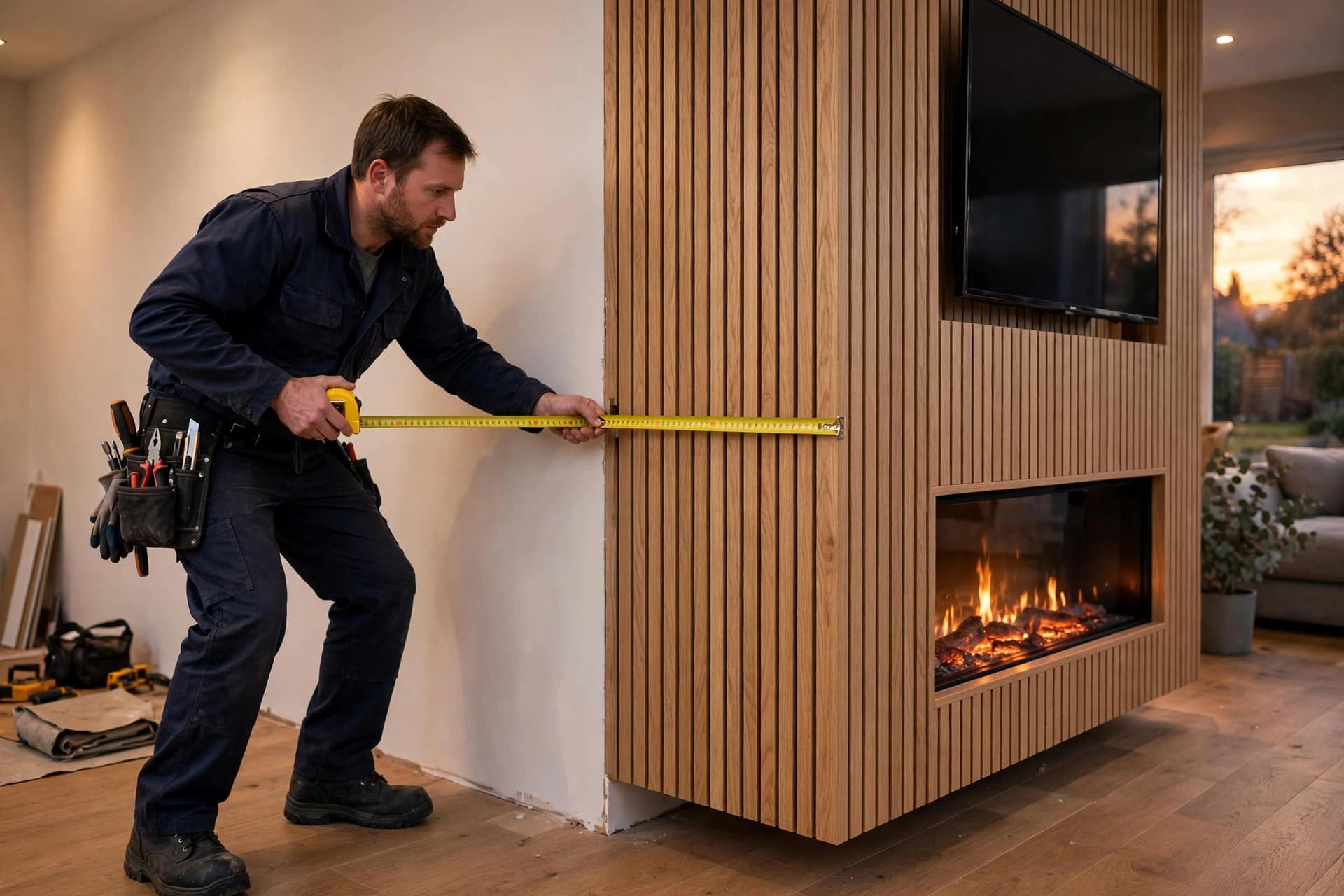
Fire depth is the physical depth of the appliance.
Media-wall depth is the total depth of the finished structure.
A media wall may therefore need to be deeper than the fireplace itself because it has to accommodate framing, boards, cables, sockets and finishing materials.
For example, you cannot assume that a 200mm-deep appliance automatically means you can build a finished 200mm-deep media wall.
The construction needs to be designed around the actual appliance and installation instructions.
This is one reason why measuring the fire before cutting timber can prevent expensive alterations later.
What Electrical Planning Does a Media Wall Fire Need?
Electrical planning should happen before the wall is closed.
Think about the complete system rather than only the fireplace.
You may need to plan for:
- Fireplace power
- TV power
- HDMI cables
- Broadband/network connection
- Soundbar
- Games console
- Streaming devices
- LED lighting
- Smart-home equipment
Your cable routes should be planned before plasterboard or MDF is installed.
For a detailed guide, see our media wall wiring and cable management guide .
For electrical work in England, Approved Document P provides statutory guidance relating to electrical safety in dwellings and explains requirements around electrical installation work.
Where electrical work is required, use a suitably competent electrician and follow the applicable requirements for your location.
1-Sided vs 2-Sided vs 3-Sided Electric Fire
| Fire Type | Best For | Main Advantage | Planning Complexity |
| 1-sided | Standard media walls | Clean front view | Lower |
| 2-sided | Corner/angled layouts | Wider flame visibility | Medium |
| 3-sided | Statement feature walls | Panoramic effect | Higher |
| Wall-mounted | Shallow installations | Less structural work | Model-dependent |
The important point is that 3-sided does not automatically mean better .
Choose the configuration that suits how people actually see the media wall.
If the sofa faces the wall directly and the sides are rarely visible, a 1-sided model may provide everything you need.
If the media wall is visible from an open-plan kitchen-diner, a panoramic configuration may make more sense.
Electric Fire for a Small Living Room
A small room needs careful proportion.
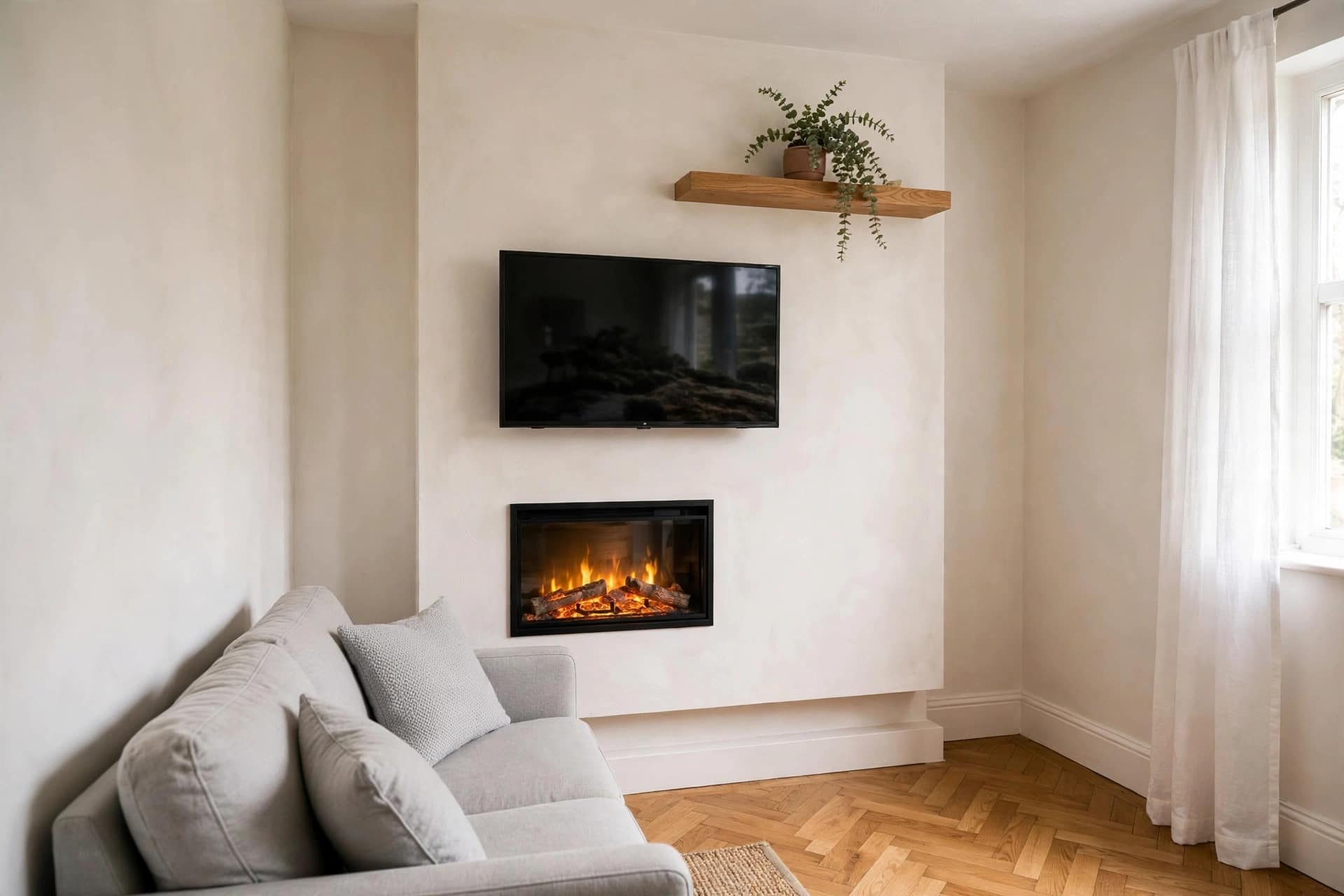 A large media wall can quickly reduce usable floor space, particularly if the construction projects significantly into the room.
For compact UK homes, consider:
- A shallower construction
- A smaller fire
- Floating or recessed storage
- Minimal shelving
- Wall-mounted equipment
- Integrated cable management
- Light or visually simple finishes
Our small living room media wall ideas guide covers ways to keep the feature wall from overwhelming the room.
This matters particularly in compact terraces, apartments and smaller new-build living rooms.
Electric Fire for a Large Media Wall
A large wall gives you more freedom, but it also creates another problem: proportion.
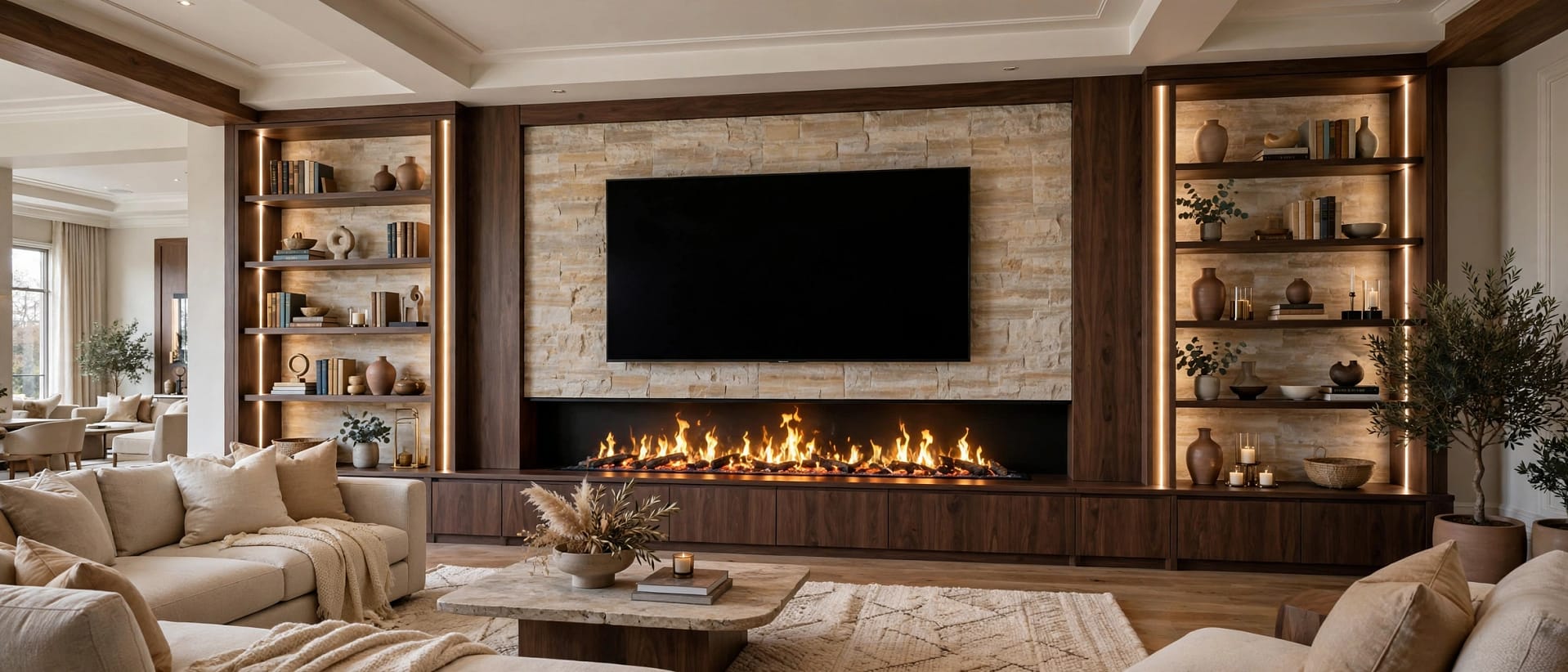 A small fire on a very wide wall can look lost.
For a large feature wall, consider:
- Wider linear fires
- Larger TVs
- Full-width built-in storage
- Symmetrical shelving
- Vertical lighting
- Longer furniture
- Continuous finishes
The fire should remain visually connected to the TV rather than looking like a small appliance placed inside a very large wall.
Should You Buy the TV or Electric Fire First?
For a new media wall, the fire dimensions should be established before the timber frame is built .
The TV can then be selected around the available space and intended viewing distance.
This is also the approach recommended in recent specialist media-wall sizing guidance: determine the fireplace/build dimensions first rather than constructing the wall and attempting to make the appliance fit afterwards.
If you already own the TV, measure the actual television rather than relying only on the advertised screen size.
A 65″ TV is not necessarily the same physical width as another 65″ model.
Common Electric Fire for Media Wall Mistakes
1. Choosing the fire after building the wall
This can leave you with a recess that does not match the appliance.

2. Using screen size instead of actual TV dimensions
A 55″, 65″ or 75″ label tells you the diagonal screen size, not the exact outside width.
3. Making the fire too narrow
The TV can visually overpower the fireplace.
4. Ignoring appliance depth
A fire that fits the width may still create problems with overall wall depth.
5. Forgetting the finished wall thickness
The frame is not the finished wall. Add boards, plaster, panels and other finishes to the calculation.
6. Installing the TV too high
The fireplace can push the screen upward if the layout is not planned carefully.
7. Forgetting cables
HDMI, power, soundbar and network cables should be considered before closing the wall.
8. Assuming every electric fire has the same clearances
It does not.
Always use the installation requirements for the exact model.
9. Designing around photographs
A product may look perfect online but still be unsuitable for the physical dimensions of your room.
10. Treating the fire as a standalone purchase
The best result comes from designing the TV, fire, wall, storage and viewing position as one system.
Electric Fire for Media Wall Buying Checklist
Before buying your fire, check each of these:
- Actual TV width measured
- Available wall width measured
- Desired fire width established
- Fire height checked
- Fire depth checked
- Recess dimensions checked
- Manufacturer installation manual checked
- TV clearance checked
- Heat outlet direction checked
- 1-sided/2-sided/3-sided configuration confirmed
- Electrical requirements checked
- Socket positions planned
- HDMI/cable routes planned
- Soundbar position planned
- Heating output checked
- Thermostat/timer checked
- Flame-only mode checked
- Warranty checked
- Delivery lead time checked
If the wall is being built by a professional, give them the exact fire model and manufacturer’s installation dimensions before construction starts.
How to Plan the Whole Media Wall
The fireplace is only one part of the project.
A successful media wall normally needs five decisions to be made together:
- TV
Choose the screen based on viewing distance, available wall space and your preferences.
- Electric Fire
Choose the fire width, configuration, depth and heating specification.
- Wall
Design the frame around the actual appliances.
- Storage
Decide whether you need closed cupboards, open shelving or a minimalist floating arrangement.
- Lighting
Plan LED lighting before the wall is closed.
Our media wall lighting guide explains how lighting can be integrated into the design rather than added as an afterthought.
How Materials Affect an Electric Fire Media Wall
The finish you choose can completely change the appearance of the fireplace.
Popular UK options include:
- Painted MDF
- Plasterboard
- Fluted panels
- Acoustic slats
- Wood finishes
- Stone-effect finishes
- Venetian plaster
- Microcement-style finishes
However, the material should never interfere with the manufacturer’s installation requirements.
For design-led inspiration, our fluted panel media wall guide covers one of the popular contemporary finishes used in UK media-wall designs.
For darker premium interiors, you can also explore our walnut and dark wood media wall ideas .
What Is the Best Electric Fire for a Media Wall?
There is no single model that is best for every home.
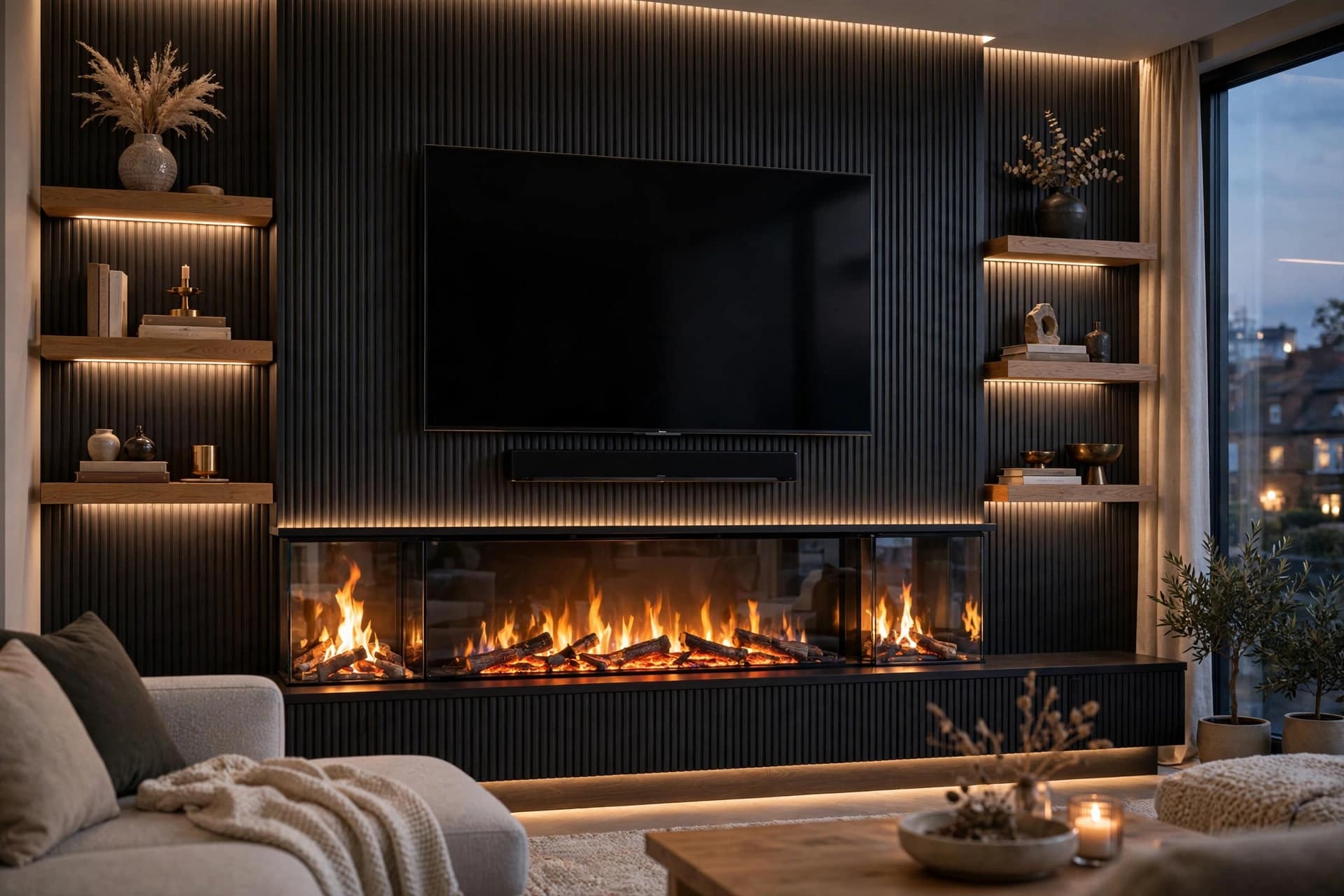 Instead, look for the fire that best matches your:
- TV width
- Media-wall width
- Room size
- Required depth
- Preferred viewing angle
- Heating requirements
- Budget
- Flame-effect preference
- Installation configuration
A compact room may benefit from a shallow, smaller appliance, while a large open-plan room may suit a wider panoramic model.
The most expensive fire is not automatically the right choice.
The best choice is the one that fits the room, wall, TV and installation requirements as a complete system .
FAQs
What size electric fire do I need for a 55-inch TV?
A 55-inch TV is approximately 1217mm wide, although the exact measurement varies by model. A fire around 1300–1500mm can provide a useful starting point for planning, but you should compare the actual dimensions of the TV and fireplace before building the wall.
What size electric fire do I need for a 65-inch TV?
A typical 65-inch TV is approximately 1440mm wide. A 1500mm fire is a common starting point, while some designs may use a wider 1600–1800mm appliance. Always check the exact product dimensions rather than choosing solely from the screen size.
Can an electric fire go underneath a TV?
Many electric fires are designed for media-wall installations with a TV above them, but the exact clearances and installation requirements vary by model. Always follow the fireplace manufacturer’s instructions and the TV manufacturer’s guidance.
How deep should a media wall be for an electric fire?
There is no universal depth. The finished wall needs to accommodate the specific fire, required clearances, framing, boards, cables and any other equipment. Always start with the manufacturer’s installation dimensions.
Are 3-sided electric fires better?
Not necessarily. A 3-sided fire can provide a panoramic flame view, but it may require more careful construction. If your media wall is mainly viewed directly from the front, a 1-sided fire may be more appropriate.
Do electric media wall fires need ventilation?
Requirements vary between appliances. Some fires have specific airflow or clearance requirements. Never assume that an electric fire can simply be enclosed because it does not have a traditional flue. Follow the exact installation instructions supplied with the model.
Can an electric fire be used without heat?
Many models provide a flame-only mode, allowing the visual effect to be used without operating the heater. Check the specification of the particular fire before buying.
Should I buy the TV before building the media wall?
For a new build, establish the fireplace and appliance dimensions before constructing the frame. If you already own the TV, measure its actual width and height and design around those dimensions.
Is an electric fire expensive to run?
Running cost depends on the appliance’s power consumption, how long it operates and your electricity tariff. Use the formula kW × hours × price per kWh to estimate the cost of heating.
Can a media wall be too deep?
Yes. A deeper wall takes more floor space and can make a smaller living room feel narrower. The goal is to create enough depth for the appliances and construction requirements without adding unnecessary bulk.
Final Thoughts
Choosing an electric fire for a media wall should start with measurements rather than appearance.
Before you order the fire, establish the actual TV dimensions, available wall width, appliance depth, recess requirements, electrical layout and manufacturer’s installation instructions.
Then design the media wall around those measurements.
That approach gives you much more flexibility to create the finish you want without discovering later that the fire does not fit the recess, the TV has been pushed too high or the wall has taken too much space from the room.
For the complete project, continue with our how to build a media wall UK guide and use the media wall layout calculator to help plan the proportions before cutting timber.