
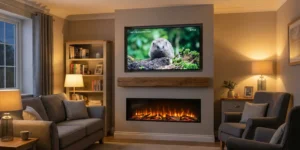
Mounting your TV above the fireplace creates an elegant focal point while saving precious floor space. It’s become one of the most popular living room layouts in UK homes. But this setup comes with serious risks that most homeowners don’t discover until after the damage is done.
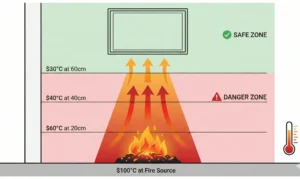
Heat damage is the primary concern for TV above fireplace safety in the UK. Your television operates safely between 0-35°C according to manufacturer specifications from major brands like Samsung and LG. Meanwhile, wood burners exceed 100°C at the surface, and even electric fires can push wall temperatures beyond safe limits.
The good news? You absolutely can mount a TV above your fireplace safely. But it requires careful planning, proper equipment, and ongoing maintenance. This comprehensive guide covers everything from choosing the right fireplace type to step-by-step installation instructions that protect your investment.
How Hot Is Too Hot for Your TV?
Modern TVs contain temperature-sensitive components that degrade rapidly above 35-37°C. Circuit boards warp. Capacitors leak. LCD backlights fail prematurely.
“Most televisions are designed to operate in ambient temperatures up to 35°C,” explains Mark Beynon, co-founder of Imaginfires. “Exceed that consistently, and you’re looking at significantly reduced lifespan. We see TVs fail in as little as 18 months when mounted too close to high-heat sources.”
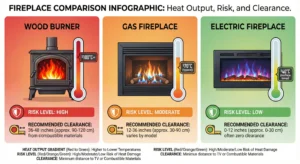
Wood-burning stoves generate surface temperatures exceeding 100°C. Gas fireplaces reach 60-80°C. This heat rises in a concentrated column directly toward your television. Even electric fires, while much cooler, can push wall temperatures to 40-45°C in enclosed spaces.
What fails first:
- Capacitors bulge and leak (causes power issues)
- LCD/LED backlights dim prematurely
- Circuit boards develop micro-cracks
- Plastic housing warps
Most warranties explicitly exclude heat damage. Samsung, LG, Sony, and Panasonic all state that mounting above heat sources voids coverage. That £1,500 OLED becomes a £1,500 mistake if you get the clearances wrong.
What Do UK Building Regs Actually Say?
UK building regulations don’t specifically address TV placement. But they mandate clearances for combustible materials, which includes the plastics and components inside your television.
According to UK Building Regulations Document J, combustible materials must maintain specific distances from heat sources:
Mandatory minimum clearances:
- Solid fuel appliances: 400mm
- Gas fires: 400mm minimum
- Inset/cassette fireplaces: 300mm minimum
- Non-combustible materials: 250mm minimum
HETAS, the UK’s official heating appliance authority, recommends 450-600mm for frequently-used fireplaces when electronics are involved.
“Each manufacturer has specific ‘distance to combustibles’ requirements,” notes Kevin Walmsley, TV expert at AO.com. “These override general guidelines. If your stove manual says 500mm, that’s your minimum regardless of what building regs state.”
Fireplace Type Showdown: Which Is Safest?
Wood-Burning Stoves (Highest Risk)
Log burners produce uncontrolled radiant heat. Output varies based on fuel load and air supply. Surface temperatures regularly exceed 100°C.
Smoke and particulate matter compound the problem. Fine ash escapes and settles on your TV, clogging ventilation ports and creating an insulating layer that traps internal heat.
Minimum requirements for log burners:
- 60cm clearance absolute minimum
- Substantial oak beam or stone mantel (400mm+ from stove top)
- Pull-down mount that moves TV away when fire is active
- Heat shield behind TV
Better wood burner options:
- Contura i51 – Controllable output (£2,800-3,200)
- ACR Neo 1C – DEFRA approved, clean burn (£1,400-1,800)
- Morso 6148 – Consistent heat output (£2,200-2,600)
Gas Fireplaces (Moderate Risk)
Gas fires offer controlled heat output. Glass-fronted models contain most heat, though the glass itself reaches 70-80°C.
Top UK gas fires for TV mounting:
- Gazco Studio 1 Glass Fronted – Heat directed forward (£1,200-1,600)
- Verine Passion High Efficiency – 86% efficiency, controlled heat (£900-1,200)
- Flavel Kenilworth HE – Glass front, moderate heat (£700-950)
Minimum clearance: 35-40cm with a heat deflector mantel.
Electric Fireplaces (Lowest Risk – Recommended)
Electric fires are purpose-built for media wall installations with TVs. Heat output is minimal (1-2kW) and directed outward.
“Electric fireplaces are specifically engineered for TV mounting scenarios,” says Phil Wood, UK Managing Director at Contura. “Heat output is controlled, directed, and easily regulated. They’re the obvious choice if you want both safety and aesthetics.”
Best electric fires for TV mounting:
| Model | Width | Heat Output | Smart Features | Price |
| Celsi Ultiflame VR Elite | 130cm | 1-2kW | Alexa/Google compatible | £1,200-1,500 |
| Dimplex Opti-myst Pro 1000 | 100cm | 2kW | Realistic 3D flames | £800-1,100 |
| Gazco eReflex 135R | 135cm | 1.5kW | Remote control, dimmer | £1,400-1,700 |
| Endeavour Fires Egton | 116cm | 1-2kW | 10 flame colors, timer | £600-850 |
| Modern Flames Landscape Pro | 170cm | 1.5kW | App control, Bluetooth | £2,200-2,800 |
Minimum clearance drops to 20-25cm for quality electric fires. Maintain 30cm+ for optimal ventilation.
Best TV Mounts for Above-Fireplace Installation
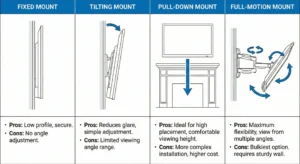
Standard fixed mounts are wrong for this application. You need movement capability to handle both heat and viewing angles.
Top-Rated Mounts for UK Installations:
- MantelMount MM540 Enhanced Pull-Down (£350-450)
- Lowers up to 30cm for viewing, raises to protect from heat
- 27-65kg weight capacity
- Built-in soundbar mounting
- Best for: Log burner or gas fire installations
- Vogel’s THIN 545 Tilt Mount (£120-180)
- 20° tilt range for high mounting
- Tested to 3x stated weight capacity
- Up to 65″ TVs
- Best for: Electric fires where pull-down isn’t necessary
- Sanus VLF728 Full-Motion (£180-250)
- Extends 46cm from wall
- 15° tilt, 180° swivel
- 32-90″ TV compatibility
- Best for: Corner or off-center installations
- Tranquil Mount TM-A1 Pull-Down (£280-350)
- UK company, excellent customer service
- Gas-assisted lowering mechanism
- Integrated cable management
- Best for: Budget-conscious buyers wanting pull-down functionality
Step-by-Step Installation Guide
Phase 1: Pre-Installation Planning
Step 1: Measure wall temperature
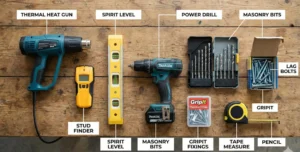
Run your fireplace at maximum output for 2 hours. Use a thermal heat gun to measure temperature at your planned TV mounting location every 15 minutes.
If readings exceed 40°C, you need more clearance or better heat protection.
Step 2: Check manufacturer specifications
Review your TV’s warranty documentation and maximum operating temperature. Check your fireplace manual for “distance to combustibles” specifications.
Step 3: Assess wall structure
Identify your wall type: plasterboard over studs, solid brick/stone, or chimney breast. Use a stud finder with wire/pipe detection. Mark stud locations.
Step 4: Plan cable routing
Determine cable paths: through-wall routing (requires electrician), surface trunking, or conduit systems. Use heat-resistant cables rated to 80°C+ near the fireplace.
Phase 2: Protection Installation
Step 5: Install heat shield or mantel
If using an oak fireplace beam, ensure 400mm minimum from the fireplace opening. The beam needs 15-20cm projection depth.
Popular UK suppliers:
- Off the Grain: Custom oak beams (£200-500)
- The Wooden Beam Company: Solid oak options (£150-400)
- Direct Fireplaces: Heat shields and mantels (£80-300)
Step 6: Set up cable management
Install cable trunking or conduit from TV location to power and devices. Use proper wiring techniques to maintain fire safety.
Phase 3: Mount Installation
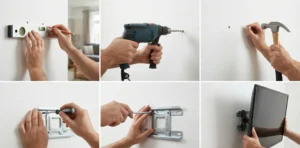
Step 7: Mark mounting positions
Hold your mounting bracket against the wall at planned height. Use a spirit level for perfect horizontal alignment. Mark all drilling points.
Optimal TV height by size:
- 42-48″ TVs: 61 inches from floor to center
- 49-55″ TVs: 63 inches from floor to center
- 56-65″ TVs: 65-67 inches from floor to center
Step 8: Drill mounting holes
For plasterboard walls:
- Drill pilot holes at stud locations (6mm bit)
- Insert lag bolts through bracket into studs
- Minimum 2 studs, preferably 3 for heavy TVs
For masonry walls:
- Use 8-10mm masonry bit
- Drill to depth specified by anchor manufacturer (60-80mm)
- Insert Rawlplug shield anchors
- Tap anchors flush with wall surface
Step 9: Install mounting bracket
Secure the bracket using appropriate fixings:
- Stud mounting: M8 or M10 lag bolts, minimum 60mm penetration
- Masonry: 10mm sleeve anchors or resin anchors
- Plasterboard without studs: GripIt fixings rated for TV weight
Use a spirit level to verify the bracket is perfectly horizontal.
Step 10: Attach TV to mount
This requires two people for TVs over 40 inches. Follow manufacturer instructions precisely. Verify all locking mechanisms are fully engaged before letting go.
Phase 4: Connection and Testing
Step 11: Route and connect cables
Connect HDMI, power, and other cables. Route through cable management systems. Use cable ties to bundle neatly with slight slack for mount movement.
Step 12: Test mount stability
Gently apply pressure to all four TV corners. It should feel rock-solid with no movement. Test full range of motion on tilting or full-motion mounts.
Step 13: Run temperature test
Turn on both TV and fireplace. Monitor for 1-2 hours:
- Wall temperature behind TV (should stay below 35°C)
- TV ventilation port temperature
- Any unusual smells or sounds
What About Sound Quality? The Soundbar Problem
TVs mounted high above fireplaces create audio challenges. Sound projects over listeners’ heads, creating thin, distant audio quality.
“Mounting a TV above eye level changes the entire audio landscape,” explains Francis Fernando, home theater specialist. “You need to bring sound down to ear level.”
Soundbar Solutions for High TV Placement
Best soundbars for fireplace installations:
- Sonos Arc – Upward-firing speakers compensate for height (£899)
- Samsung HW-Q990C – 11.1.4 channels, object tracking (£1,499)
- Sony HT-A5000 – 5.1.2 channels, room calibration (£799)
- Bose Smart Soundbar 600 – TrueSpace spatial processing (£499)
Mount soundbars on the mantel or use dedicated brackets attached to the TV mount. Ensure proper clearances for ventilation.
Alternative: Shelf-mounted bookshelf speakers at ear level
- KEF LSX II LT – Wireless, room-filling sound (£999/pair)
- Q Acoustics M20 HD – Bluetooth, excellent clarity (£369/pair)
- Ruark MR1 Mk2 – British-made, warm sound (£449/pair)
Temperature Monitoring: Your Ongoing Safety System
Installation isn’t the end of safety considerations. Regular monitoring prevents problems before they cause damage.
Essential Monitoring Equipment
Thermal Heat Gun (£20-40)
- Bosch UniversalTemp: Accurate to ±1.5°C (£35)
- Milwaukee 2267-20: Professional grade, data logging (£120)
- Fluke 62 MAX+: Rugged, dual laser targeting (£85)
Smart Temperature Sensors (£15-30 each)
- Aqara Temperature Sensor: Smart home alerts via app (£15)
- Eve Room: HomeKit compatible (£99)
Set alerts for temperatures exceeding 35°C at TV location.
Maintenance Schedule
Monthly:
- Tighten all mounting bolts
- Clean TV ventilation ports with compressed air
- Inspect cables for discoloration
- Wipe down heat shields or mantels
Quarterly:
- Full temperature test with thermal gun
- Deep clean fireplace
- Update maintenance log
Annually:
- Professional chimney sweep for wood burners (£60-120)
- Service gas fires per schedule (£80-150)
- Replace worn cables or hardware
When You Absolutely Shouldn’t Do This
Don’t mount a TV above your fireplace if:
Your wood burner is the primary heating source used 4+ hours daily. Wall temperature at TV height exceeds 45°C with fireplace running. Mounting would place TV more than 60° above eye level when seated.
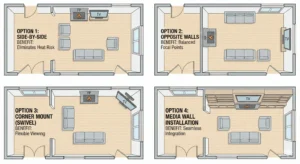
Better Alternative Arrangements
Side-by-side placement: Mount TV on wall adjacent to fireplace. Eliminates all heat concerns.
Opposite wall mounting: Place TV directly across from fireplace. Ergonomically superior for viewing.
Corner installation: Use full-motion mount in corner. Swivel toward seating when watching.
Dedicated media wall: Build purpose-designed media wall structure with proper ventilation and heat isolation.
Real-World Cost Breakdown
Basic Electric Fireplace Setup:
- Electric fireplace: £600-1,200
- Tilting TV mount: £120-180
- Heat-resistant cables: £40-60
- Professional installation: £150-250
- Total: £910-1,690
Mid-Range Gas Fire Installation:
- Gas fireplace: £900-1,500
- Oak mantel beam: £200-400
- Pull-down mount: £280-350
- Heat shield: £80-150
- Professional installation: £300-500
- Gas safe engineer: £200-350
- Total: £1,960-3,250
Premium Media Wall Build:
- Pre-built media wall unit: £1,200-3,000
- Electric media wall fire: £800-1,800
- Professional installation: £500-1,000
- Electrical work: £200-400
- Sound system integration: £400-1,200
- Total: £3,100-7,400
Smart Home Integration for Enhanced Safety
Many electric and gas fires now include smart features:
Celsi Ultiflame VR Elite (£1,200-1,500)
- Alexa and Google Assistant voice control
- Smartphone app with scheduling
- Automatic shut-off at set temperatures
Gazco eReflex Skope (£1,600-2,000)
- Native Alexa integration
- Voice-activated control
- Energy monitoring
Smart temperature monitoring with Home Assistant + Aqara Sensors (£60)
- Monitor wall temperature continuously
- Alert via phone if thresholds exceeded
- Automatically cut fireplace power at dangerous temperatures
Final Thoughts
Mounting a TV above a fireplace in the UK is entirely achievable when approached with proper planning. Electric fireplaces offer the straightforward path with minimal risk. Gas fires require more precautions but remain viable. Wood burners demand extensive safety measures that may not be worthwhile.
Proper clearances, adequate heat protection, quality mounting hardware, and ongoing temperature monitoring all contribute to long-term success. When done correctly, this setup can deliver years of reliable service. But if your situation requires compromising on safety margins, choose a different mounting location.
Frequently Asked Questions
What is the minimum safe distance for a TV above a log burner in the UK?
UK building regulations require 400mm minimum, but experts recommend 450-600mm for TVs above log burners depending on heat output. Always check your specific stove manufacturer’s specifications as some require greater clearance.
Will my TV warranty cover heat damage from a fireplace?
No. Samsung, LG, Sony, and Panasonic explicitly exclude heat damage from warranties. Many state that mounting above heat sources voids coverage entirely. Check your specific model’s warranty documentation before installation.
Can I use a standard fixed mount for above-fireplace installation?
Not recommended. Use tilting mounts (£120-180) minimum, or preferably pull-down mounts (£280-450) like MantelMount. These address both viewing angles and heat exposure by allowing movement.
Are electric fireplaces safe for mounting a TV above?
Yes, electric fireplaces are the safest option. They produce minimal heat (1-2kW) directed outward. Recommended clearance is 20-30cm versus 40-60cm for gas or wood. Brands like Celsi and Dimplex specifically design models for media wall installations.
What’s the best alternative if I can’t safely mount above my fireplace?
Side-by-side placement eliminates all heat concerns while keeping both features visible. Mount TV on the adjacent wall (works well with UK alcoves) or use opposite wall mounting for optimal viewing ergonomics.