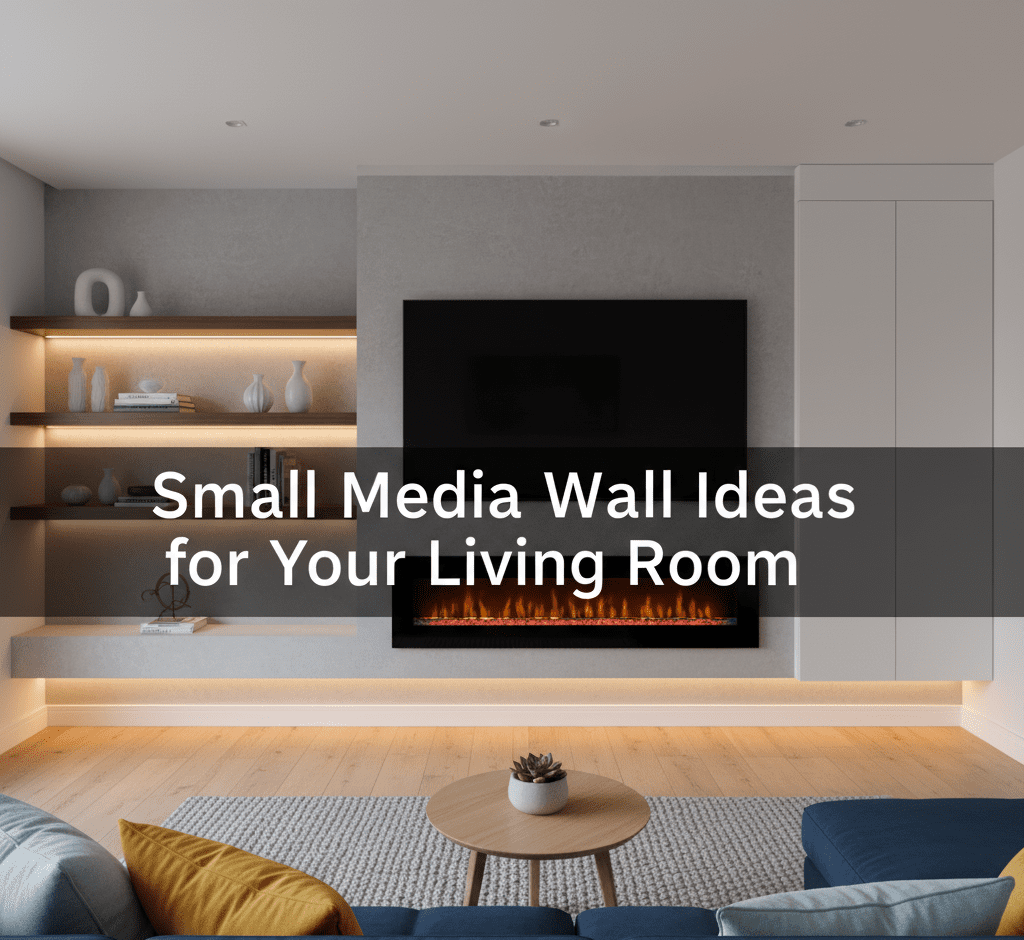
A media wall is one of the most searched home improvement projects in the UK right now — and one of the most misunderstood when it comes to property value. The honest answer is more nuanced than either side of the argument usually admits: a media wall can genuinely increase how quickly your home sells and how desirable it looks in listing photos, but it will not reliably appear as a line item on a surveyor’s valuation.
Whether it adds value depends on four things: the quality of the build, the neutrality of the finish, the size and type of property, and what buyers in your local market expect. This guide separates what actually happens — based on how surveyors, estate agents, and buyers respond to media walls in 2026 — from the optimistic marketing content most fitters publish.
The Distinction Nobody Explains: Marketability vs Valuation
These are two different things and most content conflates them.
Property valuation (what a RICS surveyor or mortgage lender calculates) is based on comparable recent sales in your area. A surveyor does not add £5,000 to a valuation because there is a media wall in the living room. They look at what similarly-sized homes in the same street have sold for. A media wall does not appear as a named line item in this calculation unless comparable homes in the street consistently feature similar installations.
Marketability (how quickly your home sells, how many viewings it gets, and how many offers you receive) is where a media wall reliably delivers. In a competitive housing market — typically properties above £280,000 where buyers have options — a well-photographed, neutral media wall creates a stronger first impression on Rightmove. Buyers linger longer in the room during a viewing. The home feels finished and ready to move into rather than requiring immediate work.
The practical result: a well-built media wall is more likely to help you sell faster and at your asking price than to generate a formal valuation increase. In a market where 1 in 4 sales fall through, reducing time on market has a real financial value even if it doesn’t show on a mortgage survey. If you’re planning a build with resale in mind, our guide on what a media wall realistically costs to build helps you work out whether the numbers stack up.
When a Media Wall Adds Value — The Four Conditions
Based on real estate agent feedback and buyer behaviour patterns, a media wall consistently improves sale outcome when all four of these conditions are met:
-
Professional or bespoke installation
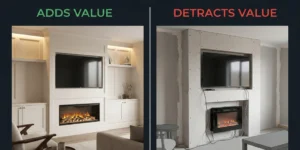
A media wall that looks like it belongs to the architecture of the room — flush panels, properly recessed electric fire, hidden cable infrastructure, quality lighting — reads to buyers as a permanent feature and structural improvement. A freestanding or plasterboard-only build that wobbles when touched, has visible screws, or leaves cable holes unpainted does the opposite. Dean Watson, a bespoke furniture maker, put it directly: a structural improvement that provides multi-functioning components adds value. A plasterboard box that just holds a TV does not.
-
Neutral or timeless finish
Deep charcoal and forest green media walls look exceptional in photographs and in real life. They are also the most divisive finish with buyers. A buyer who doesn’t share your taste now faces a redecorating job — and they will price that in when making an offer. Estate agents consistently advise that neutral finishes (warm white, off-white, greige, pale sage) perform better at viewings even if they photograph slightly less dramatically. If you are building for your own enjoyment and are not planning to sell within five years, personal colour is perfectly reasonable. If resale is a consideration, lean neutral.
-
Right-sized for the room
A media wall that fills an entire chimney breast in a 3.5m wide living room looks designed. A media wall that consumes all natural light, blocks the window return, or makes the room feel like a cinema in a home where buyers expect a lounge creates a negative. Buyers in smaller properties especially — 2-bed terraces, flats — often register an oversized media wall as a feature they would need to remove rather than enjoy. Our guide on planning your media wall with resale in mind covers how to proportion the build to the room.
-
Competitive local market
In London, the South East, and city-centre locations where the average property sits above £350,000 and buyers frequently compare six to ten options before offering, a well-built media wall can differentiate meaningfully. In rural areas and lower-value markets where buyers are less expectant of premium features, the same build has less impact on perception. The feature adds most value where buyers already expect a high-specification home.
When a Media Wall Can Hurt Your Sale
Nobody in the fitter market writes about this, but it happens — and understanding it is more useful than another list of benefits.
Bold personalised colours are the most common problem. A deep navy blue or forest green media wall that photographs beautifully for an Instagram reel signals significant redecorating to a buyer who doesn’t share the aesthetic. Zoopla’s consumer expert Daniel Copley has noted that overly personalised feature walls can prevent buyers from visualising their own belongings in the space. The same principle applies directly to media walls with distinctive finishes.
TV recess cut for a specific screen size is a practical trap. If you’ve built a precise recess for a 65-inch television, a buyer who wants a 75-inch or 85-inch — increasingly standard — cannot use the wall as built. They now either accept a cosmetic compromise or face a demolition and rebuild cost. Buyers will factor this in at offer stage.
Poor cable management visible at the sides or bottom of a TV mount tells a buyer immediately that the build was rushed. Exposed conduit, Velcro cable ties, or cables routed around rather than through the wall all register as ‘unfinished’ even if the face of the wall looks acceptable.
The wrong room matters too. A media wall in a formal reception room of a period home or in a bedroom above around £600,000 tends to clash with buyer expectations. At that price point, buyers typically want flexibility and high-spec neutrality rather than fixed entertainment architecture.
The Rightmove Photography Effect — How It Really Works
This is the most reliable way a media wall adds value, and it is almost never discussed clearly.
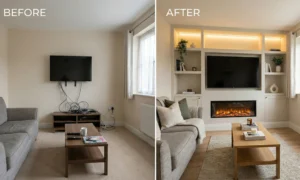
Estate agents have consistently noted that buyers form their initial impression of a property within the first few listing photos — and that a room with a well-built media wall photographs dramatically better than a room with a TV on a stand and visible cables. A blank painted wall behind a mounted television produces a flat, forgettable listing photo. A media wall with LED ambient lighting, a glowing fireplace insert, and considered panelling produces a photo that stops the scroll.
More Rightmove clicks translate to more viewing requests. More viewing requests translate to more competition among buyers. More competition produces faster sales and stronger offers. The financial value of this chain is real — it simply does not show up as a formal valuation figure.
For this reason alone, if you are planning to sell within 12 months and your living room currently has a mounted television with no feature wall, a well-built neutral media wall is likely to produce a return on investment simply through improved listing photography and better buyer first impressions. Whether it exceeds its build cost in that return depends on your market and price point.
Realistic ROI Breakdown by Build Type
Here is what the research across real installations actually shows, separating build type from the vague industry average:
| Build Type | Build Cost | Realistic ROI | Verdict |
| DIY plasterboard box | £500–£1,200 | £0 or negative | No value added. May put buyers off. |
| Mid-range professional | £2,500–£5,000 | £1,500–£3,000 | Neutral to slight positive. Speeds up sale. |
| Bespoke joinery (neutral) | £6,000–£12,000 | £3,000–£7,000 | Adds value. Structural feel, move-in ready. |
| High-spec with fireplace | £10,000–£18,000 | £5,000–£9,000 | Strong value if neutral, photogenic, well-built. |
These figures assume a neutral or near-neutral finish. A polarising colour finish reduces the upper estimate by 30-50% in most markets. A fireplace addition increases both the cost and the potential return — a well-specified electric fire in the recess is consistently the feature buyers most positively note on viewings.
One clear industry figure comes from Carisglow, which estimates that a professionally installed media wall and fireplace costing £10,000–£15,000 could add approximately £5,000–£7,500 to resale value — roughly 50% ROI. This is broadly consistent with what estate agents report for well-executed, neutral builds. It does not account for the secondary value of a faster sale or stronger multiple-offer position, which in a competitive market can significantly exceed the formal valuation uplift.
Does a Media Wall Add Value in a Rental Property?
For rental properties, the calculation shifts. A media wall with a built-in electric fireplace and professional LED lighting is a legitimate amenity that higher-specification rental properties in city centres can market as a feature — similar to integrated appliances or a home office setup. In high-end city rentals above £2,000 per month, it contributes to a ‘move-in ready’ premium finish that commands higher yields.
In standard residential rentals below this threshold, the practical risk is durability and tenant interaction. Built-in entertainment features require maintenance and carry a higher risk of damage claims. Most letting agents advise treating a media wall in a standard rental as a neutral background feature rather than an active rent-driver. Build it in neutral tones, do not include a smart TV or complex technology in the wall, and ensure it is structurally robust against repeated use of the fireplace insert.
Regional Differences — Does Location Change the Answer?
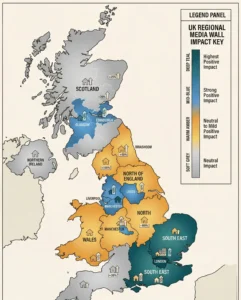
London and South East (average property values £450,000+): Media walls have the highest positive impact here. Buyers at this price point compare multiple premium properties, spend significant time on Rightmove, and notice listing photographs. A high-specification neutral media wall with a fireplace performs well as a feature because it matches expectations at the price point.
Major cities outside London (Manchester, Leeds, Bristol, Birmingham, Edinburgh — £250,000–£450,000): Strong positive effect in this range for professional or bespoke builds with neutral finishes. This is where the ‘move-in ready’ signal matters most to buyers who are often first-time buyers at the upper end of their budget.
North of England and Wales (average property values below £200,000): The impact is more muted. At sub-£200,000, buyers have lower expectations of premium features and are more likely to view a media wall as something they need to work around. The cost-to-return ratio at this price point is weakest.
Rural and period properties (any region): A media wall in a Georgian townhouse, Edwardian terrace with original cornicing, or rural farmhouse typically clashes with the property’s character and the buyer profile it attracts. At best neutral. At worst a minor deterrent.
What Surveyors and Mortgage Lenders Actually See
A RICS residential surveyor conducting a HomeBuyer Report or Building Survey will note the presence of a media wall if it is a notable feature or if there are concerns about the build — most commonly around the electric fireplace recess, fire safety compliance, or the structural integrity of the stud frame. A surveyor will not typically note it as a value-adding feature in the same way they would a new kitchen or extension.
For mortgage purposes, the lender’s valuation surveyor uses comparable sales. If homes in the street have consistently sold with similar features, the feature is absorbed into local pricing. If your home is the first in the street to have a bespoke media wall, the surveyor has no comparable to reference and will not add value for it. This is normal and expected — it does not mean the feature is without benefit.
There is no Building Regulations requirement to notify your local authority about a media wall build unless it involves structural changes to load-bearing walls, creation of a new habitable room, or electrical work that falls under Part P. Standard stud wall and panelling work on an existing wall does not require Building Regs approval. Part P notifiable electrical work — socket additions, new circuits — does. Always use a registered electrician for this element. For the full breakdown, our media wall wiring guide covers what requires notification and what does not.
FAQs — What People Actually Ask Before Building
Should I build a media wall before putting my house on the market?
Only if the build is to a professional standard and uses a neutral or near-neutral finish. A well-built neutral media wall improves listing photography and buyer first impressions. A cheap or bold build creates work for a buyer and will be used to negotiate your price down. If you cannot spend at least £2,500–£3,000 on a professional installation, you are better off mounting the television cleanly without a feature wall.
Will the estate agent mention the media wall in the listing description?
Most will, particularly if it includes a built-in electric fireplace. Estate agents consistently report that media wall fireplaces are noted as a specific selling point in descriptions because they resonate with buyers searching for lifestyle-ready features. A panelling-only wall without a fireplace is typically described as a feature wall rather than a media wall and generates less specific interest.
Does a media wall affect a mortgage valuation?
Generally no, not as a named line item. A mortgage valuation surveyor sets a value based on comparable sales. Unless comparable properties in your area have sold at a premium with similar features, the media wall does not produce a formal valuation uplift. The value is in marketability — how quickly and at what price you achieve an offer — rather than in the formal valuation figure.
Can a buyer make me remove a media wall?
No. A media wall is a fixture — it is legally part of the property once built. A buyer cannot require removal as a condition of purchase. They can factor the cost of removal or redecoration into their offer, which is why neutral finishes protect your negotiating position. If you specifically want to take the media wall with you — which is unusual and usually impractical — you would need to agree this in writing before exchange of contracts.
Does a media wall affect buildings insurance?
You should notify your insurer of any significant home improvement including a media wall with an integrated electric fireplace. The fire element in particular should be disclosed. Most home insurance policies require notification of features involving electrical work or heat sources within the home. Failure to disclose can affect a claim. Check your specific policy terms and notify as a precaution.