
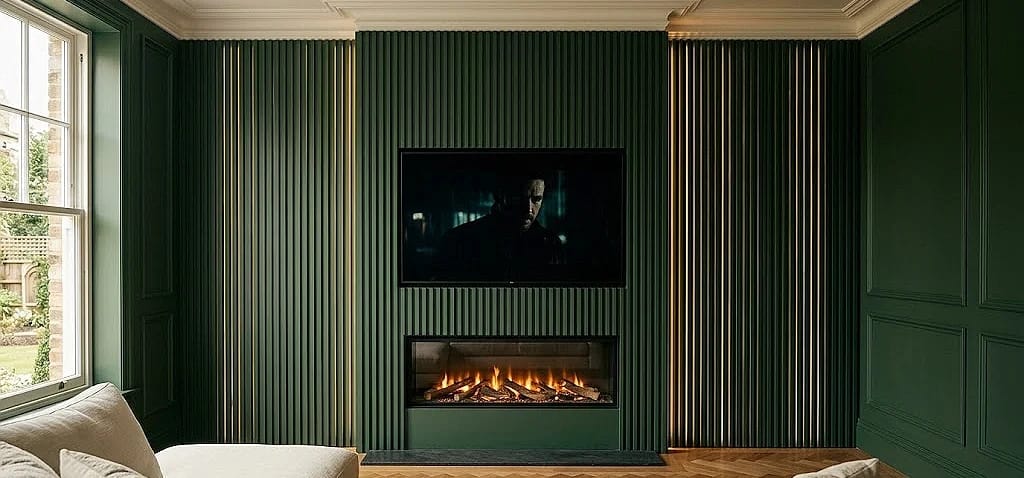
Fluted panels are the most searched panel type for media walls in the UK right now — and the market is flooded with budget options, confusing terminology, and content that skips the things that actually matter. This guide covers what you need to know before spending £200–£1,500 on materials: which panel type fits your setup, the fire safety rule most people get wrong, why MDF panels bow and how to stop it, and what everything realistically costs.
If you have an electric fireplace in your media wall, go to the fire safety section before you order anything.
What Is a Fluted Panel Media Wall?
A fluted panel media wall is a feature wall built around your TV — and often a fireplace — where the surface finish uses panels with vertical grooves machined into them. Those grooves are the flutes. They create a play of light and shadow that changes throughout the day, making the wall feel architectural and considered rather than flat and painted. According to Panels by Sofia co-founder Summa Costandi, 2026 homeowners are specifically moving away from generic accent walls and instead panelling actual architectural features — fireplaces, alcoves, and media walls — to work with the room’s structure. Fluted panels on a media wall is not just a trend anymore. It is a considered design decision.
Fluted MDF vs Acoustic Slat Panel — Which Do You Actually Need?
These two panel types look almost identical in photos. They are not interchangeable.
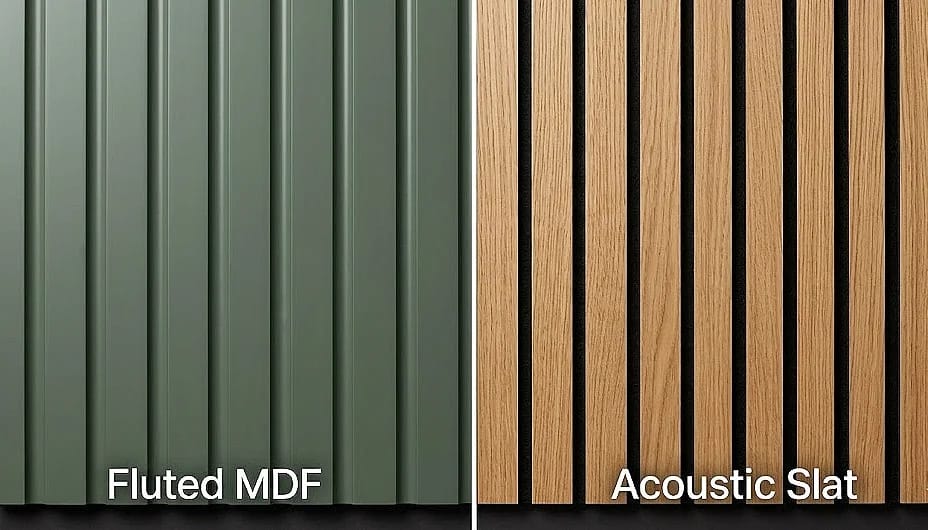
Fluted MDF panels are Hidrofugo moisture-resistant MDF boards with grooves CNC-routed into the surface. They arrive unfinished. You prime and paint them any colour you choose. They have zero acoustic benefit — the grooves are purely visual. Budget option. Full creative control over colour.
Acoustic slat panels (Acupanel, Akupanel, Naturewall slat range) are completely different in construction. Narrow wood veneer slats — oak, walnut, smoked oak, charcoal — are bonded onto a PET felt backing. That felt actively absorbs sound waves and reduces echo in rooms with hard floors and high ceilings. They come pre-finished in natural wood tones. You do not paint them.
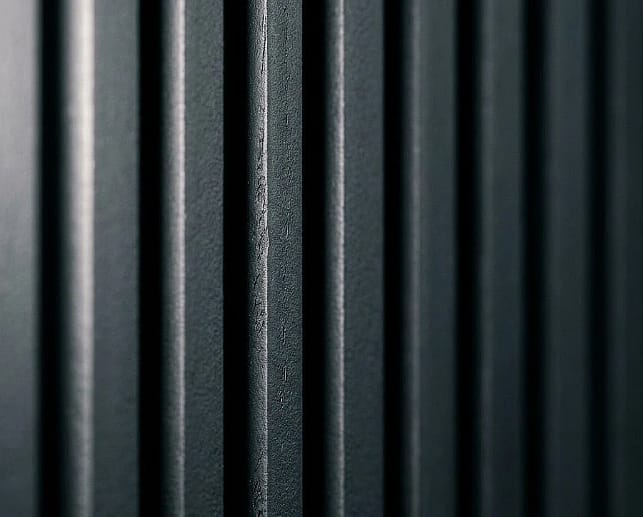
They look similar from across the room. Up close, the difference is clear: fluted MDF is continuous grooves carved into one board; acoustic slat panels are individual slats floating on a felt layer.
Choose fluted MDF if you want a painted finish, full colour control, and your room doesn’t have a significant echo problem. Choose acoustic slat if you want natural wood finish without painting, your room bounces sound noticeably, and budget runs to £90–£150 per panel.
If you’re still comparing materials for the full wall build, our guide on choosing the right materials for your media wall covers the structural layers in detail.
The Fire Safety Rule Most People Get Wrong
Standard Hidrofugo MDF is moisture-resistant. The green core you see when you cut it confirms that. What it is not — and this is the confusion that costs people money — is fire-resistant. Hidrofugo and fire-rated are two entirely different properties.
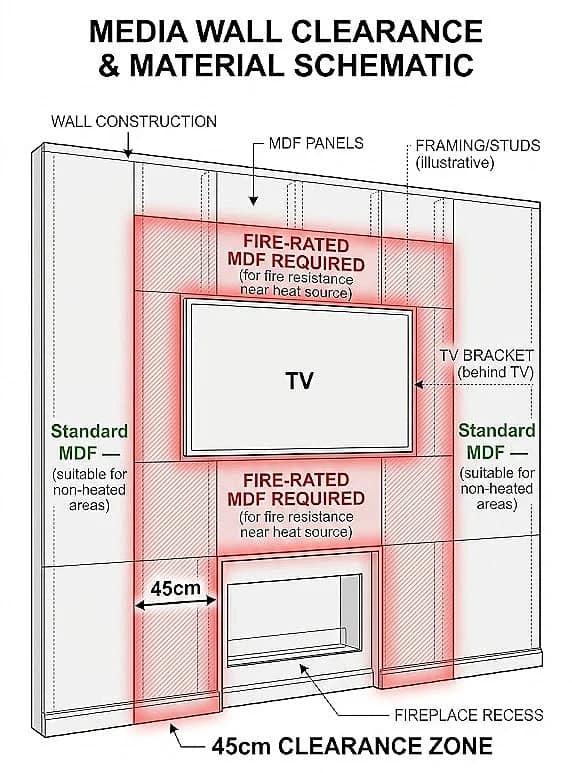
Fire-rated MDF (FR MDF) complies with Euroclass B or C fire ratings under BS 476. Euroclass B provides 60-minute resistance; Euroclass C provides 30 minutes. Any panel within your electric fire manufacturer’s stated clearance distance — typically 45cm from the firebox — must use fire-rated MDF. This applies to panels beside the firebox, above it, and on the returns where the recess meets the main wall. Always check your specific fire’s installation manual as some models require more than 45cm clearance.
Fire-rated fluted MDF looks identical to standard once primed and painted. The cost difference is roughly £15–£60 extra per panel depending on supplier. CNC Creations, The Wall Exchange, and Uniboards all stock fire-rated fluted MDF as standard products. Acoustic slat panels with PET felt backing should not be used adjacent to heat sources unless the manufacturer explicitly certifies them for it — the felt is combustible. Check the product data sheet before ordering.
Why Fluted MDF Panels Bow — And How to Prevent It
This catches out both first-timers and experienced joiners. Panels arrive flat, then bow after installation and painting. Here is why — and most guides get this wrong.
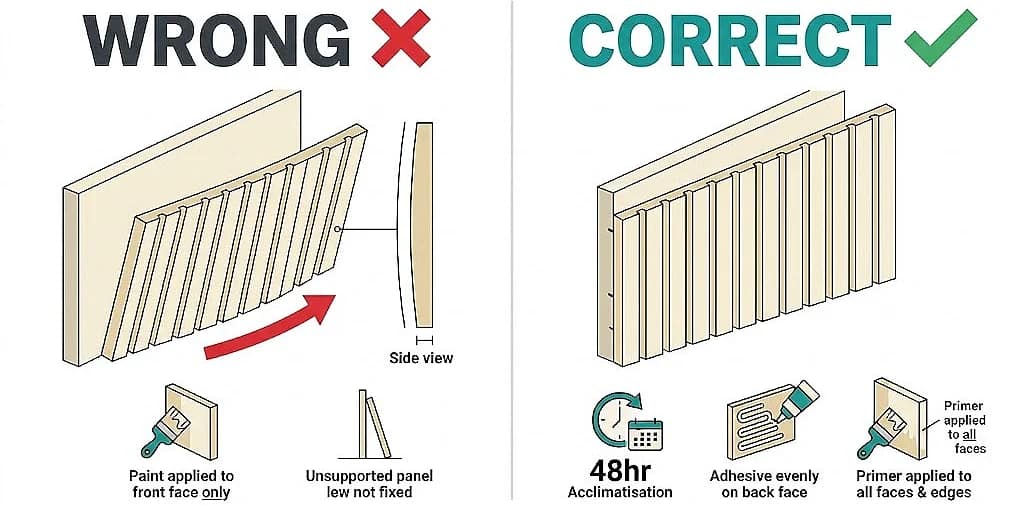
Fluted panels are made by CNC-machining grooves into one face of an MDF board. That machining removes material that was under compression in the MDF skin. Releasing that surface tension causes the board to want to curve toward the machined face. If you then paint only the front before securing the panel — or paint it while it is unsupported — the water from water-based primer is absorbed unevenly. The painted face swells slightly. The differential tension between faces increases the bow further.
Prevention: Let panels acclimatise flat in the room for 48 hours. Fix to the wall with grab adhesive and pin nails first — allow 24 hours to cure before painting. Once secured to a flat substrate, any tendency to bow is resisted by the wall. Prime and paint all faces including the back and all edges to equalise moisture absorption on both sides.
How to Fit Fluted Panels on a Media Wall
Plan the layout from centre outward , not edge to edge — this ensures any partial panels are equal width on both sides. For the TV zone, use landscape orientation (wider than tall) rather than floor-to-ceiling portrait: it suits the horizontal proportions of the media wall section.
Cut with a mitre saw and fine-tooth blade. For internal corners, cut both panels at 45° and mitre-join. Use a cut-to-size service from your supplier if you want to eliminate on-site cutting entirely.
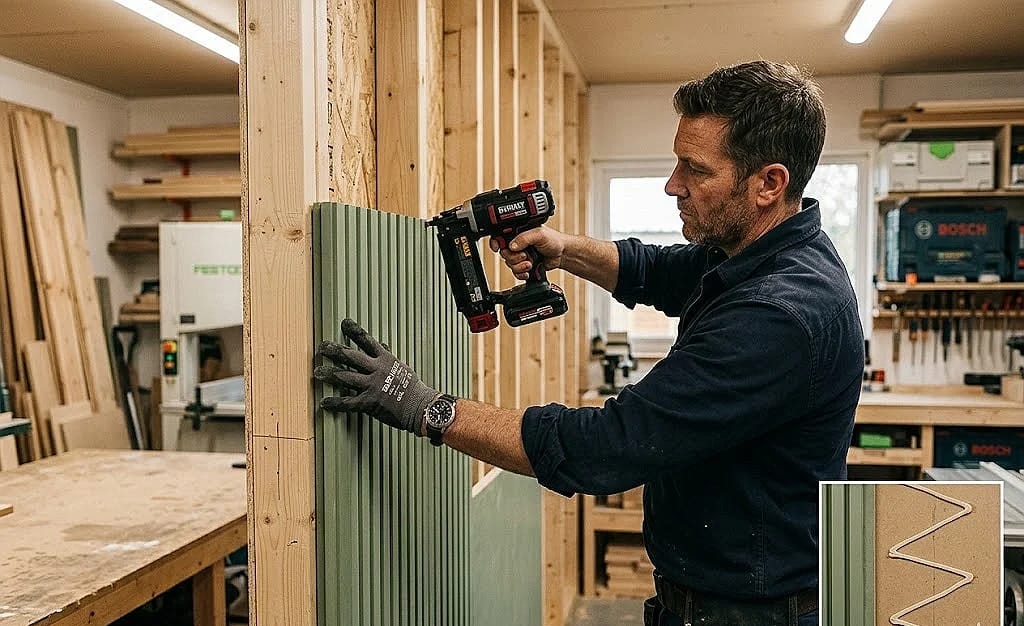
Fix with grab adhesive (No More Nails or CT1) in a zigzag pattern, plus 40mm pin nails at top and bottom while the adhesive cures. Do not skip the pin nails — panels can slip down if unsupported during the 24-hour cure window.
Seal edges with decorator’s caulk along all panel joins and perimeter edges before priming. Prime all surfaces including back face and edges. Two topcoats in matte or satin finish — gloss is not recommended as the grooves catch light unpredictably and magnify imperfections.
For LED strip setup, our media wall lighting guide explains how profiles sit inside fluted grooves and how to prevent glare interference with your screen. For cable routing safety, Electrical Safety First provides clear guidance on running cables safely within stud wall voids.
Best Colours for a Fluted Panel Media Wall in 2026
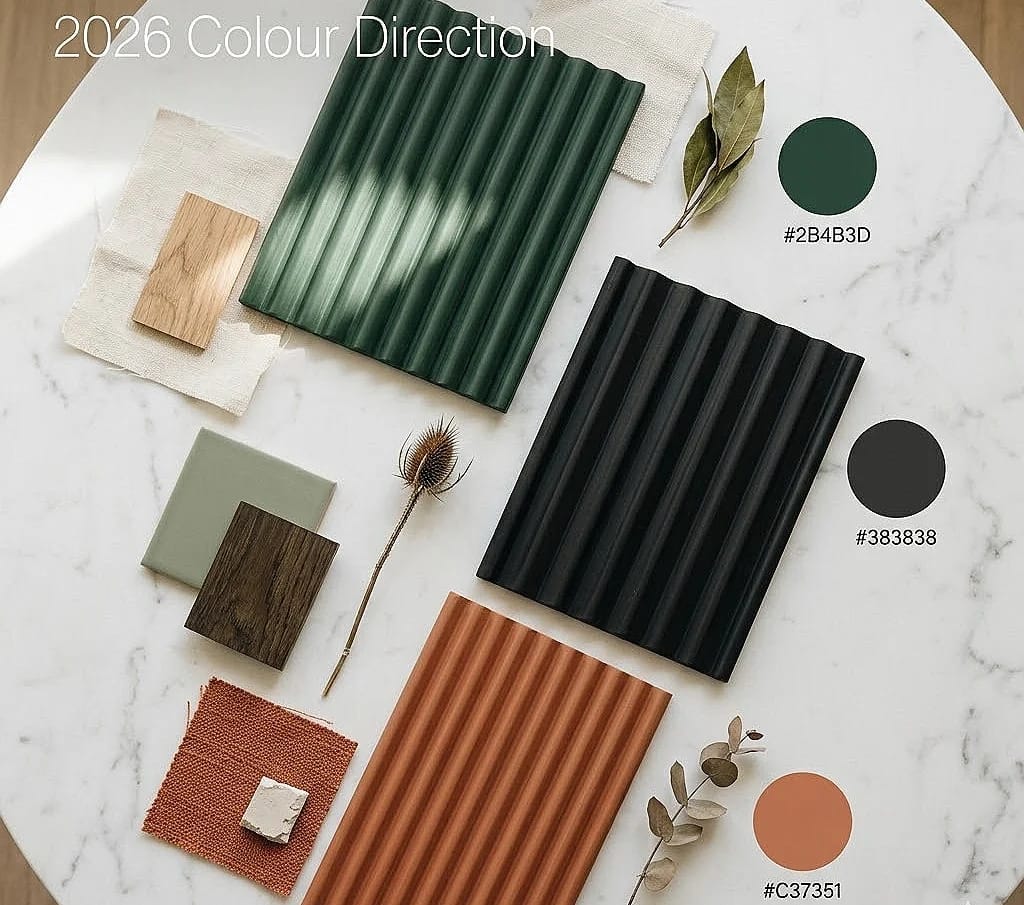
Fluted MDF responds to colour differently to flat walls. Dark colours deepen the groove shadows dramatically — the texture becomes far more visible. Light colours flatten the effect.
Deep green (forest, bottle, hunting) is the stand-out choice. Against oak flooring or a cream sofa, the contrast reads as architectural without being aggressive.
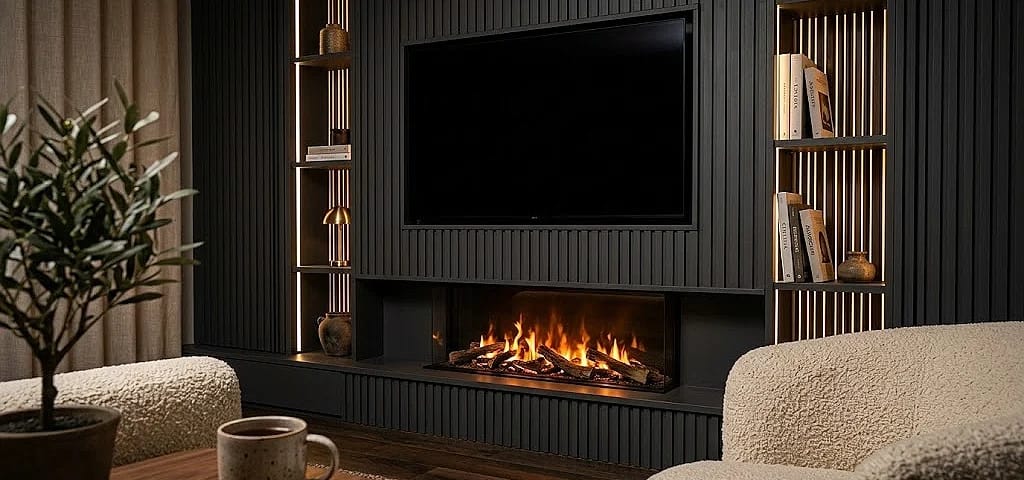
Charcoal and matte black create the maximum shadow depth. Paired with warm amber LED strips the result is cinematic. The dark surround also reduces eye strain during viewing — it acts like the blackout border of a cinema screen.
Clay and warm terracotta suit rooms with natural materials, plants, and linen. If using acoustic slat panels, walnut veneer sits in the same tonal family.
Avoid gloss finish and avoid pale shades — both erase the visual benefit of a textured surface.
How Much Do Fluted Panels Cost? (UK 2026 Prices)
Standard fluted MDF (paintable): £20–£35 per panel. Panels by Sofia, Naturewall, and CNC Creations all in this range.
Fire-rated fluted MDF: £37–£90 per panel depending on size and supplier. Do not substitute standard MDF in the fire zone.
Acoustic slat panels: £60–£120 per panel. Acupanel Contemporary Oak and Walnut sit at £80–£120. Premium large-format veneer panels reach £130–£150+.
A standard 3-metre media wall needs roughly 5–8 landscape panels or 8–12 portrait panels. Add 10% for cut wastage.
Total material cost: Fluted MDF wall £240–£470 (panels + adhesive, primer, paint, caulk). Acoustic slat wall £540–£1,280. Professional fitting onto an existing structure adds £150–£300 in labour.
Where to Buy in the UK
Panels by Sofia — UK-made fluted MDF, cut-to-size service, free samples in two days. Best for painted finish projects.
CNC Creations — UK manufacturer, industrial CNC cutting, stocks fire-rated fluted MDF. Best for precision fireplace recess work.
The Wall Exchange — fire-rated fluted MDF as a standard stocked product, not a special order. Fast dispatch.
Acupanel (thewoodveneerhub.co.uk) — market-leading acoustic slat panel in the UK. Contemporary Oak and Walnut are the top media wall sellers.
Naturewall — UK-crafted Hidrofugo MDF fluted panels, primed and unprimed. Consistent quality for painted projects.
FAQs — Real Questions People Ask
My MDF fluted panels bowed after I painted them. Why?
CNC machining releases internal surface tension in the MDF skin, creating a tendency to curve toward the machined face. Painting the front face before the panel was properly secured — or not sealing the back face — made the moisture imbalance worse. Fix: always secure panels to a flat substrate first, then prime and paint all faces including back and edges.
Can I mount my TV directly into fluted MDF panels?
No. MDF cannot hold bracket fixings under the dynamic load of a wall-mounted TV. Use a stud finder to locate the timber framework or solid masonry behind the panel and bolt your VESA bracket through the panel into structural support. The panel sits around the bracket and conceals the fixing.
Do I need fire-rated panels for all of the media wall or just next to the fire?
Only the zone within your electric fire manufacturer’s stated clearance distance requires fire-rated MDF — typically 45cm. Everything outside that zone can use standard Hidrofugo MDF. Check your specific fire’s installation manual for the exact distance as it varies by model. When in doubt, use fire-rated panels across the full recess and 60cm either side.
How do I get an invisible join between two fluted panels?
Position the join so it lands on a flute groove, not a ridge. Align the panels so a groove runs down the seam. Fix both panels, allow the adhesive to fully cure, then run a thin bead of flexible decorator’s caulk into that groove and sand lightly when dry. The join reads as another groove and disappears completely.
What is the actual difference between fluted panels and acoustic slat panels?
Fluted MDF: a single board with routed grooves — purely visual, fully paintable, no acoustic effect. Acoustic slat panels: individual wood veneer slats on PET felt backing — the felt absorbs sound and reduces room echo noticeably. Both look similar from across a room. Up close the construction is completely different. Choose based on whether you need a painted finish or natural wood, and whether room acoustics are a genuine problem.